
The Subcontractor's Guide: Bidding to Getting Paid
By Wyatt Cooper · Published · 9 min read
Key takeaways
- A subcontractor gets paid in proportion to the paper it controls: a clear bid, a subcontract it has read, approved submittals, written change orders and complete pay applications.
- Most payment problems are set at the subcontract: retainage, pay terms, notice deadlines and closeout obligations are all in it before the first day on site.
- Never do extra work on a verbal instruction; get it in writing and price it before you build it, or as soon after as your contract allows.
- Closeout is part of your scope: punch items and closeout documents stand between you and your retainage, so start them early.
A subcontractor gets paid by controlling the paper at every phase: bid exactly what the documents show and say what you exclude; read the subcontract's pay terms, retainage and notice deadlines before you sign; get submittals approved before you buy; put every question in an RFI and every change in writing; bill monthly against your schedule of values with the right lien waiver; and finish punch items and closeout documents early to release retainage.
Bidding: price exactly what the documents show
Read the whole bid package before you price it: the drawings and specification sections for your trade, Division 01 (general requirements, which carry closeout, submittals and temporary facilities), the bid form, every addendum, and the subcontract form the GC will use. A bid is compared line by line against the GC's scope, so say what you include and what you do not.
- Bid the scope on the GC's bid form, in its order, so your number can be compared without a phone call.
- Price each alternate separately; do not fold it into the base bid.
- List exclusions and qualifications in plain words: "Excludes fire caulking at rated penetrations; by others" is clear, "standard exclusions apply" is not.
- Acknowledge every addendum by number. A bid that misses an addendum is often thrown out or carried with a risk adjustment.
- Ask questions in writing before the due date, so the answer goes to every bidder.
To see how a GC reads your number against the others, and why a missing scope item or an unacknowledged addendum costs you the job, see how GCs level subcontractor bids.
The subcontract: where payment is decided
The subcontract decides how and when you are paid long before your first pay application. Read these clauses before you sign, and push back on the ones you cannot live with while you still have leverage.
- Scope: does the scope exhibit match your bid, including your exclusions? If not, fix it now.
- Pay terms: when you are paid after the GC is paid, and whether payment depends on the owner paying the GC. Some states limit or void pay-if-paid clauses; check your state's law.
- Retainage: the percentage held, and when it is reduced or released. See how retainage is calculated.
- Change orders: who can direct a change, the form it must take, and how many days you have to give notice of a claim. Missed notice can lose you the money.
- Flow-down: the prime contract's terms that the subcontract passes to you, including the owner's warranty and closeout requirements.
- Closeout: the documents you owe (O&M manuals, as-builts, warranties, attic stock, training, final lien waiver) and whether final payment waits on them.
On federal construction, prime contractors must put a payment clause in each subcontract: pay the sub for satisfactory work no later than 7 days after the prime is paid, pay an interest penalty on late payments, and give written notice of any withholding with its amount, the cause and what is needed to release it (FAR 52.232-27). The same clause lets the subcontract hold retainage if the parties agree. Most states have their own prompt payment laws for public and sometimes private work; their terms vary.
Before you mobilize: submittals, insurance and schedule
Before the first crew arrives, the GC will want your certificates of insurance and other compliance documents, your schedule of values, and your submittals: product data, shop drawings and samples for every spec section in your scope. Submit early, in the order the materials need to be bought, and do not buy or fabricate anything that needs approval until it is approved. A long-lead item submitted late becomes your delay.
Your schedule of values is your billing for the whole job. Break it into lines you can measure progress on, keep labor and material apart where the GC asks, and do not front-load it; a GC who sees an unbalanced schedule of values may reject it or hold back your first pay application.
During the work: RFIs, daily records and changes in writing
When the documents conflict or leave something out, ask in writing before you build: one question per RFI, with the drawing and spec section, a proposed answer, and the date you need it by. See how to write an RFI. An answer that adds work or time is a change, not just an answer; say so in writing.
Keep your own daily record: crew size, work done, deliveries, weather, delays and who directed what. When a dispute comes months later, the side with records made that day usually wins the argument.
For changes, get written direction before you do the work wherever you can, price it with your backup (labor hours, material quotes, equipment), and give notice within the time your subcontract allows when you cannot. The GC side of the same process, including how markups are applied, is in how to price a change order.
Getting paid: pay apps, retainage and lien waivers
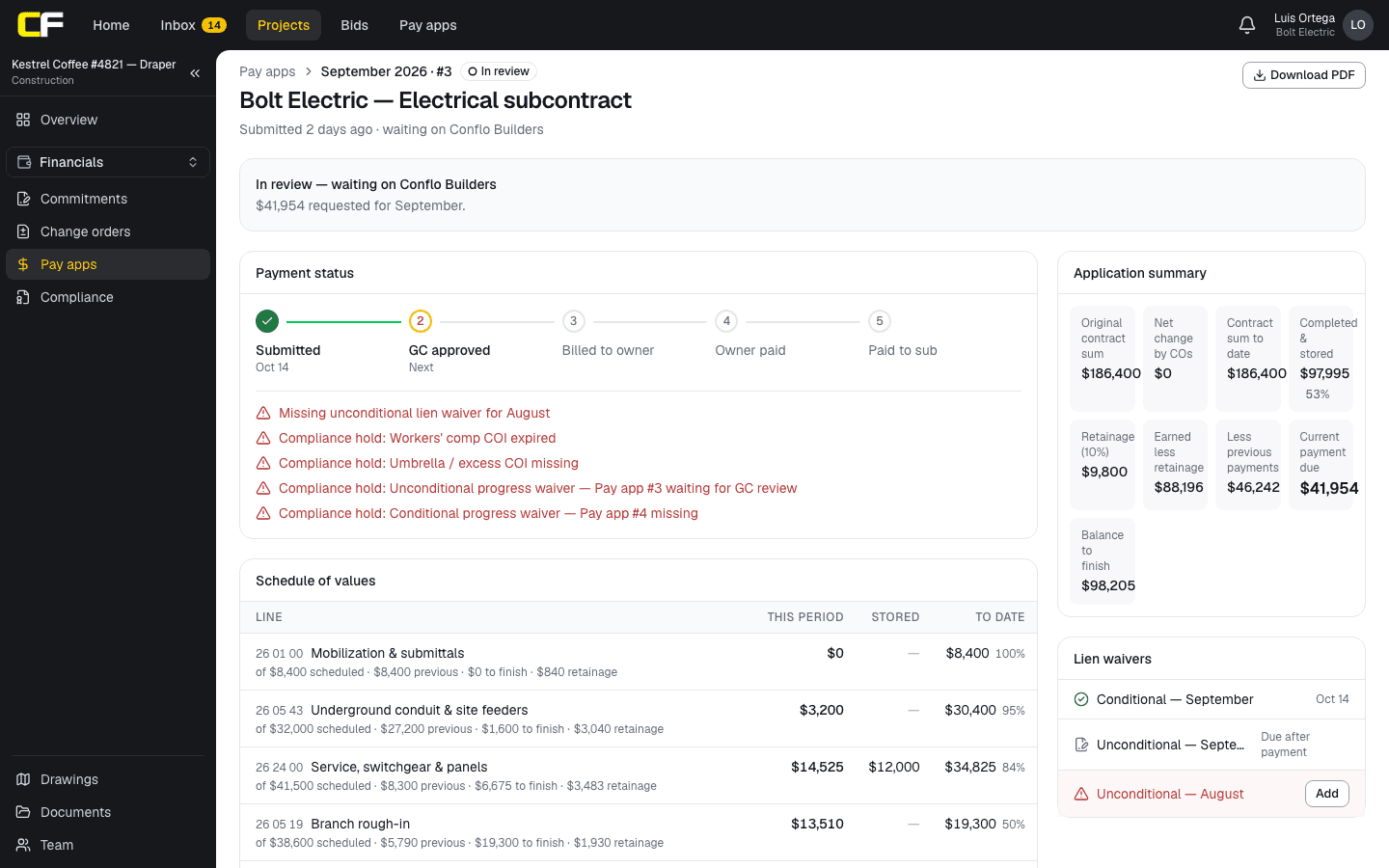
Bill every month, on the GC's cutoff date, against your schedule of values: the percent complete on each line, stored materials if the contract allows them, retainage held, previous payments and the amount due now. Attach the lien waiver the GC asks for, usually a conditional waiver for this payment and an unconditional one for the last. Step by step: how a subcontractor fills out a pay application.
On federal fixed-price construction, the prime contractor certifies with each payment request that subcontractors and suppliers have been paid from earlier payments and will be paid on time from this one (FAR 52.232-5). If you are not paid on a federal job with a payment bond, the Miller Act lets a sub or supplier that contracted with the prime or with one of its subcontractors, and is not paid in full within 90 days of its last work, sue on the bond; one with no contract with the prime must give the prime written notice within 90 days, and any suit must be brought within one year of the last labor or material (40 U.S.C. § 3133).
Punch list and closeout: the last 5% that holds your retainage
Near the end, the GC walks the job and gives you a list of your punch items. Fix each one, show the fix with a photo, and tell the GC it is ready for review. Self-punch your own work first so the GC's list is short; a sub whose items keep coming back slows everyone's closeout, including its own.
Start your closeout documents as soon as your equipment is approved and installed, not when the GC asks at the end: O&M manuals for the installed models, record drawings with your changes, warranties in the form the specs require, attic stock with a signed receipt, owner training, and your final lien waiver. Owners often want a contact for warranty calls too; San Diego State University's closeout procedures ask for 24/7 contacts for the subcontractors on critical equipment. What the GC assembles from your documents is described in how a GC assembles a closeout package.
Retainage is usually reduced or released at substantial completion, with an amount held for open punch items, and the rest at final payment; your subcontract sets the terms. Then the warranty period runs. On federal construction the contractor's warranty runs one year from final acceptance and the prime must obtain the warranties normally given in commercial practice, which usually means yours and your manufacturers' (FAR 52.246-21). Answer warranty calls quickly; it is the last impression a GC has before the next bid list.
Every guide for subcontractors
Preconstruction
How Do Architects Write Construction Specifications?
How architects write construction specifications: MasterFormat numbers, the three-part section, specs versus drawings, and an example section.
· 6 min read
Money
How Do You Back-Charge a Subcontractor?
How a GC back-charges a subcontractor: the contract basis, notice and a chance to cure, a cost record by day, the markup, and the deduction the sub signs.
· 6 min read
Money
How Do You Bill a Change Order on a Pay App?
Add an executed change order to your pay app: its own line, the new contract sum, partial billing, deducts and retainage, with a worked example.
· 7 min read
Money
How Do You Bill for Stored Materials on a Pay App?
Bill delivered but uninstalled materials: the backup owners ask for, on site vs off site, and how stored amounts move to installed work. Worked example.
· 7 min read
Money
How Do You Bill Time-and-Materials Work?
Bill T&M work a GC will pay: written direction first, a ticket signed every day, labor, equipment and materials at agreed rates, markup once. Example.
· 7 min read
Preconstruction
How Do You Build a Construction Schedule?
Build a commercial construction schedule step by step: activities from the estimate, durations from crew rates, logic, procurement and the critical path.
· 8 min read
Bidding
How Do You Calculate Concrete for a Slab?
How to calculate cubic yards of concrete for a slab, footings and piers: the formulas, a worked example, and how much extra to order and why.
· 6 min read
Bidding
How Do You Calculate Labor Burden for a Crew?
Calculate labor burden for a crew: payroll taxes, workers' comp, insurance and benefits over wages, then the cost per productive hour to bid with.
· 6 min read
Closeout
How Do You Close Out a Subcontract?
A GC's checklist to close out a subcontract: settle the last change orders, take the final pay app, release retainage against waivers, record the warranty.
· 6 min read
Closeout
How Do You Collect O&M Manuals From Subcontractors?
How a GC collects O&M manuals from every trade: request them early by spec section, check them against what was installed, and send back the thin ones.
· 6 min read
Construction
How Do You Do a Job Hazard Analysis?
Do a job hazard analysis as OSHA 3071 lays it out: break the task into steps, name each hazard, set controls in order, with a worked saw-cutting JHA.
· 6 min read
Bidding
How Do You Do a Quantity Takeoff?
How a subcontractor does a quantity takeoff: scope from the specs, written dimensions, units, waste, a sheet reference on every line and a check.
· 7 min read
Construction
How Do You Document a Weather Delay?
How a GC documents a weather delay that wins a time extension: the daily log entry, the critical path, comparing to normal weather, and the notice.
· 8 min read
Money
How Do You Fill Out Certified Payroll (WH-347)?
Fill out weekly certified payroll on Form WH-347: the header, each worker's hours, rates, fringes and deductions, and the Statement of Compliance.
· 9 min read
Construction
How Do You Fill Out the OSHA 300 Log?
Fill out the OSHA 300 log from 29 CFR 1904: who keeps one, which construction injuries are recordable, columns A to M, and a worked year with 300A totals.
· 8 min read
Closeout
How Do You Get a Certificate of Occupancy?
The GC's sequence for a certificate of occupancy: plan the final inspections early, clear life safety first, and know when a temporary certificate helps.
· 6 min read
Preconstruction
How Do You Get Added as Additional Insured?
How a GC gets added as additional insured on a sub's policy: the subcontract wording, the endorsement to ask for, and why a certificate alone isn't enough.
· 6 min read
Preconstruction
How Do You Get Bonded as a Contractor?
How a subcontractor gets bid, performance and payment bonds: the surety agent, the underwriting packet, bonding capacity and the SBA's bond guarantee.
· 7 min read
Money
How Do You Issue a Subcontract Change Order?
Issue a subcontract change order the sub can sign and bill: what goes on it, the revised subcontract sum, time, and the reservation of claims. Example.
· 8 min read
Construction
How Do You Keep an RFI Log?
How a GC keeps an RFI log: the columns that matter, ball in court and days open, a filled-in log, and how to run it at the weekly meeting.
· 7 min read
Money
How Do You Make a Miller Act Payment Bond Claim?
A Miller Act payment bond claim, step by step: who can claim, the 90-day notice, the one-year suit deadline from 40 U.S.C. § 3133, with dated timeline.
· 8 min read
Preconstruction
How Do You Read a Certificate of Insurance (ACORD 25)?
How to read an ACORD 25 certificate of liability insurance box by box, and what a GC checks in each one against the subcontract's insurance exhibit.
· 7 min read
Bidding
How Do You Read Construction Drawings Before You Bid?
How a subcontractor reads a drawing set before bidding: the index and notes, your sheets and everyone else's, details, schedules, specs and gaps.
· 7 min read
Preconstruction
How Do You Run a Preconstruction Kickoff Meeting?
How a GC runs the preconstruction meeting: who attends, a worked agenda of procedures to agree before work starts, and what to record.
· 7 min read
Construction
How Do You Run a Toolbox Talk?
Run a toolbox talk in ten minutes: one hazard from today's work, shown at the work, the controls, the crew's questions, and a record of who attended.
· 6 min read
Preconstruction
How Do You Track Long-Lead Items on a Job?
How a GC tracks long-lead items: work back from the need-on-site date through lead time and submittal review to an order-by date, and review it weekly.
· 6 min read
Construction
How Do You Update a Construction Schedule?
How to update a construction schedule each month: the data date, actual dates, remaining durations, the baseline comparison and a slip narrative.
· 7 min read
Construction
How Do You Write a Construction Incident Report?
Write a construction incident report: the first hour, the facts to record, the root cause, and how a filled-in report decides the OSHA 300 log.
· 7 min read
Construction
How Do You Write a Recovery Schedule?
How a GC writes a recovery schedule: measure the slip, price crews, overtime and resequencing, show the days each recovers, and keep the logic honest.
· 8 min read
Preconstruction
How Do You Write a Site Logistics Plan?
How a GC writes a site logistics plan: gates, deliveries, laydown, the crane, fire and exits, the OSHA minimums, and one plan per phase.
· 8 min read
Preconstruction
How Do You Write a Site-Specific Safety Plan?
Write a site-specific safety plan from OSHA's own construction rules: the emergency page, hazards by phase, who controls each one, and a filled-in example.
· 7 min read
Money
How Does a Florida Notice to Owner Work?
Florida's notice to owner from Fla. Stat. § 713.06: who serves it, the 45-day deadline, the 40-day mailing rule, the required warning and a dated example.
· 8 min read
Money
How Does a GC Review a Sub's Change Order Request?
Review a sub's change order request like the owner will: is it a change, was notice on time, do hours, prices and markup hold up. Worked example.
· 8 min read
Preconstruction
How Does a No-Damages-for-Delay Clause Work?
What a no-damages-for-delay clause in a subcontract does, how it trades money for time, one state's limit on it, and what to ask before you sign.
· 7 min read
Closeout
How Does a Sub Close Out Punch List Items?
A subcontractor's method for punch lists: sort your items by area, fix them in one trip, prove each fix with a photo, and get them closed the first time.
· 6 min read
Bidding
How Does a Subcontractor Get on a GC's Bid List?
How a subcontractor gets onto a general contractor's bid list: who to contact, the capability sheet and prequal packet to send, and how to stay invited.
· 6 min read
Closeout
How Does a Subcontractor Keep As-Built Drawings?
How a subcontractor keeps as-built drawings: one marked-up set, red, green and blue, updated weekly, buried work dimensioned, turned in on time.
· 6 min read
Construction
How Does a Subcontractor Request a Substitution?
How a sub requests a product substitution: when the spec allows it, what the request must show, a side-by-side example, and how it is routed and decided.
· 7 min read
Closeout
How Does a Subcontractor Submit a Final Pay App?
A sub's final pay app: bill every line to 100%, reconcile change orders, list open claims, and send the closeout papers and final waivers. Worked example.
· 8 min read
Construction
How Does a Subcontractor Write a Notice of Delay?
How a subcontractor writes a notice of delay to the GC: what to include, when to send it, a sample letter, and why the subcontract's deadline comes first.
· 7 min read
Preconstruction
How Does a Waiver of Consequential Damages Work?
What an owner gives up and gets under a mutual waiver of consequential damages, how liquidated damages fit, and what to ask before you sign it.
· 6 min read
Construction
How Does an Architect Issue a Drawing Revision?
How an architect issues a revised drawing sheet: clouds around what changed, a delta with the revision number, the revision block and the issue.
· 7 min read
Preconstruction
How Does an Indemnity Clause in a Subcontract Work?
How a subcontract's indemnity clause works: broad, intermediate and limited forms, a worked claim under each, one state's limits, and what to ask.
· 7 min read
Money
How Does California's 20-Day Preliminary Notice Work?
California's preliminary notice from the Civil Code: who sends it, to whom, the 20-day rule, what it must say and how to serve it, with a dated example.
· 8 min read
Closeout
How Does Termination for Convenience Work?
What a termination for convenience clause lets an owner or GC do, what a sub must do on notice, and what it can recover, with a worked settlement.
· 6 min read
Bidding
How Door and Hardware Subs Bid Commercial Work
How door, frame and hardware subs bid commercial work: counting openings, the hardware schedule submittal, keying, frames by whom, and fire-rated labels.
· 10 min read
Bidding
How Earthwork Subs Bid and Bill Commercial Work
How an earthwork and site utility sub bids and bills commercial work: scope splits, unit prices for rock and bad soil, haul math, trench costs, a pay app.
· 8 min read
Bidding
How Elevator Contractors Bid and Bill Commercial Work
How elevator contractors bid commercial work and bill it: work by others, the order-by date from approved drawings, a milestone SOV and acceptance.
· 9 min read
Bidding
How Fire Sprinkler Subs Bid and Bill Commercial Work
How fire sprinkler subs bid design-build work and bill it: the basis of design, hydraulic calcs, the fire marshal's review, tests and a pay period.
· 10 min read
Bidding
How Flooring Subs Bid and Bill Commercial Work
How commercial flooring subs take off and order carpet, LVT and base, settle slab moisture testing and prep with the GC, and bill material and labor.
· 11 min read
Bidding
How Glazing Subs Bid and Bill Commercial Work
How glazing subs bid curtain wall and storefront: takeoff units, the clarifications that protect you, the engineering and mockup submittals, and billing.
· 10 min read
Bidding
How Insulation Subs Bid and Bill Commercial Work
How insulation subs bid commercial work: the thermal, firestopping and mechanical insulation splits, takeoff units, submittals and an SOV by floor.
· 10 min read
Bidding
How Low-Voltage Subs Bid and Bill Commercial Work
How low-voltage subs bid data, security and AV work: the split with the electrical sub, a takeoff by drops, testing and labeling, and an SOV to bill.
· 9 min read
Bidding
How Masonry Subs Bid and Bill Commercial Work
How masonry subs bid commercial work in units and bill it: block and brick counts, grout and rebar, the mock-up panel, weather, and the lintel line.
· 10 min read
Preconstruction
How Much Insurance Does a Subcontractor Need?
The coverages a subcontract asks for, how a GC sets the limits, and how to check your policies against the insurance exhibit before you sign.
· 7 min read
Bidding
How Painting Subs Bid and Bill Commercial Work
How commercial painting subs take off by surface and coating system, price from production rates, clarify damage by others and bill prime and finish coats.
· 12 min read
Construction
How Should a Contractor Prepare for an OSHA Inspection?
Prepare for an OSHA inspection on a construction site: the records to have ready, who meets the inspector, and each step of the visit from OSHA's manual.
· 6 min read
Bidding
How Steel Subs Bid and Bill Commercial Work
How structural steel subs bid commercial work by the ton and bill it: shop drawings as the release to fabricate, mill material and a spend-based SOV.
· 11 min read
Construction
How to Write Construction Meeting Minutes (With Example)
How to write construction meeting minutes: header, attendance, numbered old and new business, action items with owners and dates, and an example.
· 7 min read
Preconstruction
OCIP vs CCIP: How Does Wrap-Up Insurance Work?
OCIP vs CCIP for owners: who buys a wrap-up, what it covers, how bids change, where the gaps are, and how to tell whether it saves money on your project.
· 7 min read
Money
Pay-if-Paid vs Pay-When-Paid: What Do They Mean?
Pay-if-paid shifts the risk of owner nonpayment to the sub; pay-when-paid only sets timing. How to tell them apart, and three state statutes on them.
· 8 min read
Construction
Revise and Resubmit: What Should a Sub Do Next?
A submittal came back revise and resubmit. What a sub should do next: read every comment, answer each one, and get the next revision approved fast.
· 6 min read
Definition
What Are As-Built Drawings?
As-built drawings are the contract drawings marked up to show what was actually built. Definition, how they differ from record drawings, and an example.
· 3 min read
Definition
What Are Liquidated Damages in Construction?
Liquidated damages are a daily amount, fixed in the contract, that a contractor pays for finishing late. Definition, a worked example, LDs vs. penalties.
· 3 min read
Definition
What Are Means and Methods in Construction?
Means and methods are how the contractor builds the work: equipment, crews, sequence and safety. Definition, who is responsible, and an example.
· 3 min read
Definition
What Are Performance and Payment Bonds?
A performance bond guarantees the work gets finished; a payment bond, that subs and suppliers get paid. Definitions, the Miller Act rule, an example.
· 3 min read
Definition
What Are Stored Materials on a Pay App?
Stored materials are delivered but not yet installed, billed in their own pay app column. Definition, the rules for on-site and off-site, and an example.
· 4 min read
Construction
What Do You Do After a Failed Building Inspection?
What a GC does after a failed building inspection: split the correction notice by trade, fix and check, book the reinspection, protect the schedule.
· 7 min read
Definition
What Does Additional Insured Mean?
An additional insured is a company added to someone else's liability policy by endorsement. What it means on a job, and why a certificate isn't enough.
· 3 min read
Construction
What Does OSHA Require for Fall Protection?
OSHA fall protection in construction from 29 CFR 1926.501: the 6-foot rule, where other heights apply, the fall protection plan exception, a roof example.
· 8 min read
Construction
What Does OSHA Require for Trench Safety?
OSHA trench rules from Subpart P: the 5-foot rule and its exceptions, soil types, sloping, shoring and trench boxes, daily inspections, a worked trench.
· 8 min read
Construction
What Does OSHA's Silica Rule Require on a Job?
OSHA's construction silica rule, 29 CFR 1926.1153, task by task: Table 1 controls and respirators, the four-hour rule, the written plan, a worked day.
· 8 min read
Definition
What Is a Back-Charge in Construction?
A back-charge is a deduction from a sub's payment for costs the GC incurred because of the sub's work. Definition, a worked example, and how it differs.
· 3 min read
Definition
What Is a Bid Bond?
A bid bond guarantees a bidder will sign the contract and furnish bonds if it wins. Definition, a federal example, and bid bond vs. performance bond.
· 3 min read
Definition
What Is a Bid Form in Construction?
A bid form is the document a bidder fills in and signs to submit its price. What it holds, a filled-in example, and how it differs from a proposal.
· 3 min read
Definition
What Is a Bid Package in Construction?
A bid package is the scope and documents sent out for one price, usually one trade's work. What goes in it, an example, and bid package vs. bid set.
· 3 min read
Definition
What Is a Certificate of Insurance (COI)?
A certificate of insurance summarizes the policies a contractor carries on the day it is issued. What it shows, an example, and why it isn't the policy.
· 3 min read
Definition
What Is a Change Order in Construction?
A change order is a signed amendment to a construction contract that changes the work and adjusts price, time or both. Definition and a worked example.
· 3 min read
Definition
What Is a Change Order Request?
A change order request is a contractor's priced proposal for a change, sent before a change order exists. Definition, an example, and the notice clock.
· 4 min read
Definition
What Is a Cost Code in Construction?
A cost code is the number that tags every budget line, contract, invoice and change order to the same category of work. Definition and an example.
· 3 min read
Definition
What Is a Daily Log in Construction?
A daily log is the superintendent's same-day record of a job site: weather, crews, work, deliveries, delays. Definition, an example, and why it matters.
· 3 min read
Definition
What Is a Letter of Intent in Construction?
A letter of intent says the work will be awarded before the contract is signed, sometimes authorizing limited work. Definition and an example.
· 3 min read
Definition
What Is a Long-Lead Item in Construction?
A long-lead item takes so long to approve, build and ship that it must be ordered early. Definition, the order-by math, and an example.
· 3 min read
Definition
What Is a Look-Ahead Schedule?
A look-ahead schedule breaks the next few weeks of the master schedule into the work each crew will do. Definition, an example, and how it differs.
· 3 min read
Definition
What Is a Preliminary Notice?
A preliminary notice tells the owner and GC early that a sub or supplier is on the job and may claim a lien. Definition, two state rules, an example.
· 4 min read
Definition
What Is a Purchase Order in Construction?
A construction purchase order buys materials or equipment at stated prices, quantities and delivery terms. Definition, an example, PO vs. subcontract.
· 3 min read
Definition
What Is a Scope of Work in Construction?
A scope of work says what a contractor will and won't do, and which documents it rests on. Definition, an example, and scope vs. specifications.
· 3 min read
Definition
What Is a Shop Drawing?
A shop drawing shows exactly how a trade will fabricate and install part of the work, submitted for review before fabrication. Definition and an example.
· 4 min read
Definition
What Is a Subcontract?
A subcontract is the GC's contract with a sub for part of the prime contract's work. What it holds, and how it differs from a purchase order.
· 3 min read
Definition
What Is a Substitution Request?
A substitution request asks to use a product other than the one specified, with proof it is equal. Definition, an example, and or-equal vs. substitution.
· 3 min read
Definition
What Is a Takeoff in Construction?
A takeoff counts and measures every item of work on the drawings, the base of a bid. Definition, a worked drywall example, and takeoff vs. estimate.
· 3 min read
Definition
What Is a Unit Price in Construction?
A unit price is a fixed price per unit of measured work, paid on the quantity installed. Definition, a worked example, and the 15% quantity rule.
· 3 min read
Definition
What Is an Addendum in Construction?
An addendum is a written change to the bid documents issued before bids are due. Definition, an example, and how it differs from an ASI and a change order.
· 3 min read
Definition
What Is an Invitation to Bid in Construction?
An invitation to bid asks contractors to price defined work by a deadline. What it contains, an example, and how it differs from an RFP and an RFQ.
· 4 min read
Definition
What Is an O&M Manual?
An O&M manual tells the owner how to operate, maintain and repair a building's equipment and systems. Definition, what goes in one, and an example.
· 3 min read
Definition
What Is an RFI in Construction?
An RFI is a contractor's written question to the design team when the drawings or specs are unclear. Definition, an example, and what an RFI is not.
· 3 min read
Definition
What Is CSI MasterFormat?
CSI MasterFormat is the standard numbering for construction specifications, reused for bid packages, cost codes and closeout. Definition and an example.
· 3 min read
Definition
What Is Mobilization in Construction?
Mobilization is the work and cost of setting up on site before production starts, often paid as a lump-sum line. Definition, an example, demobilization.
· 3 min read
Definition
What Is Overhead and Profit (OH&P)?
Overhead and profit is the markup a contractor adds to direct cost. Definition, a worked example, and how OH&P differs from general conditions.
· 2 min read
Definition
What Is Subcontractor Prequalification?
Prequalification is a GC's review of a sub before inviting it to bid: finances, safety, experience, capacity. Definition, an example, and vs. onboarding.
· 3 min read
Definition
What Is the Warranty Period in Construction?
The warranty period is how long the contractor must fix defective work after completion. Definition, start dates, repaired work, and a worked example.
· 3 min read
Definition
What Is Time and Materials (T&M) in Construction?
Time and materials pays actual hours at agreed rates plus materials and equipment at cost plus markup. Definition, a priced ticket, and when it is used.
· 3 min read
Construction
What Should a GC Do When a Sub Falls Behind?
What a GC does when a sub falls behind: measure it, talk, send written notice with a cure period, ask for a recovery plan, supplement, terminate.
· 7 min read
Alternatives
BuildingConnected Alternatives for Sending Bids
Alternatives to BuildingConnected for sending trade bids, compared on who pays, published prices, bidder networks, leveling and what happens after award.
· 6 min read
Definition
Conditional vs Unconditional Lien Waiver
A conditional lien waiver takes effect only when payment clears; an unconditional one takes effect when signed. The difference, side by side, from statute.
· 3 min read
Closeout
How Do You Assemble a Construction Closeout Package?
A closeout checklist by spec section and company: O&M manuals, as-builts, warranties, attic stock, training, lien waivers. Build it at buyout. Example.
· 9 min read
Preconstruction
How Do You Build a Schedule of Values?
Split the contract sum into billable lines that follow the work, price each with its share of overhead and profit, and keep closeout real. With an example.
· 7 min read
Bidding
How to Write a Scope of Work for a Subcontractor
Write a subcontractor scope of work from the drawings and specs: a summary, numbered inclusions, named exclusions, alternates and the documents behind it.
· 7 min read
Definition
What Are General Conditions in a Construction Bid?
General conditions in a bid are the contractor's cost of running the job: supervision, temporary facilities, site services. Not the A201 contract document.
· 4 min read
Definition
What Is Retainage in Construction?
Retainage is a percentage of each construction progress payment held back until the work is complete. Definition, an example, and how it differs.
· 3 min read
Comparison
Conflo vs BuildingConnected for Bidding
Conflo and BuildingConnected compared for sending trade bids: who pays, published prices, leveling, the bidder network and what happens after award.
· 7 min read
Money
How Does a Subcontractor Fill Out a Pay Application?
A subcontractor's pay app bills percent complete and stored materials per schedule-of-values line, less retainage and prior payments, with a lien waiver.
· 9 min read
Money
How Does a Subcontractor Get Retainage Released?
Finish your scope, close your punch items, send closeout documents and a written release request with the waiver asked for, and know your state's deadline.
· 6 min read
Bidding
How HVAC Subs Bid and Bill Commercial Work
How HVAC subs bid commercial mechanical work and bill it: equipment lead times, clarifications, a schedule of values and stored-equipment billing.
· 7 min read
Bidding
How Roofing Subs Bid and Bill Commercial Work
How a commercial roofing sub bids and bills: the manufacturer warranty the spec requires, approved-applicator status, stored materials and closeout.
· 6 min read
Money
Mechanic's Lien Deadlines: How They Work
How mechanic's lien deadlines are counted: the notices before, the filing deadline, the deadline to sue, and five states' filing deadlines from statute.
· 8 min read
Template
Free Pay Application Template With Schedule of Values
A free Excel pay application: a summary sheet and a schedule of values with change orders, stored materials and retainage, calculated. No email needed.
· 4 min read
Template
Free RFI Template With a Filled-In Example
A free RFI template in Word, no email needed: every field a good request for information needs, a response section, and a filled-in example on page two.
· 4 min read
Construction
How Does a Subcontractor Prepare a Submittal?
How a subcontractor prepares a submittal the GC and architect can approve the first time: what to include, how to mark it up, deviations, and resubmittals.
· 9 min read
Bidding
How Drywall and Framing Subs Bid Commercial Work
How drywall and metal framing subs bid commercial work: the scope gaps at blocking, firestopping and finish levels, priced in a worked example.
· 6 min read
Bidding
How Plumbing Subs Bid and Bill Commercial Work
How plumbing subs bid commercial work and bill it in phases (underground, rough-in, finish), with clarifications, a schedule of values and an example.
· 6 min read
Bidding
How to Write a Sub Proposal a GC Can Level
Write a subcontractor bid proposal the GC can level: match its scope items, break out prices, price exclusions, and see what the GC does with each line.
· 7 min read
Money
What Are Prompt Payment Acts in Construction?
Prompt payment acts set how fast owners and contractors must pay and what late payment costs. The federal act and five states' rules, with a timeline.
· 8 min read
Definition
What Is Substantial Completion?
Substantial completion is when the work is complete enough for the owner to use it as intended. What it triggers: retainage, warranties, delay damages.
· 3 min read
Template
Free Submittal Log Template (Excel)
A free submittal log template in Excel, no email needed: one row per spec item, with approve-by and submit-by dates worked out from lead times.
· 4 min read
Bidding
How Concrete Subs Bid and Bill Commercial Work
How a concrete subcontractor bids and bills commercial work: lump sum vs unit prices, the testing before and after each pour, and a worked pay app.
· 7 min read
Bidding
How Do You Bid a GC's Job as a Subcontractor?
How a subcontractor bids commercial work for a GC: choosing jobs, reading the invitation, pricing, writing a bid the GC can level, and what comes after.
· 7 min read
Preconstruction
How Do You Set Up a Submittal Log From the Specs?
Build a submittal log from the specs: one row per required item, section by section, with approve-by and submit-by dates worked back from the schedule.
· 10 min read
Bidding
How Electrical Subs Bid and Bill Commercial Work
How electrical subs bid commercial work and bill it: clarifications, a schedule of values with rough-in, gear and trim, and stored switchgear.
· 7 min read
Money
Texas Retainage Law: What Property Code Ch. 53 Says
Texas retainage from the statutes: the owner's 10% reserve, notice and lien deadlines for unpaid retainage, and the public-works caps of 10% and 5%.
· 9 min read
Definition
What Is a Punch List in Construction?
A punch list is the list of work still to be completed or corrected once a building is substantially complete. What goes on it, who writes it, an example.
· 3 min read
Money
California Retainage Law: Private and Public Jobs
California retention rules from the statutes: the new 5% private cap from 2026, the 5% public cap, release deadlines and the 2% monthly penalty.
· 8 min read
Template
Change Order Pricing Calculator
A free change order pricing calculator (Excel): direct cost, markup on your own and subcontracted work, insurance and bond, to the cent. No email needed.
· 4 min read
Money
How Can a Subcontractor Get Paid Faster?
Subcontractors get paid faster by billing on the GC's cutoff, sending clean pay apps and waivers, and using the prompt-pay dates that start the clock.
· 6 min read
Money
How Does a Subcontractor Write a Change Order Request?
A sub's change order request: notice first, then scope, priced direct cost, your markup, days and backup the GC can pass to the owner. Worked example.
· 9 min read
Definition
What Is a Pay Application in Construction?
A pay application is a contractor's monthly request for payment against the schedule of values, less retainage and earlier payments. With an example.
· 3 min read
Definition
What Is a Transmittal in Construction?
A transmittal is the cover sheet that records what was sent, to whom, when and why, such as a submittal sent to the architect. The fields, with an example.
· 3 min read
Preconstruction
What Paperwork Does a GC Require From a Sub?
The documents a GC asks a subcontractor for before work and payment: W-9, insurance certificate and endorsements, license, safety program, waivers.
· 6 min read
Template
Free Punch List Template (Excel)
A free punch list template in Excel: location, description, company, trade, priority, photo, due date and status, with a status count. No email needed.
· 4 min read
Money
How Do You Fill Out a Conditional Lien Waiver?
Fill out a conditional lien waiver field by field: the claimant, customer, through date, check details and exceptions, tied to the pay app's figures.
· 8 min read
Money
Retainage Laws in the Five Largest Construction States
Retainage caps and release deadlines in California, Texas, Florida, New York and North Carolina, from each state's statutes, private and public.
· 10 min read
Definition
What Is a Submittal in Construction?
A submittal is what the contractor sends the design team to show how it will meet the specs: shop drawings, product data, samples. Types and an example.
· 4 min read
Alternatives
Free Bid Management Software for Subcontractors
What subcontractors can use free to receive, track and submit bids: Conflo, PlanHub's free profile, BuildingConnected's free Bid Board, and a spreadsheet.
· 6 min read
Alternatives
Procore Alternatives for Small and Mid-Size GCs
Procore alternatives for small and mid-size general contractors, compared on published price, pricing model and commercial tools, with who each one suits.
· 6 min read
Template
Retainage Calculator for Pay Applications
Free retainage calculator: enter work to date and the rate to get retainage held, previous payments and the amount due, including a rate reduction.
· 3 min read
Definition
RFI vs Submittal: What Is the Difference?
An RFI asks the design team what the documents mean; a submittal shows how the contractor will meet them. The difference, side by side, with an example.
· 3 min read
Definition
What Is a Mechanic's Lien?
A mechanic's lien is a legal claim against a property by someone who improved it and was not paid. Who can file one, how it works, and what it is not.
· 3 min read
Definition
What Is a Plug Number in a Bid?
A plug number is an estimator's own figure for work with no firm price yet: a placeholder in the estimate, or an add to a bid that excluded scope.
· 4 min read
Definition
What Is a Schedule of Values?
A schedule of values splits a construction contract sum into line items that every pay application bills against. Definition, example and how it differs.
· 3 min read
How it works in Conflo
Conflo is free for subcontractors and suppliers. When a GC runs its job in Conflo, you see only your own invitations, acknowledge each addendum before you bid, and submit your number with the scope items you include, alternates priced separately, and your exclusions and qualifications (trade bids). After the award, your bid does not change; changes go through a change order.
You submit your pay app against your subcontract's schedule of values, with this period's percent complete and stored materials per line, and Conflo calculates retainage, previous payments and the amount due to the cent; the GC approves it or sends back only the wrong lines with a note. On the punch list you see only your company's items and mark each fixed with a photo or a note. In the closeout package you see exactly which documents your company still owes, turn each one in, and see the GC's note on anything sent back.
The bottom line
From the sub's seat, every phase of a job is a chance to protect the money: a clean bid, a subcontract you have read, approved submittals, written changes, complete pay apps and early closeout documents.
Read your next subcontract for pay terms, retainage and notice deadlines before you sign it, and start your closeout documents the week your equipment is installed.
Sources
- FAR 52.232-27, Prompt Payment for Construction Contracts — Acquisition.gov, U.S. General Services Administration. Read October 16, 2026.
- FAR 52.232-5, Payments under Fixed-Price Construction Contracts — Acquisition.gov, U.S. General Services Administration. Read October 16, 2026.
- 40 U.S. Code § 3133, Rights of persons furnishing labor or material — U.S. Government Publishing Office. Read October 17, 2026.
- FAR 52.246-21, Warranty of Construction — Acquisition.gov, U.S. General Services Administration. Read October 16, 2026.
- Facilities Design Guidelines, Section 01 77 00: Closeout Procedures — San Diego State University, Facilities Planning. Read October 16, 2026.
Questions
How do subcontractors get paid?
Usually monthly, by submitting a pay application to the general contractor against the subcontract's schedule of values, with a lien waiver. The GC includes it in its own pay application to the owner and pays the sub after it is paid, on the terms in the subcontract.
How long does a GC have to pay a subcontractor?
It depends on the subcontract and the law. On federal construction, subcontracts must require payment within 7 days after the prime is paid. Many states set their own prompt payment deadlines for public and some private work.
What should a subcontractor check before signing a subcontract?
That the scope matches the bid and its exclusions, the pay terms and any pay-if-paid clause, the retainage and its release, how changes are directed and the notice deadlines, flow-down terms, and the closeout documents owed.
What can a subcontractor do if it is not paid?
Follow the subcontract's dispute and notice steps first. Depending on the job, a sub may have mechanics lien rights (private work) or payment bond rights (public work, such as the Miller Act on federal jobs), each with strict deadlines that vary by state.
When does a subcontractor get its retainage back?
Usually part at substantial completion and the rest at final payment, after punch items and closeout documents are done. The subcontract sets the terms, and some states limit how long retainage can be held.
Related
Pillar
The Construction Project Lifecycle: Bid to Closeout
The phases of a construction project, from planning and design to bidding, building and closeout, and what the owner, architect, GC and subs do in each.
· 7 min read
Role hub
The General Contractor's Guide: Bid to Closeout
What a general contractor is responsible for at every phase of a commercial job, from bidding and buyout to RFIs, change orders, pay apps and closeout.
· 8 min read
Money
Retainage Laws in the Five Largest Construction States
Retainage caps and release deadlines in California, Texas, Florida, New York and North Carolina, from each state's statutes, private and public.
· 10 min read
Money
Mechanic's Lien Deadlines: How They Work
How mechanic's lien deadlines are counted: the notices before, the filing deadline, the deadline to sue, and five states' filing deadlines from statute.
· 8 min read