
How Elevator Contractors Bid and Bill Commercial Work
By Wyatt Cooper · Published · 9 min read
Key takeaways
- An elevator bid is priced per car from a handful of numbers (type, capacity, speed, stops, openings, travel and finishes) and lives or dies on its list of work by others.
- The lead time runs from approved shop drawings and finish selections, so the date that matters is the latest day the drawings can be approved, worked backward from when the equipment must be on site.
- Build the schedule of values around releases and deliveries, not floors: drawings, equipment, cab and entrances, installation, and acceptance testing.
- The job is not turned over until the elevator passes its acceptance inspection, and most specs add a period of included maintenance after that.
Elevator contractors bid commercial work per car, from the type, capacity, speed, stops, openings, travel and cab finishes in the spec, plus the maintenance period it asks for, with a clear list of work by others: the hoistway, pit, power, fire alarm and sprinkler work they need before they start. They bill against a schedule of values built around shop drawings, equipment release and delivery, installation and acceptance, and are paid the last of it after the elevator passes inspection.
What an elevator subcontract usually covers
The elevator contractor furnishes and installs the car, rails, machine or hydraulic unit, controller, entrances, fixtures and wiring inside the hoistway and machine room, tests it, and supports the acceptance inspection. The federal guide specification for hydraulic passenger elevators asks for a system that "complies with ASME A17.1/CSA B44 in its entirety", the elevator safety code (UFGS 14 24 23). Almost everything around the elevator is built by other trades first, which is why the bid is as much a list of what you need from others as a price.
Elevators are regulated by the state or its delegate, not only the city building department. Washington's elevator program, for example, has contractors apply for "a permit for a new conveyance installation" and building owners apply for an "Annual Operating Certificate" (Washington L&I). Check who files and who pays the fees in your state, and say so in the bid.
Write the work by others into the bid
The usual fight on an elevator job is over what has to be ready when your crew arrives. The guide spec shows how many trades touch the elevator: it calls for a sprinkler "shutoff valve, check valve, and non-adjustable, zero time-delay flow switch, in each sprinkler line immediately outside of each machine room, control room, and hoistway, as applicable", control wiring from that flow switch to a shunt-trip breaker, and fire alarm devices specified in Division 28 (UFGS 14 24 23). Name each item and who provides it.
| Item | Common question | Write in your clarifications |
|---|---|---|
| Hoistway | Who builds it plumb and to the size on your shop drawings, and who checks it? | Hoistway by others, plumb and within the tolerance on the approved drawings, before mobilization |
| Pit | Who provides waterproofing, the sump and the pit depth shown? | Pit, waterproofing and sump by others; your pit ladder, channels and stop switch if the spec puts them in your section |
| Machine room or control space | Who provides the room, its door, lighting and cooling for the heat load you submit? | Room, ventilation or cooling and lighting by others, sized from your heat-load data |
| Power | Who brings the main feed, disconnects and the cab lighting circuit? | Feeders, disconnects and lighting circuits by the electrical sub, to the points on your drawings |
| Fire alarm and sprinkler | Who provides recall devices, the shunt-trip interface and the sprinkler valves and flow switches? | Detectors, interface relays and sprinkler work by those trades; your controller connections included |
| Emergency phone line | Who brings the line or data connection to the controller? | Line to the machine room by others; car phone and wiring in the hoistway included |
| Temporary use | Can the GC use a car during construction, and on what terms? | Excluded unless agreed in writing: protection, daily rate, cleaning and refurbishment before turnover |
If something on that list is not ready, say in the bid that a return trip is a change. A change order request is much easier to win when the clarification was in your proposal. For the electrical side of the same interface, see how electrical subs bid commercial work.
Submittals and the release to manufacture
Elevator submittals are heavy and early. The guide spec's list includes shop drawings of the system, components, drive and wiring diagrams; product data; design data for reaction loads, heat loads and emergency power; certificates for the warranty, welders and the elevator mechanic's state license; a maintenance control program; and at closeout the elevator certification certificate (UFGS 14 24 23). Its shop drawings must show the hoistway "in plan and elevation" with clearance dimensions, which is what the GC and architect check the building against.
Your lead time usually starts when the drawings are approved and the cab finishes and fixtures are selected, not when you sign. Put that in the bid in plain words, list the selections you need from the architect, and send the submittal early with everything the reviewer needs; how to prepare a submittal covers the package.
Worked example: the order-by date
The fictional "Cedar Rise Elevator" holds the subcontract for one hydraulic passenger elevator. The GC's schedule needs the rails, jack, pump unit and controller on site on Monday, May 3, 2027, so the crew can start in the hoistway. Cedar Rise's manufacturer quotes 112 calendar days from release, and the architect's review period in the spec is 21 calendar days.
- 1Cedar RiseSubmits shop drawings and finish selections by Monday, December 21, 2026 (21 days before release).
- 2GC and architectReview and approve them by Monday, January 11, 2027.
- 3Cedar RiseReleases the order to the manufacturer on January 11, 2027, the latest order-by date (May 3 minus 112 days).
- 4ManufacturerShips so the equipment arrives by Monday, May 3, 2027.
- 5Cedar RiseStarts installation in a hoistway the GC has turned over ready.
The check, counted back from May 3: 3 days to April 30, 30 more to March 31, 31 more to February 28, 28 more to January 31 (92 days so far), and 20 more to January 11 (112). Then 21 days before January 11 is December 21. Any day lost in review moves delivery past May 3 unless the manufacturer can make it up, so a resubmittal is a schedule problem, not just paperwork.
A schedule of values built on milestones
Elevator money moves in large steps: drawings, the equipment release, deliveries and acceptance. A schedule of values that follows those steps lets you bill each one when it happens, instead of arguing over a percent of one lump line. A sample for the job above:
| Line | Description | Scheduled value |
|---|---|---|
| 1 | Shop drawings, design data and submittals | $8,000 |
| 2 | Permit and state filing | $3,000 |
| 3 | Rails, jack, pump unit and controller, material | $62,000 |
| 4 | Cab and entrances, material | $28,000 |
| 5 | Hoistway installation, labor | $38,000 |
| 6 | Cab and entrances, labor | $12,000 |
| 7 | Testing and acceptance inspection support | $6,000 |
| 8 | Maintenance control program, O&M and wiring diagrams | $2,000 |
| Total | $159,000 |
Check: $8,000 + $3,000 + $62,000 + $28,000 + $38,000 + $12,000 + $6,000 + $2,000 = $159,000. When the equipment arrives in May, line 3 is billed as material stored if your subcontract allows it, and it carries retainage like any other line unless the contract says otherwise; how a sub fills out a pay application and how to calculate retainage cover the mechanics. If your proposal asks for a deposit at signing, agree in the subcontract which line it bills against, because a percent-complete pay app has no deposit column.
Acceptance, turnover and the maintenance period
In the federal guide spec, the installing contractor runs its own pre-acceptance inspection and testing and submits "a written test data report certifying that the elevator is complete and ready for final Acceptance Inspection, Testing, and Commissioning"; the acceptance inspection is then done in the presence of a Qualified Elevator Inspector (QEI), who records the results and, once the elevator passes, signs a certificate (UFGS 14 24 23). Private jobs follow the state's process. Either way, the elevator is not turned over until it passes, which makes it one of the last items before the building is complete; see what substantial completion means.
Most specs also make you maintain the elevator for a while after acceptance. Both federal passenger elevator specs ask for warranty service "for a period of 12 months after the date of acceptance", with monthly or bi-weekly visits for "repairs, adjustments, greasing, oiling, and cleaning" and 24-hour emergency service (UFGS 14 21 23; UFGS 14 24 23). Price those visits into the bid and state the period. Hold back a closeout line, like line 8 above, so the last dollars are tied to the maintenance control program, manuals, wiring diagrams and final lien waiver. The rest of a sub's job, from bid to final payment, is in the subcontractor's guide, and where the elevator falls in the whole job is in the construction project lifecycle.
How it works in Conflo
When a GC invites you to an elevator package through Trade bids in Conflo, you read the scope items and alternates, ask questions (answers go to every bidder without your name), acknowledge each trade addendum, and submit a base bid with each scope item marked included or excluded, your alternates, and your exclusions and qualifications, which is where the work-by-others list goes. You can attach your proposal and revise the bid until bids close.
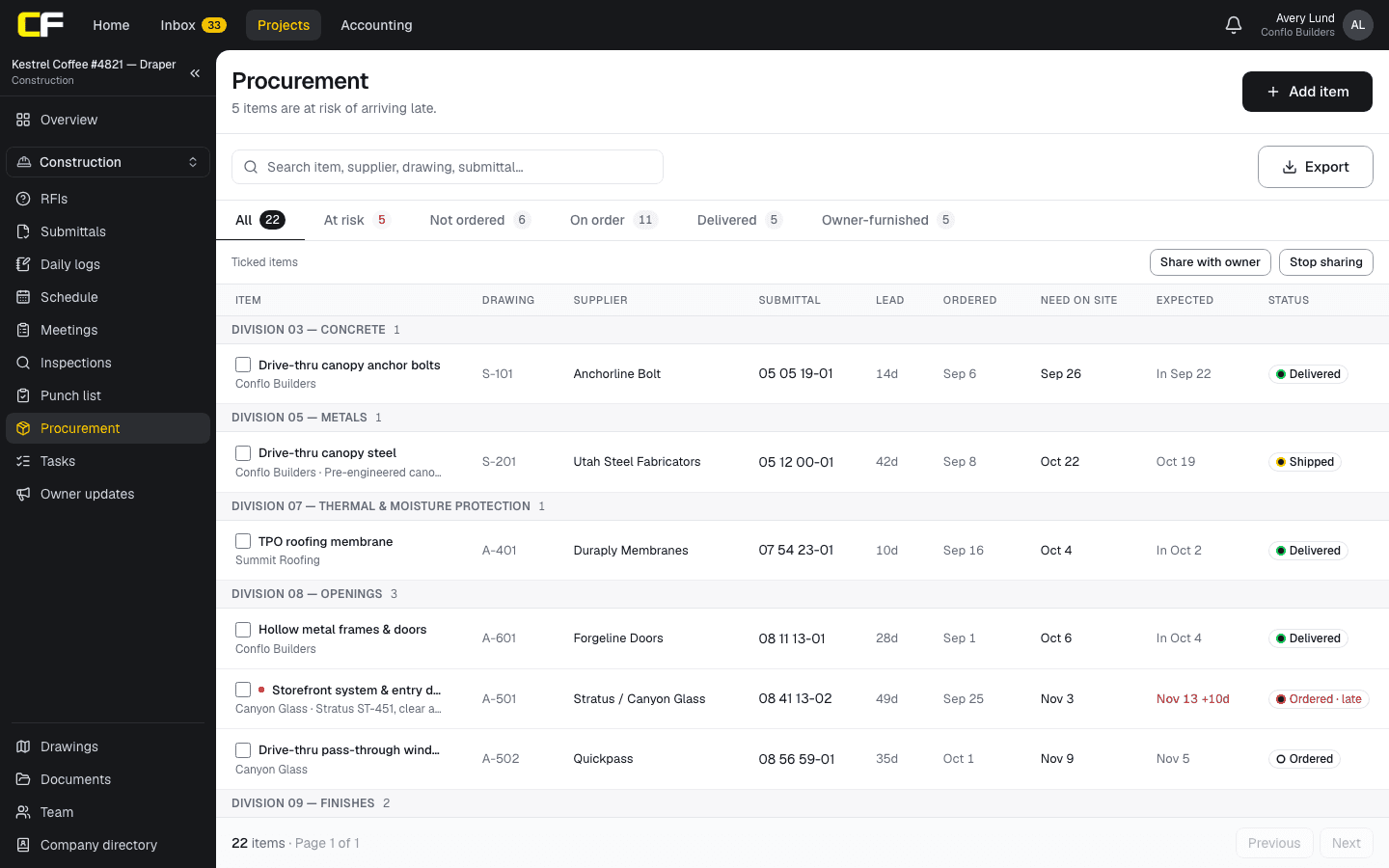
On the job, the GC tracks long-lead items in Procurement, with each item's supplier, responsible company, lead time in days and the date it is needed on site. Conflo works out the latest order-by date (the need date minus the lead time) and flags an item that is late to order or expected after it is needed. If the GC links the item to its submittal, the item shows whether that submittal is approved. As the responsible sub, you see your own items, can add one, move it from ordered to shipped to delivered with its dates, and change its details unless the GC has locked it. Not built today: a Division 14 conveying group in the procurement log, and a released-for-manufacture or deposit status.
The bottom line
An elevator bid is a price per car plus a list of everything the building must give you first. The schedule follows the approved drawings, so the real deadline is the day they must be approved, worked backward from the need date.
On your next bid, put the work-by-others table above into your proposal and state when your lead time starts.
Sources
- UFGS 14 24 23, Hydraulic Passenger Elevators (August 2025) — Whole Building Design Guide (USACE, NAVFAC, AFCEC). Read October 22, 2026.
- UFGS 14 21 23, Electric Traction Passenger Elevators (August 2025) — Whole Building Design Guide (USACE, NAVFAC, AFCEC). Read October 22, 2026.
- Elevator Program, Conveyance Management Portal — Washington State Department of Labor & Industries. Read October 22, 2026.
Questions
How do elevator contractors price a bid?
Per car, from the type (hydraulic, traction or machine-room-less), capacity, speed, number of stops and openings, travel, cab finishes and fixtures, plus the maintenance period the spec asks for, with a list of the work other trades must provide.
When does an elevator's lead time start?
Usually when the shop drawings are approved and the cab finishes and fixtures are selected, not when the subcontract is signed. Work back from the date the equipment must be on site to find the latest day for approval.
Who inspects a new elevator before turnover?
The state elevator authority or an inspector it accepts, rather than only the city building inspector. On federal jobs a Qualified Elevator Inspector witnesses the acceptance tests and signs a certificate once the elevator passes.
Does an elevator bid include maintenance?
Often, yes. The federal passenger elevator specs require 12 months of warranty service after acceptance, with monthly or bi-weekly visits and 24-hour emergency service. Read your spec and price the period it states.
Can the GC use the elevator during construction?
Only on terms agreed in writing. State in your bid that temporary use is excluded unless a separate agreement covers protection, a daily rate, cleaning and refurbishment before turnover.
Related
Bidding
How Electrical Subs Bid and Bill Commercial Work
How electrical subs bid commercial work and bill it: clarifications, a schedule of values with rough-in, gear and trim, and stored switchgear.
· 7 min read
Role hub
The Subcontractor's Guide: Bidding to Getting Paid
Every step of a commercial job from the subcontractor's seat: bidding, the subcontract, submittals, RFIs, change orders, pay apps, retainage and closeout.
· 9 min read
Money
How Does a Subcontractor Fill Out a Pay Application?
A subcontractor's pay app bills percent complete and stored materials per schedule-of-values line, less retainage and prior payments, with a lien waiver.
· 9 min read