
California Retainage Law: Private and Public Jobs
By Wyatt Cooper · Published · 8 min read
Key takeaways
- For private contracts entered into on or after January 1, 2026, Civil Code § 8811 caps retention at 5% of each payment and 5% of the contract price, down the whole chain.
- Public works have been capped at 5% under Public Contract Code § 7201 for contracts since 2012, with narrow exceptions for projects found substantially complex before bid.
- Private retention is due from the owner within 45 days after completion and from the GC to subs within 10 days of receiving it; public retention within 60 days after completion and to subs within 7 days.
- Late retention costs 2% per month on the amount wrongfully withheld, in place of interest, and the prevailing party in a collection action recovers attorney's fees.
California caps retention at 5% on both private and public jobs. On private work, Civil Code § 8811 limits retention to 5% of each payment and 5% of the contract price for contracts entered into on or after January 1, 2026. On public works, Public Contract Code § 7201 sets the same 5% limit. Owners must release private retention within 45 days after completion and public retention within 60 days, and the GC must pass it down within 10 or 7 days. Verify the current statute.
Two codes: Civil Code for private, Public Contract Code for public
California calls retainage "retention." Private works of improvement are governed by Civil Code Title 2 and public ones by Title 3 (Civil Code §§ 8160 and 9000); retention on private work is in the retention article of the Civil Code's prompt-payment chapter, which "governs a retention payment withheld by an owner from a direct contractor or by a direct contractor from a subcontractor" (Civ. Code § 8810). Retention on public work is in the Public Contract Code, §§ 7107 and 7201. The article does not apply to retention a lender withholds under a construction loan agreement (Civ. Code § 8822).
Private jobs: the 5% cap that started in 2026
Civil Code § 8811 was added by Stats. 2025, ch. 49 (SB 61), effective January 1, 2026, and applies "to a contract relating to a private work of improvement entered into on or after January 1, 2026" (Civ. Code § 8811). Its rules:
- Retention withheld by the owner from the direct contractor, by the direct contractor from a subcontractor, and by a subcontractor from its own subcontractor "shall not exceed 5 percent of the payment."
- "In no event shall the total retention proceeds withheld exceed 5 percent of the contract price."
- In a subcontract, the percentage withheld may not exceed the percentage in the contract between the owner and the direct contractor.
- Exception: the cap does not apply where the contractor gave written notice before or when the bid was requested that a performance and payment bond would be required, and the sub then fails to furnish one from an admitted surety insurer.
- Exception: the cap does not apply on a residential project that is not mixed use and does not exceed four stories.
- A court "shall award reasonable attorney's fees to the prevailing party" in an action to enforce the section.
A private contract signed before January 1, 2026 is outside § 8811 by its own terms, so its retention is whatever the contract says. The release deadlines below apply either way.
Private jobs: when retention must be released
| Who pays | Deadline | If there is a good faith dispute | Section |
|---|---|---|---|
| Owner to direct contractor | Within 45 days after completion of the work of improvement | Owner may withhold up to 150% of the disputed amount from final payment | § 8812 |
| Direct contractor to subcontractors | Within 10 days after receiving all or part of a retention payment, each sub's share | Up to 150% of the estimated value of the disputed amount | § 8814 |
| Owner or GC after disputed work is finished | Within 10 days after acceptance of the disputed work, the retention for that work | Notice of acceptance or rejection due within 10 days of the completion notice | § 8816 |
"Completion" has a statutory meaning: actual completion, occupation or use by the owner with cessation of labor, cessation of labor for 60 continuous days, or recording a notice of cessation after 30 days of cessation; on work subject to a public entity's acceptance, completion occurs on acceptance (Civ. Code § 8180). An owner may record a notice of completion within 15 days after completion (§ 8182).
Late retention carries "a penalty of 2 percent per month on the amount wrongfully withheld, in place of any interest otherwise due," and the prevailing party in a collection action recovers costs and reasonable attorney's fees (Civ. Code § 8818).
Public works: the 5% cap and the 60-day release
For public works contracts entered into on or after January 1, 2012, retention withheld by a public entity, by the original contractor from a sub and down the chain "shall not exceed 5 percent of the payment," total retention may not exceed 5% of the contract price, and a subcontract may not withhold a higher percentage than the prime contract (Pub. Contract Code § 7201). The section also bars any party from requiring another to waive it. A higher amount is allowed only where the agency's director or governing body finds, before bid and project by project, that the project is substantially complex, and says so in the bid documents; the cap also does not bind a sub that fails to furnish a bond after timely notice.
Release is set by Public Contract Code § 7107: "Within 60 days after the date of completion of the work of improvement, the retention withheld by the public entity shall be released," with up to 150% of a disputed amount withheld from final payment. Completion includes the agency's beneficial use with cessation of labor, its acceptance, cessation for 100 days beyond the contractor's control, or cessation for 30 days with a recorded notice. The original contractor must pay each sub its share "within seven days" of receiving it. Late payment draws a charge of 2% per month in lieu of interest, and an attempted waiver of § 7107 is void.
Worked example: a private job under the new cap
A fictional drywall subcontractor, "Coastline Interiors", signs a $640,000.00 subcontract in March 2026 on a fictional private office building, the "Mariposa Street Offices". The prime contract holds 5% retention, so the subcontract can hold no more than 5%.
Coastline Interiors — retention under Civil Code §§ 8811, 8812 and 8814
- Billed to date (80% complete)
- $512,000.00
- Retention held to date at 5%
- $512,000.00 × 5% = $25,600.00
- Most retention ever held (5% of the contract price)
- $640,000.00 × 5% = $32,000.00
- Work of improvement completed
- June 30, 2026
- Owner's deadline to pay retention to the GC (45 days)
- August 14, 2026
- GC receives the retention
- August 10, 2026
- GC's deadline to pay Coastline its share (10 days)
- August 20, 2026
- Penalty if $32,000.00 is wrongfully withheld
- 2% per month: $640.00 a month
The figures: 5% of $512,000.00 is $25,600.00; 5% of $640,000.00 is $32,000.00; June 30 plus 45 days is August 14 (31 days to July 31, then 14 more); August 10 plus 10 days is August 20; 2% of $32,000.00 is $640.00. A real deadline turns on the statutory completion date, which can differ from the day the last crew left.
For how the retention figure moves period by period on the pay app, see how to calculate retainage, and for the other four large states, retainage laws by state.
How it works in Conflo
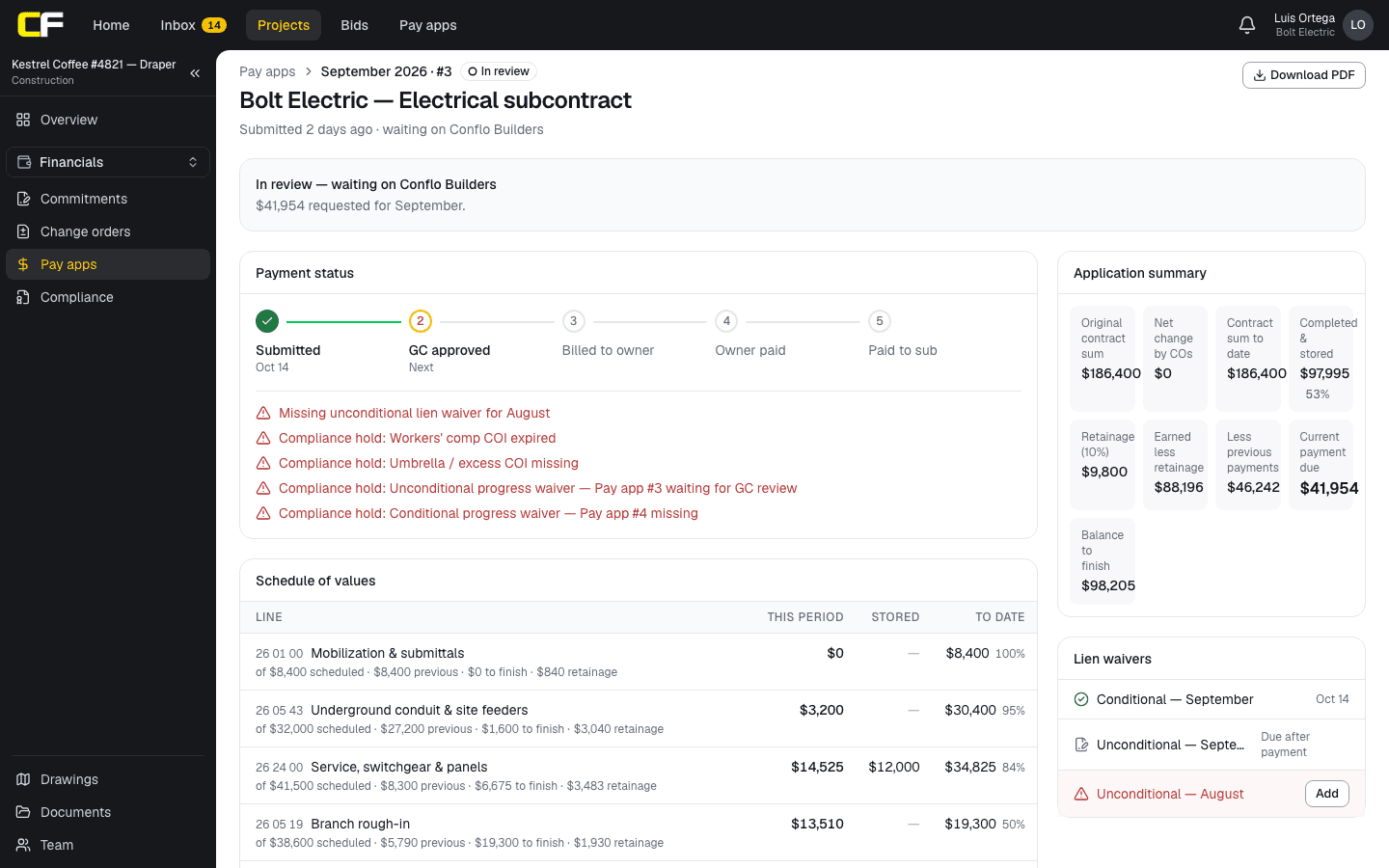
On Conflo's pay applications, each contract has one retainage percentage, from 0 to 20%, and retainage is calculated on work completed and stored to date. A subcontract signed through Conflo opens the sub's billing contract with the retainage percentage set on the subcontract. Conflo does not check your rate against California's cap: you set the rate the contract and statute allow.
Not built yet: a retainage release step, release deadline reminders and the 2% monthly penalty calculation.
The bottom line
California now caps retention at 5% on most private contracts signed from 2026 and on public works, and sets hard release deadlines: 45 or 60 days for the owner, 10 or 7 days for the GC to pass it down, and 2% a month if it is late.
For every California job, note the contract date (before or after January 1, 2026), whether it is public or private, and the completion date as the statute defines it; those three facts decide your retention rights.
Sources
- California Civil Code § 8810 — California Legislative Information. Read October 17, 2026.
- California Civil Code § 8811 — California Legislative Information. Read October 17, 2026.
- California Civil Code § 8812 — California Legislative Information. Read October 17, 2026.
- California Civil Code § 8814 — California Legislative Information. Read October 17, 2026.
- California Civil Code § 8816 — California Legislative Information. Read October 17, 2026.
- California Civil Code § 8818 — California Legislative Information. Read October 17, 2026.
- California Civil Code § 8822 — California Legislative Information. Read October 17, 2026.
- California Civil Code § 8180 — California Legislative Information. Read October 17, 2026.
- California Civil Code § 8182 — California Legislative Information. Read October 17, 2026.
- California Public Contract Code § 7107 — California Legislative Information. Read October 17, 2026.
- California Public Contract Code § 7201 — California Legislative Information. Read October 17, 2026.
Questions
What is the maximum retention in California?
5% on public works under Public Contract Code § 7201, and 5% on private works under Civil Code § 8811 for contracts entered into on or after January 1, 2026, each with listed exceptions. Total retention may not exceed 5% of the contract price.
When must a California owner release retention?
On a private job, within 45 days after completion of the work of improvement (Civil Code § 8812). On a public job, within 60 days after completion (Public Contract Code § 7107). Completion has a statutory definition, so check which event triggered it.
How fast must a California GC pay subs their retention?
On private work, within 10 days after receiving all or part of a retention payment (Civil Code § 8814). On public work, within seven days of receiving it (Public Contract Code § 7107). A good faith dispute allows withholding up to 150% of the disputed amount.
What is the penalty for late retention in California?
2% per month on the amount wrongfully withheld, in place of interest, plus attorney's fees and costs to the prevailing party in a collection action (Civil Code § 8818 for private work, Public Contract Code § 7107 for public work).
Does the 5% private cap apply to houses?
Not to a residential project that is not mixed use and does not exceed four stories, which § 8811 excludes. It also does not apply to contracts signed before January 1, 2026.
Related
Money
Retainage Laws in the Five Largest Construction States
Retainage caps and release deadlines in California, Texas, Florida, New York and North Carolina, from each state's statutes, private and public.
· 10 min read
Money
How Do You Calculate Retainage on a Pay App?
Retainage is a percentage of work completed and stored to date, held back each pay period. How to calculate it, reduce it, release it, with an example.
· 9 min read
Money
Texas Retainage Law: What Property Code Ch. 53 Says
Texas retainage from the statutes: the owner's 10% reserve, notice and lien deadlines for unpaid retainage, and the public-works caps of 10% and 5%.
· 9 min read
Money
Mechanic's Lien Deadlines: How They Work
How mechanic's lien deadlines are counted: the notices before, the filing deadline, the deadline to sue, and five states' filing deadlines from statute.
· 8 min read
Role hub
The Subcontractor's Guide: Bidding to Getting Paid
Every step of a commercial job from the subcontractor's seat: bidding, the subcontract, submittals, RFIs, change orders, pay apps, retainage and closeout.
· 9 min read