
What Is a Schedule of Values?
By Wyatt Cooper · Published · 3 min read
Key takeaways
- A schedule of values is the contract sum split into line items, and each pay application bills a percentage of each line.
- The contractor prepares it and the owner, architect or GC approves it before the first pay application; its lines must add up to the contract sum.
A schedule of values (SOV) is a list that splits a construction contract's sum into line items, each with a dollar value, that together equal the contract sum. The contractor prepares it at the start of the job, the paying party approves it, and every pay application then bills progress as a percentage of each line.
How a schedule of values works
The SOV is agreed once and then reused every month. On the pay application's continuation sheet, each SOV line gets columns for work from previous applications, work this period, materials stored, total to date, percent complete and balance to finish. The AIA describes its continuation sheet as breaking the contract sum into portions of the work "in accordance with a schedule of values prepared by the contractor" (AIA G703 summary).
Owners often set rules for it in the specifications: one university's Division 01 asks for at least one line per specification section, separate lines for stored materials and allowances, and each change order as a new line (University of Houston, Section 01 29 00). How to build one, step by step: how do you build a schedule of values.
Example
| Line | Description | Scheduled value |
|---|---|---|
| 1 | Mobilization and bonds | $6,000.00 |
| 2 | Underground rough-in | $38,000.00 |
| 3 | Above-ground rough-in | $72,000.00 |
| 4 | Fixtures, material | $46,000.00 |
| 5 | Fixture installation and trim | $40,000.00 |
| 6 | Water heaters and equipment | $18,000.00 |
| 7 | Testing, closeout and as-builts | $20,000.00 |
| Total | $240,000.00 |
If above-ground rough-in is 75% complete, the pay application shows $54,000.00 to date on line 3 (75% of $72,000.00). The free pay application workbook has this example built in.
Schedule of values vs. budget and bid breakdown
A budget is the contractor's own cost plan, private and in cost codes. A bid breakdown shows how a price was built. The schedule of values is shared with the party who pays: it carries the price, overhead and profit included, in lines that party agrees to pay against. It changes only through approved change orders, usually added as new lines.
How it works in Conflo
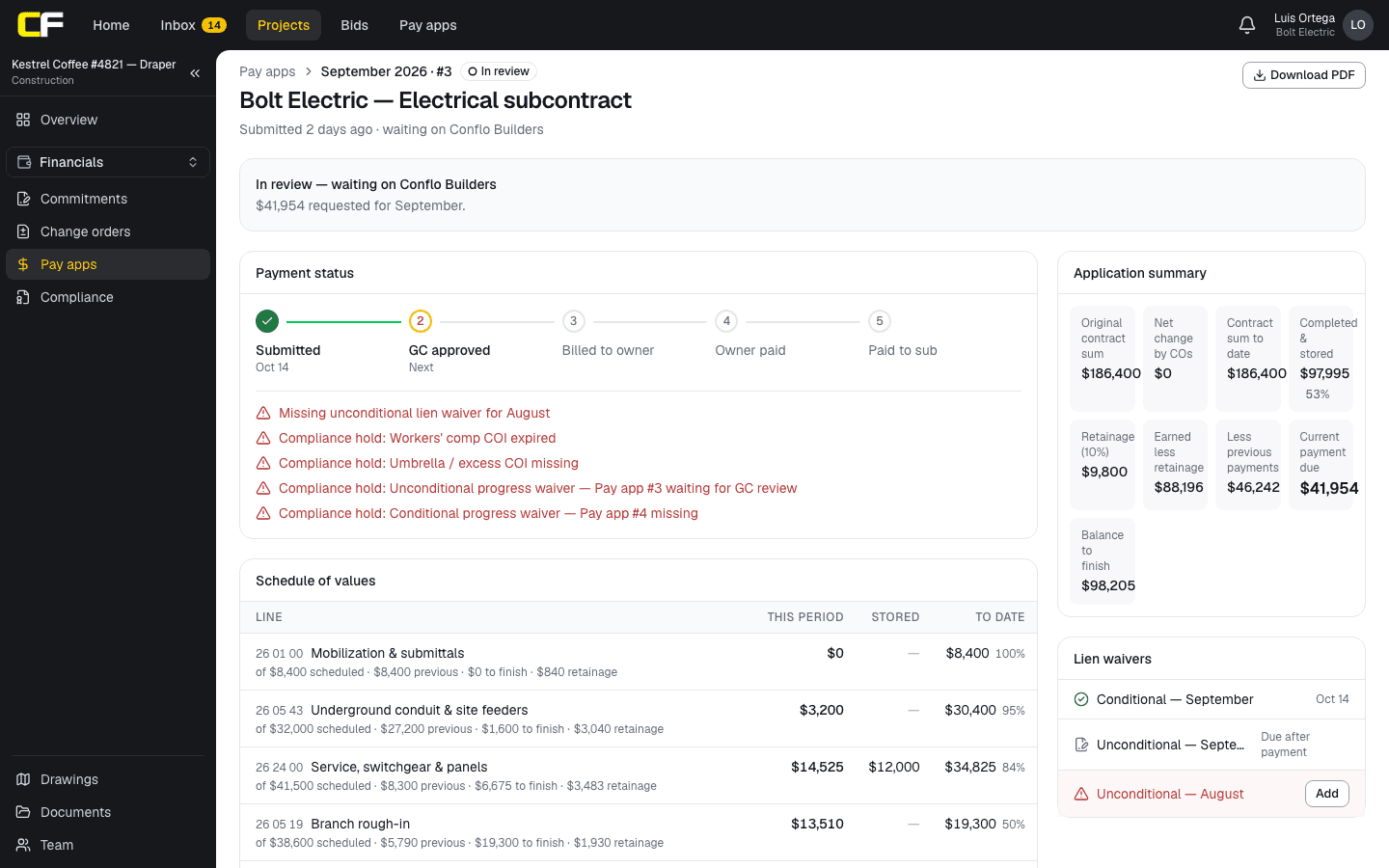
On Conflo's pay apps, each contract carries its schedule of values, and a subcontract signed in Commitments brings its lines with it. Every pay application bills against those lines, and no line can bill past 100%.
The bottom line
The schedule of values is the line-by-line price of the contract that every pay application refers back to.
Get it agreed before the first billing, with lines small enough to check in the field.
Sources
- Summary: G703–1992, Continuation Sheet — AIA Contract Documents (The American Institute of Architects). Read October 16, 2026.
- Section 01 29 00, Payment Procedures (master construction specification) — University of Houston, Facilities Planning and Construction. Read October 16, 2026.
Questions
Who approves a schedule of values?
The party who pays on the contract, often through the architect on owner contracts and the GC's project manager on subcontracts. Approval usually comes before the first pay application.
Does the schedule of values include overhead and profit?
Usually yes, spread across the lines. Some specifications require each line to include its proportionate share of overhead and profit, so no line is inflated.
Is a schedule of values the same as a G703?
No. The G703 is the AIA's continuation sheet form, which bills against the schedule of values. The schedule itself is the list of lines and values, whatever form it is billed on.
Related
Preconstruction
How Do You Build a Schedule of Values?
Split the contract sum into billable lines that follow the work, price each with its share of overhead and profit, and keep closeout real. With an example.
· 7 min read
Definition
What Is a Pay Application in Construction?
A pay application is a contractor's monthly request for payment against the schedule of values, less retainage and earlier payments. With an example.
· 3 min read
Template
Free Pay Application Template With Schedule of Values
A free Excel pay application: a summary sheet and a schedule of values with change orders, stored materials and retainage, calculated. No email needed.
· 4 min read
Money
How Does a Subcontractor Fill Out a Pay Application?
A subcontractor's pay app bills percent complete and stored materials per schedule-of-values line, less retainage and prior payments, with a lien waiver.
· 9 min read
Role hub
The General Contractor's Guide: Bid to Closeout
What a general contractor is responsible for at every phase of a commercial job, from bidding and buyout to RFIs, change orders, pay apps and closeout.
· 8 min read