
How Plumbing Subs Bid and Bill Commercial Work
By Wyatt Cooper · Published · 6 min read
Key takeaways
- Commercial plumbing follows three inspected phases, underground, rough-in and finish, and the schedule of values should follow them too.
- Clarify the edges in the bid: where site utilities stop, excavation and backfill, owner-furnished fixtures, gas, and fire protection.
- Fixtures are a large material purchase, so a separate fixture material line lets you bill them as stored when they are delivered, where the contract allows.
- In the example below, finishing underground in month 2 bills $31,380, with $3,138.00 retained at 10% and $28,242.00 due.
Plumbing subcontractors bid commercial work from a takeoff of fixtures, pipe by system and size, equipment such as water heaters, and the labor for each phase, with clarifications for site utilities, excavation, gas, owner-furnished fixtures and fire protection. They bill monthly against a schedule of values split by phase: underground below the slab, rough-in or top-out of waste, vent and water, and finish when fixtures are set and trimmed, plus equipment, testing and closeout lines.
The three phases of commercial plumbing
- 1UndergroundSanitary and storm piping below the slab, tested and inspected before backfill and the slab pour
- 2Rough-in (top-out)Waste, vent and domestic water piping in walls and ceilings, tested and inspected before walls close
- 3FinishFixtures set and trimmed, equipment connected, systems started and flushed, final inspection
The phases are set by the work itself and by the inspections the local plumbing code requires before each is covered, so your billing and your crew plan should follow them. The trade's associations, the Plumbing-Heating-Cooling Contractors Association (PHCC) and the Plumbing Contractors of America, part of the Mechanical Contractors Association of America (MCAA), publish education and resources for contractors in this work.
Clarifications that protect a plumbing bid
| Item | The question | State in the bid |
|---|---|---|
| Site utilities | Where does your work start: at the building wall, a set distance out, or at the main? | The point of connection for sewer, storm and water |
| Excavation and backfill | Who digs, shores, backfills and compacts the underground? | Included, or by the site contractor |
| Slab work | Who saw-cuts, cores and patches? | Included or by others, and whether firestopping is yours |
| Fixtures | Contractor-furnished, or owner-furnished and you install? | Which fixtures you furnish and which you only set |
| Gas piping | In the plumbing scope or the mechanical scope? | Included from meter to equipment, or excluded |
| Fire protection | Sprinklers are often a separate trade | Excluded unless the bid says otherwise |
| Permits and fees | Who pulls the permit and pays utility tap fees? | Permit included; tap and impact fees by owner, or as priced |
Ask unclear items through the GC's bid questions so every bidder hears the answer. A GC reading your exclusions will price any gap against you when it levels the bids.
A schedule of values that follows the phases
| Line | Description | Phase | Scheduled value |
|---|---|---|---|
| 1 | Mobilization and submittals | General | $8,500 |
| 2 | Underground sanitary and storm | Underground | $52,300 |
| 3 | Rough-in, waste and vent | Rough-in | $61,800 |
| 4 | Rough-in, domestic water | Rough-in | $47,600 |
| 5 | Gas piping | Rough-in | $18,900 |
| 6 | Fixtures, material | Finish | $39,400 |
| 7 | Fixtures, set and trim | Finish | $22,700 |
| 8 | Water heaters and equipment | Finish | $21,300 |
| 9 | Testing, inspections and startup | General | $6,000 |
| 10 | Closeout documents | General | $5,500 |
| Total | $284,000 |
By phase: underground $52,300; rough-in $61,800 + $47,600 + $18,900 = $128,300; finish $39,400 + $22,700 + $21,300 = $83,400; general $8,500 + $6,000 + $5,500 = $20,000. The four add to $284,000. Rough-in is the largest phase, which is why a sub that splits it by system or by floor can bill steadily through the middle of the job.
Worked example: billing the underground
The fictional "Ostrander Plumbing" holds the subcontract above with 10% retainage. At the end of month 1 the underground was 40% complete ($20,920 billed). In month 2 it is finished, tested and inspected, and the slab is poured.
Ostrander Plumbing, pay app 2, line 2: underground sanitary and storm
- Scheduled value
- $52,300.00
- Previous (40%)
- $20,920.00
- This period (60%)
- $31,380.00
- Completed to date (100%)
- $52,300.00
- Retainage on this period at 10%
- $3,138.00
- This line's share of the payment due
- $28,242.00
Checks: 40% of $52,300 is $20,920; 60% is $31,380; together $52,300. 10% of $31,380 is $3,138.00, and $31,380 − $3,138 = $28,242. Bill the inspection-passed phase when it passes; a GC will often ask for the inspection record before it approves a line at 100%.
Stored fixtures and equipment
Fixtures and water heaters often arrive weeks before they are set. Whether you can bill them as stored material depends on the contract. On federal fixed-price work, material delivered to the site may be counted, and material stored elsewhere only where the contract specifically authorizes it and you show you have title (FAR 52.232-5). Private subcontracts usually want a bill of sale, insurance and secure storage. Retainage applies to stored material too; see how to calculate retainage.
Plumbing closeout documents
- As-built drawings showing underground and concealed piping as installed.
- Test records and inspection sign-offs for each phase.
- Backflow preventer test reports and water system disinfection reports where the jurisdiction or specification requires them.
- O&M manuals and warranties for water heaters, pumps and fixtures.
- The final lien waiver and the retainage release request.
For the monthly form itself, see how to fill out a pay application as a subcontractor.
How it works in Conflo
When a GC sends a plumbing package through Trade bids in Conflo, the sub prices the GC's scope items, marking each included or excluded, prices alternates and lists exclusions and qualifications, and can revise the bid until the due time. If it wins and signs the subcontract, it bills in Pay apps: percent complete this period and materials stored for each line, with previous billing carried forward and retainage calculated on completed and stored to date. The GC can send back single lines with a note.
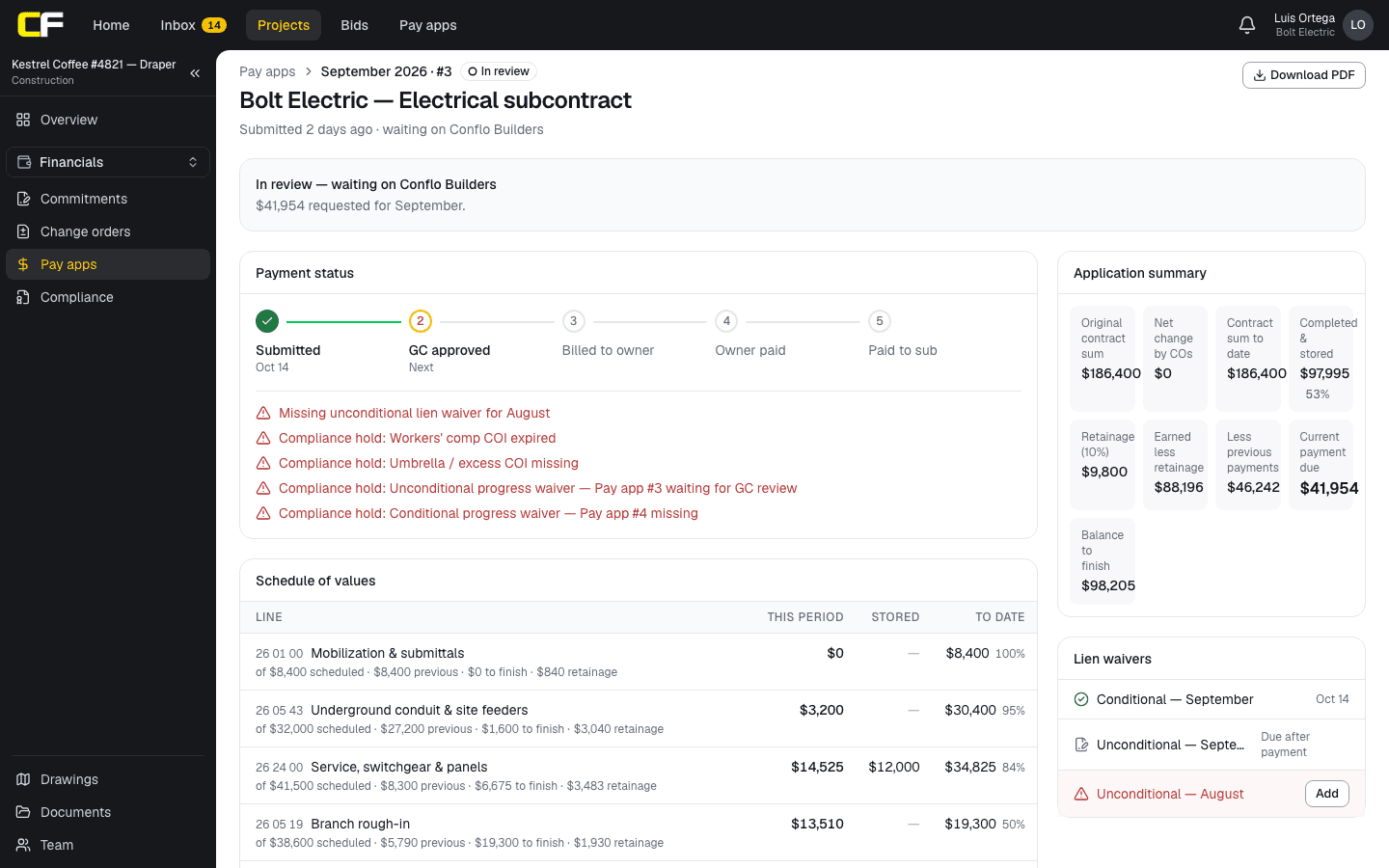
Not built today: attaching an inspection record to a schedule-of-values line.
The bottom line
Plumbing bids and bills follow the same three phases the inspector does. Clarify where your work starts and stops, split rough-in so it can be billed as it goes, and keep fixtures on their own material line.
Before the next bid, check your proposal template against the seven clarifications above.
Sources
- Plumbing-Heating-Cooling Contractors Association — PHCC. Read October 16, 2026.
- Who We Are — Mechanical Contractors Association of America. Read October 16, 2026.
- FAR 52.232-5, Payments under Fixed-Price Construction Contracts — Acquisition.gov, U.S. General Services Administration. Read October 16, 2026.
Questions
What are the phases of commercial plumbing?
Underground below the slab, rough-in (also called top-out) of waste, vent and water piping in walls and ceilings, and finish, when fixtures are set and trimmed and equipment is connected. Each is usually inspected before it is covered.
How should a plumbing sub split its schedule of values?
By phase and system: underground, rough-in split by system or floor, gas, fixture material, fixture setting, equipment, testing and closeout. That lets each phase bill as it is completed and inspected.
What should a plumbing bid exclude or clarify?
The point of connection to site utilities, excavation and backfill, saw-cutting and coring, owner-furnished fixtures, gas piping, fire protection, and permit and tap fees.
Can a plumbing sub bill for fixtures before they are installed?
Often, as stored material, if the contract allows it and you provide what it asks for, such as a bill of sale, insurance and secure storage. Retainage usually applies.
Related
Money
How Does a Subcontractor Fill Out a Pay Application?
A subcontractor's pay app bills percent complete and stored materials per schedule-of-values line, less retainage and prior payments, with a lien waiver.
· 9 min read
Bidding
How Electrical Subs Bid and Bill Commercial Work
How electrical subs bid commercial work and bill it: clarifications, a schedule of values with rough-in, gear and trim, and stored switchgear.
· 7 min read
Money
How Do You Calculate Retainage on a Pay App?
Retainage is a percentage of work completed and stored to date, held back each pay period. How to calculate it, reduce it, release it, with an example.
· 9 min read
Bidding
How Fire Sprinkler Subs Bid and Bill Commercial Work
How fire sprinkler subs bid design-build work and bill it: the basis of design, hydraulic calcs, the fire marshal's review, tests and a pay period.
· 10 min read
Role hub
The Subcontractor's Guide: Bidding to Getting Paid
Every step of a commercial job from the subcontractor's seat: bidding, the subcontract, submittals, RFIs, change orders, pay apps, retainage and closeout.
· 9 min read