
What Is a Plug Number in a Bid?
By Wyatt Cooper · Published · 4 min read
Key takeaways
- A plug is your own estimate standing in for a price you do not have: in the estimate until a sub's bid replaces it, or on a leveling sheet to cover scope a bidder left out.
- A plug is not an allowance: an allowance is a fixed amount written into the contract documents for every bidder; a plug is private to the estimator.
- Write down where each plug came from, use the same plug for every bidder who excluded the item, and replace plugs with real prices before you commit.
A plug number (or plug) is an estimator's own figure for work with no firm price yet. In an estimate, it stands in for a trade until a subcontractor's bid replaces it. On a leveling sheet, it is the GC's estimate of scope a bidder excluded, added to that bid so all bids cover the same work.
Two places plugs are used
In the estimate. Before bids arrive, the estimator carries a number for every trade from takeoff and history: the plug. It keeps the total complete, and it is the benchmark each bid is judged against. A division with no bids on bid day still carries its plug. See how to build an estimate from sub bids.
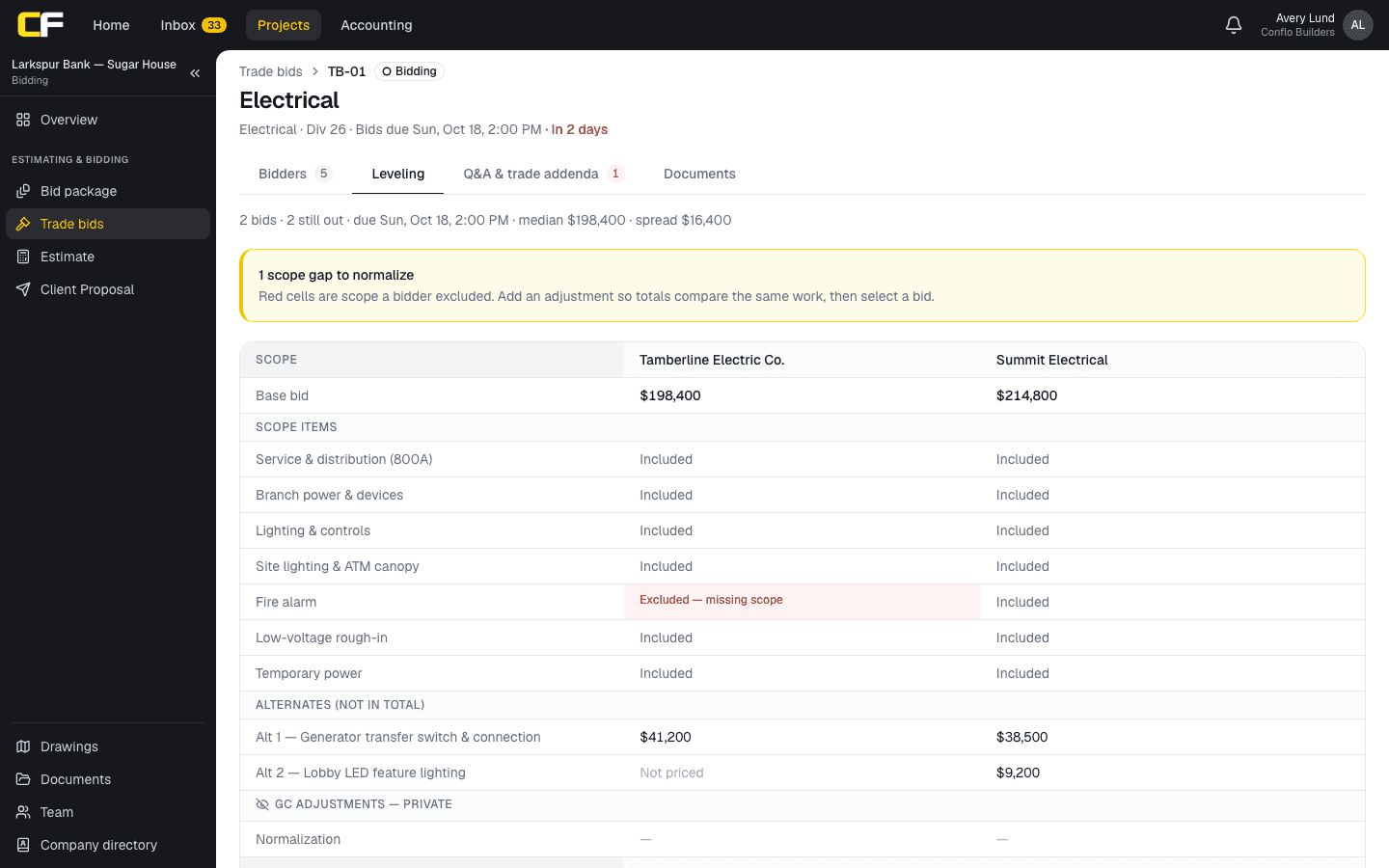
On the leveling sheet. When a bidder excludes an item the scope includes, the estimator adds a plug for it so the bid can be compared with bids that included it (how to level subcontractor bids). Public owners use the same idea in their own estimates: the Federal Highway Administration calls the engineer's estimate "the benchmark for analyzing bids" (FHWA).
Plugs in practice
- Estimate plug (fictional): HVAC carried at $92,000 from the GC's takeoff because no HVAC bids are in. When a $95,400 leveled bid arrives, it replaces the plug, and the estimate rises $3,400.
- Leveling plug (fictional): a drywall bidder excludes firestopping; the GC adds $11,200 from its own takeoff, so a $412,000 base bid levels at $423,200 before any other adjustment.
A plug is only as good as its source. In order of preference: another bidder's breakout for the same item, your own quantities and unit costs, then a separate quote. The bidder's own price beats them all, so ask the apparent low bidder to price its exclusions before award. Some public contracts formalize that check: one construction manager-at-risk contract has the low trade bid reviewed to verify it accounted for all the costs of its scope (NC State University).
For subcontractors, the lesson runs the other way: an exclusion you do not price gets the GC's plug. See how to write a sub proposal a GC can level.
How it works in Conflo
In Conflo's Estimate, a plug is its own kind of line, and a carried sub bid replaces only a division's plug lines. On a trade bid's leveling tab, you add private plus or minus adjustments to a bid, optionally tied to a scope item; a scope item a bidder excluded is flagged until an adjustment covers it.
The bottom line
Plugs make an incomplete set of prices comparable and keep the estimate whole. Source each one, apply it the same way to every bidder, and keep it private.
Then replace every plug you can with a real price before the number becomes a contract. The free bid leveling spreadsheet has a column for where each plug came from.
Sources
- Guidelines on Preparing Engineer's Estimate, Bid Reviews and Evaluation (October 7, 2021), Preparing Engineer's Estimate — Federal Highway Administration. Read October 17, 2026.
- Section II, General Provisions (Construction Manager-at-Risk), part 3, Principal Trade & Specialty Contracts — NC State University Facilities. Read October 16, 2026.
Questions
What is the difference between a plug and an allowance?
An allowance is a fixed amount the contract documents tell every bidder to include for work not yet defined, and it is reconciled later against actual cost. A plug is the estimator's own private figure for a price it does not have yet.
Where do plug numbers come from?
From the best number available: another bidder's breakout for the same item, your own takeoff and unit costs, or a separate quote. Write the source next to each plug.
Should bidders see the GC's plugs?
No. Plugs are the GC's estimates. Ask a bidder to price its own exclusions instead of showing it your number.
Related
Bidding
How Do You Level Subcontractor Bids?
Level subcontractor bids by pricing every scope gap, exclusion and missing addendum so each bid covers the same work, then compare the leveled totals.
· 9 min read
Bidding
How Do You Build an Estimate From Sub Bids?
Build a GC estimate from sub bids: plug each division, carry the leveled bid in place of the plug, add your own work and general conditions, then markups.
· 7 min read
Definition
Bid Tabulation vs Bid Leveling: What's the Difference?
A bid tabulation records each bid as received; bid leveling adjusts each bid for scope gaps so all cover the same work. How they differ, with an example.
· 4 min read
Template
Free Bid Leveling Spreadsheet (Excel Template)
A free bid leveling spreadsheet for Excel: five bidders, fifteen scope rows, plugs and deducts, leveled totals, median and alternates. No email needed.
· 4 min read
Role hub
The General Contractor's Guide: Bid to Closeout
What a general contractor is responsible for at every phase of a commercial job, from bidding and buyout to RFIs, change orders, pay apps and closeout.
· 8 min read