
How Do You Close Out a Subcontract?
By Wyatt Cooper · Published · 6 min read
Key takeaways
- Close a subcontract in order: settle every pending change order, confirm the closeout documents and punch items, then take the final pay application.
- The final pay application bills the subcontract to 100 percent of its revised value and asks for the retainage.
- Release retainage against a final lien waiver from the sub and, where needed, its suppliers, and check its insurance and compliance documents first.
- Record the warranty start date and term for the sub's work, then mark the subcontract closed so nothing else is billed against it.
To close out a subcontract, settle every pending change order so the revised value is final, confirm the sub's punch items are closed and its closeout documents approved, then take a final pay application billing 100 percent with the retainage. Pay it against the sub's final lien waiver and current compliance documents, record the warranty start date and term, and mark the subcontract closed so nothing more is billed.
Why close each subcontract on purpose
A subcontract left open after the trade leaves the site is where a late change order, a duplicate bill or an unpaid supplier's lien comes from. Closing each one on purpose, in the same order every time, settles the money while the people who know the job still answer the phone. It is also how the GC builds its own case for final payment from the owner.
On federal fixed-price construction, for example, the owner makes final payment after "completion and acceptance of all work", a properly executed voucher and a "release of all claims", other than claims in stated amounts the contractor specifically excepts (FAR 52.232-5(h)). A GC that has closed each subcontract knows exactly what to except. For the whole closeout around it, see how to assemble a closeout package, the general contractor's guide and the project lifecycle.
The checklist, in order
| Step | What to confirm | Why it comes here |
|---|---|---|
| 1. Change orders | Every pending change order approved, rejected or withdrawn | The revised value must be final before the last bill |
| 2. Punch list | Every punch item for the trade verified and closed | Final payment usually waits on completed work |
| 3. Closeout documents | O&M manuals, warranties, as-builts and attic stock approved | Most subcontracts make them a condition of final payment |
| 4. Final pay application | Billed to 100% of the revised value, retainage requested | One last bill against a final number |
| 5. Lien waivers and compliance | Final waiver from the sub, and from suppliers where your state or contract calls for it; insurance current | Payment releases rights; get the waiver for it |
| 6. Pay and release | Retainage paid within your subcontract's and the law's time | Prompt payment rules apply to retainage too in many states |
| 7. Warranty | Start date and term recorded, with the sub's warranty contact | The warranty is what survives the subcontract |
| 8. Close | Subcontract marked closed | No further billing against it |
Collect the documents early. For closing O&M manuals and punch items with a trade, see how to collect O&M manuals and how a sub closes out punch items. For waiver forms, see conditional vs unconditional lien waivers; for retainage rules, how to get retainage released; for step 4 from the sub's side, how a sub submits a final pay app.
Paying the last dollars
Your subcontract and your state's law set how fast the final payment and retainage must move once you are paid. On federal work, the GC's subcontracts must carry a clause to pay the sub "not later than 7 days from receipt of payment" for satisfactory performance, with an interest penalty if late (FAR 52.232-27(c)). State prompt payment acts differ; see prompt payment acts.
Record the warranty with the subcontract. The federal closeout guide specification has the contractor list, for each warranted item, the starting point and duration of the warranty and the people to call for service, with separate expiration dates for any warranty longer than one year (UFGS 01 78 00, §1.9.1).
A worked example: a fictional electrical subcontract
The subcontract is fictional: electrical, $480,000 original value, 5 percent retainage. Two change orders are approved, one adds $22,500 and one deducts $4,000, and a third for $3,200 is still pending when the trade finishes.
- 1GC and subSettle the pending $3,200 change order: the sub withdraws it after the GC shows the work was in the base scope
- 2GCRevised value is final: $480,000 + $22,500 − $4,000 = $498,500
- 3GCConfirms all 9 electrical punch items closed and the O&M manuals, warranty letter and as-builts approved
- 4SubSubmits the final pay application: billed to date $498,500, retainage held $24,925
- 5SubSends a conditional final lien waiver for $24,925 and a current insurance certificate
- 6GCPays the $24,925 when the owner pays, within the subcontract's time, and takes the unconditional final waiver
- 7GCRecords the one-year warranty from substantial completion and closes the subcontract
The arithmetic: $480,000 + $22,500 − $4,000 = $498,500. Retainage at 5 percent of $498,500 is $24,925, so the sub had been paid $498,500 − $24,925 = $473,575 before the final payment, and the final payment is the $24,925.
How it works in Conflo
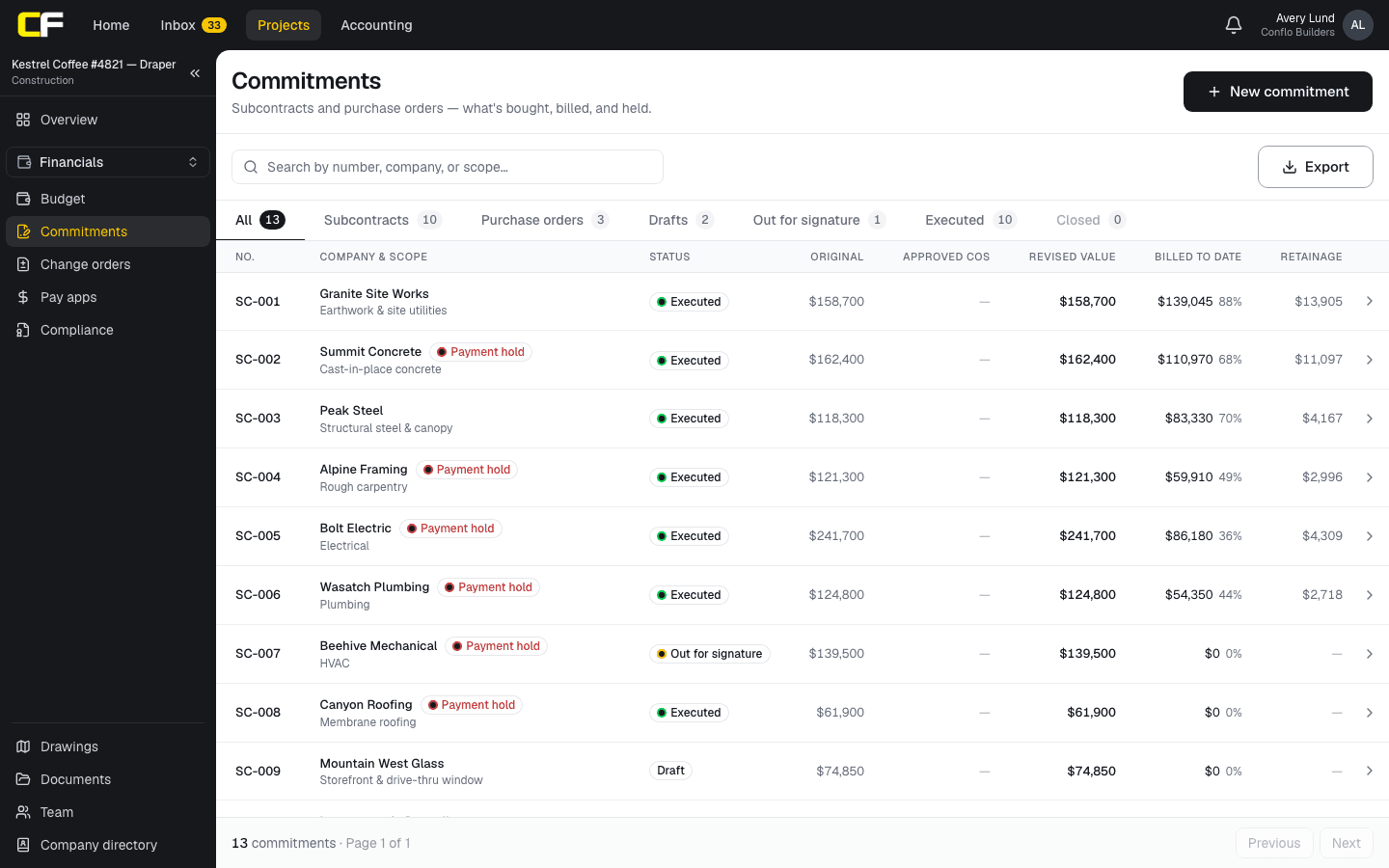
In Conflo's commitments, each subcontract carries its schedule of values, its linked change orders (approved and pending) and its linked pay applications. An executed subcontract shows the percent billed, the amount left to bill and any change orders still pending; the list shows the original and revised value, billed to date and retainage held.
If the company has missing, expired or unreviewed required compliance documents, such as insurance certificates or lien waivers, the subcontract shows a payment hold. Final lien waivers, warranties and O&M manuals are requested and approved in the closeout package, and the GC adds each warranty to the project's warranties list with its start date and term. When the work is settled, the GC closes out the subcontract, which records the date and the amount billed; it can be reopened if needed.
The bottom line
Close every subcontract in the same order: change orders, punch, closeout documents, final pay application, waivers, payment, warranty, closed.
Done that way, the last check matches a final number, every lien right is released for what was paid, and the warranty is on record before the trade moves on.
Sources
- FAR 52.232-5, Payments under Fixed-Price Construction Contracts — Acquisition.gov, U.S. General Services Administration. Read October 22, 2026.
- FAR 52.232-27, Prompt Payment for Construction Contracts — Acquisition.gov, U.S. General Services Administration. Read October 22, 2026.
- UFGS 01 78 00 Closeout Submittals (August 2026), §1.9.1 — Whole Building Design Guide, USACE / NAVFAC / AFCEC. Read October 22, 2026.
Questions
What documents do you need to close out a subcontract?
The final pay application, the final lien waiver, a current insurance certificate, the trade's closeout documents (O&M manuals, warranties, as-builts) and a record of every change order settled.
When should a GC release a subcontractor's retainage?
When the subcontract and your state's law say, usually after the trade's work is complete and accepted and the GC is paid. Take a final lien waiver for the amount.
What if a change order is still pending at closeout?
Settle it first: approve, reject or have it withdrawn. Closing with a pending change order leaves the final value open and invites a claim later.
Can a closed subcontract be reopened?
If something comes up, yes, by agreement; a late back charge or a warranty dispute are common reasons. Closing it on purpose makes that the exception.
Related
Closeout
How Does a Subcontractor Submit a Final Pay App?
A sub's final pay app: bill every line to 100%, reconcile change orders, list open claims, and send the closeout papers and final waivers. Worked example.
· 8 min read
Closeout
How Do You Assemble a Construction Closeout Package?
A closeout checklist by spec section and company: O&M manuals, as-builts, warranties, attic stock, training, lien waivers. Build it at buyout. Example.
· 9 min read
Closeout
How Do You Collect O&M Manuals From Subcontractors?
How a GC collects O&M manuals from every trade: request them early by spec section, check them against what was installed, and send back the thin ones.
· 6 min read
Money
How Does a Subcontractor Get Retainage Released?
Finish your scope, close your punch items, send closeout documents and a written release request with the waiver asked for, and know your state's deadline.
· 6 min read
Definition
Conditional vs Unconditional Lien Waiver
A conditional lien waiver takes effect only when payment clears; an unconditional one takes effect when signed. The difference, side by side, from statute.
· 3 min read
Role hub
The General Contractor's Guide: Bid to Closeout
What a general contractor is responsible for at every phase of a commercial job, from bidding and buyout to RFIs, change orders, pay apps and closeout.
· 8 min read