
Conditional vs Unconditional Lien Waiver
By Wyatt Cooper · Published · 3 min read
Key takeaways
- A conditional waiver gives up lien and payment rights only once the stated payment is actually received, so it is safe to sign before you are paid.
- An unconditional waiver gives up those rights when it is signed, so sign it only after the money is in your account.
- California and Texas prescribe the forms by statute, and a waiver that does not substantially follow the form is unenforceable there.
A conditional lien waiver releases a claimant's lien and payment-bond rights for an amount only when that payment is actually received. An unconditional lien waiver releases them as soon as it is signed, whether or not payment arrived. Subs usually give a conditional waiver with each pay application and an unconditional one after the check clears.
Conditional and unconditional, side by side
| Conditional | Unconditional | |
|---|---|---|
| Takes effect | Only on receipt of the stated payment | When signed |
| When to sign | With the pay application, before payment | After the payment has cleared |
| Risk if unpaid | Low: rights are kept until paid | High: rights are gone even if never paid |
| Progress and final versions | Yes | Yes |
| California form | Civ. Code § 8132 (progress), § 8136 (final) | Civ. Code § 8134 (progress), § 8138 (final) |
California's unconditional form must carry a notice that it "is enforceable against you if you sign it, even if you have not been paid" (Cal. Civ. Code § 8134); the conditional form is effective only on the claimant's receipt of payment from the bank the check is drawn on (§ 8132). In Texas, "a person may not require a claimant or potential claimant to execute an unconditional waiver and release" for an amount unless that amount was received in good and sufficient funds (Tex. Prop. Code § 53.283).
An example in one pay period
A sub bills $45,505.00 for September. It sends a conditional progress waiver for $45,505.00 through September 30 with the pay app. When the GC's check clears in October, it signs an unconditional progress waiver for the same amount, which many GCs require before releasing the next payment. Walk-through: how to fill out a conditional lien waiver.
How it works in Conflo
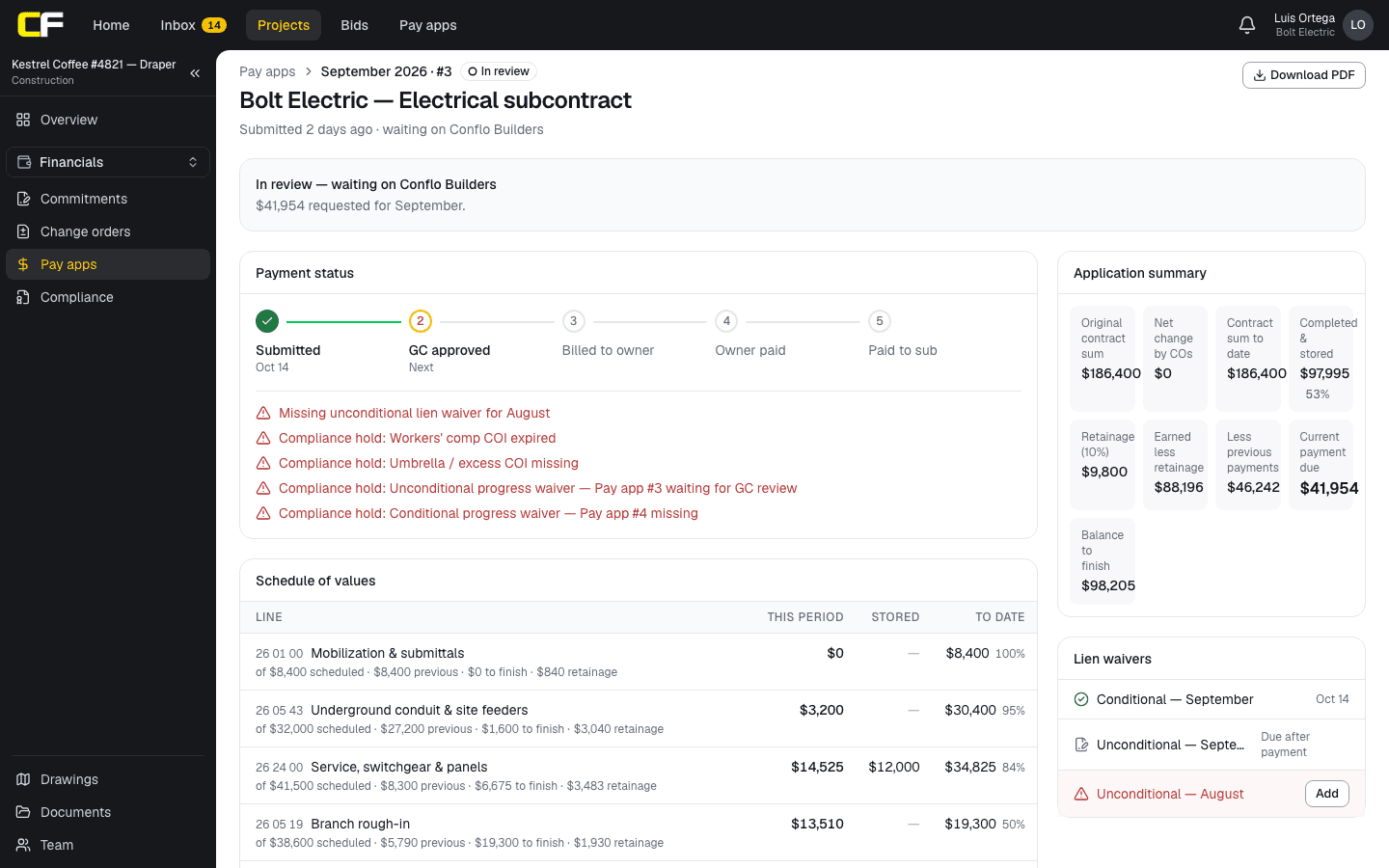
On Conflo's pay applications, the GC cannot release a sub's payment until two waivers are recorded: the conditional waiver for this period and the unconditional waiver for the sub's last payment, which can only be added once that payment is recorded. Compliance tracks all four types (conditional or unconditional, progress or final). Conflo does not generate your state's statutory form.
The bottom line
Conditional means "once I'm paid"; unconditional means "I have been paid." Never sign the second before the money clears.
Learn your state's forms, and read the related mechanic's lien deadlines so a waiver never gives up more than you were paid for.
Sources
- California Civil Code § 8132 — California Legislative Information. Read October 17, 2026.
- California Civil Code § 8134 — California Legislative Information. Read October 17, 2026.
- Texas Property Code Chapter 53, Subchapter L — Texas Legislature. Read October 16, 2026.
Questions
Which is safer to sign, a conditional or unconditional lien waiver?
A conditional waiver, because it releases rights only once the stated payment is received. An unconditional waiver releases them on signature, so sign it only after payment has cleared.
Can a GC require an unconditional waiver before paying?
Practice varies, but some states forbid it. Texas Property Code § 53.283 bars requiring an unconditional waiver unless the claimant has received that payment in good and sufficient funds. Check your state's law.
What is the difference between a progress and a final waiver?
A progress waiver covers work through a date and keeps exceptions such as retention and unpaid extras. A final waiver covers all work on the job, apart from disputed claims it lists.
Related
Money
How Do You Fill Out a Conditional Lien Waiver?
Fill out a conditional lien waiver field by field: the claimant, customer, through date, check details and exceptions, tied to the pay app's figures.
· 8 min read
Definition
What Is a Mechanic's Lien?
A mechanic's lien is a legal claim against a property by someone who improved it and was not paid. Who can file one, how it works, and what it is not.
· 3 min read
Money
Mechanic's Lien Deadlines: How They Work
How mechanic's lien deadlines are counted: the notices before, the filing deadline, the deadline to sue, and five states' filing deadlines from statute.
· 8 min read
Money
How Does a Subcontractor Fill Out a Pay Application?
A subcontractor's pay app bills percent complete and stored materials per schedule-of-values line, less retainage and prior payments, with a lien waiver.
· 9 min read
Role hub
The Subcontractor's Guide: Bidding to Getting Paid
Every step of a commercial job from the subcontractor's seat: bidding, the subcontract, submittals, RFIs, change orders, pay apps, retainage and closeout.
· 9 min read