
What Is a Look-Ahead Schedule?
By Wyatt Cooper · Published · 3 min read
Key takeaways
- A look-ahead is a short-range slice of the master schedule, commonly three weeks, rebuilt every week with the trades.
- It uses the master schedule's activity names and IDs, so the field plan and the contract schedule stay the same plan at two levels of detail.
- Its job is to clear the way: materials, submittals, inspections, crews and open RFIs are checked before the work's start date, not on it.
A look-ahead schedule is a short-range schedule, usually covering the next two to six weeks, that breaks the master schedule's activities into the day-by-day work each crew will do. The superintendent updates it weekly with the subcontractors, so materials, inspections, manpower and open questions are lined up before the work starts.
Where the look-ahead comes from
Owners write it into their specifications. The City of Los Angeles has the contractor produce, each week, a "Three-week Progress Schedule listing the activities completed and in progress for the previous week and the activities scheduled for the next two weeks" (so its look-ahead part is two weeks), with activity descriptions and IDs "consistent with the project's baseline construction schedule" (LA Bureau of Engineering, 18.1). The federal schedule specification reviews "the upcoming planned activities via a three week lookahead" at the weekly meeting with the government (UFGS 01 32 01.00 10, 3.7).
So a look-ahead is not a second schedule. It is the master schedule's next few weeks, broken into crew-sized pieces and checked for anything that would stop the work. It is usually reviewed at the OAC meeting and the subcontractor coordination meeting. The method, step by step, is in how to build a three-week look-ahead, and there is a free three-week look-ahead template.
Example
| Master activity | Look-ahead work | Crew | Week 1 | Week 2 | Week 3 | Needs before start |
|---|---|---|---|---|---|---|
| A2100 Level 2 framing | Interior walls, grids C–F | Framing sub, 8 | Mon–Fri | Mon–Wed | Track and studs on site | |
| A2140 Level 2 rough-in | Electrical rough-in | Electrician, 4 | Wed–Fri | Mon–Fri | Framing complete in grids C–F | |
| A2200 Level 2 inspection | Cover inspection | City inspector | Thu | Inspection requested 48 hrs ahead |
The last column is the point: each row names what must be true before the crew can start, so it gets checked a week or two early. When a row slips, the critical path tells you whether the finish date moves.
How it works in Conflo
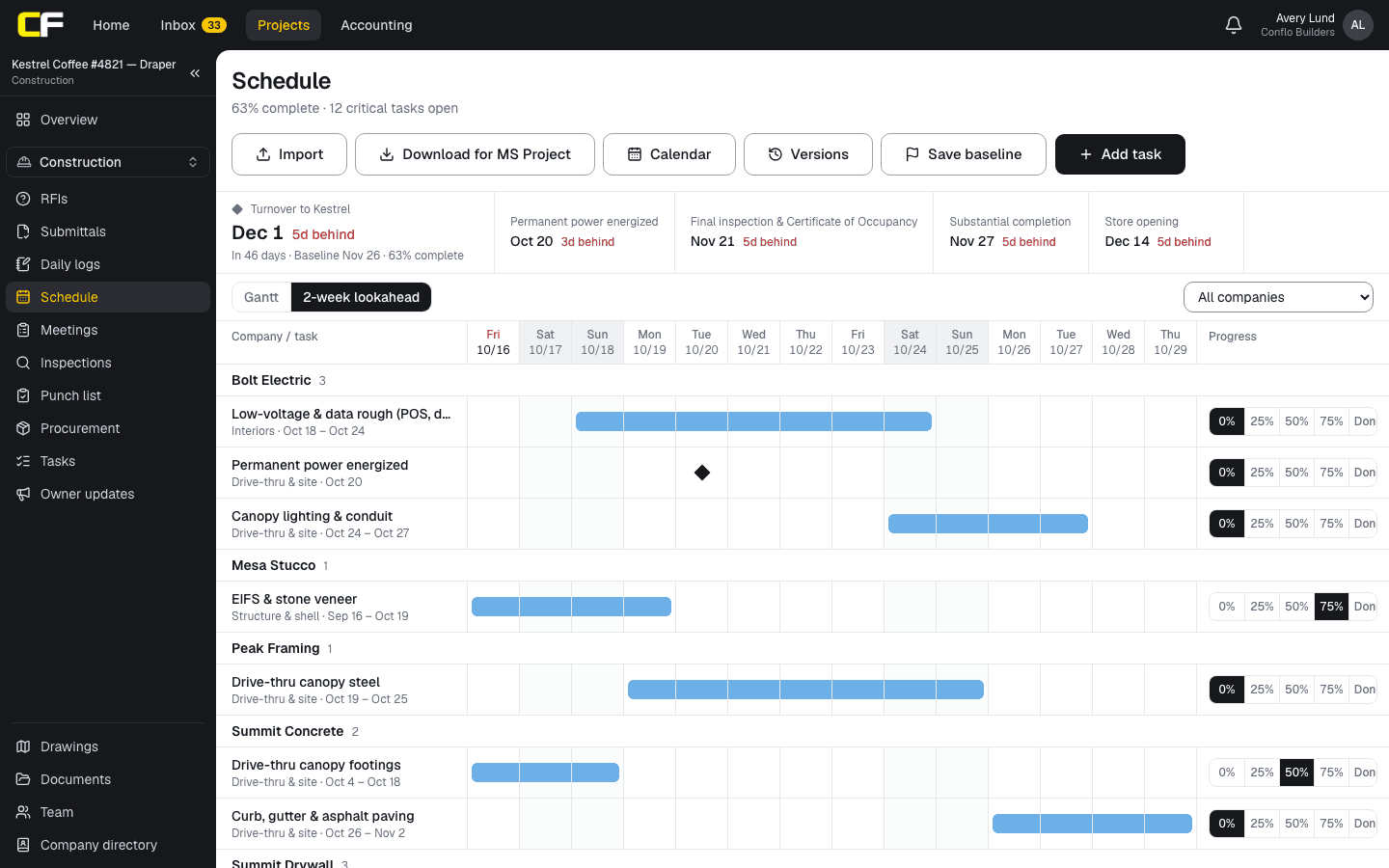
Conflo's schedule has a two-week lookahead: the next 14 days of work, grouped by the company responsible, with progress and critical tasks marked and a filter to one company.
The bottom line
A look-ahead is the next few weeks of the master schedule, written at crew level and rebuilt every week.
Keep the master schedule's activity IDs, and use it to clear materials, submittals and inspections before each start date.
Sources
- 18.1 Types of Schedules — City of Los Angeles, Bureau of Engineering, Project Delivery Manual. Read October 22, 2026.
- UFGS 01 32 01.00 10, Project Schedule (August 2026) — Whole Building Design Guide (USACE / NAVFAC / AFCEC). Read October 22, 2026.
Questions
How far ahead should a look-ahead schedule go?
Three weeks is a common span, and it is the name many owner specifications use. Some teams use two, four or six weeks.
Who makes the look-ahead schedule?
The general contractor's superintendent, with each subcontractor's foreman confirming its own crews and dates.
Is a look-ahead the same as the baseline schedule?
No. The baseline is the agreed plan for the whole job; the look-ahead details its next few weeks and changes every week.
Related
Construction
How Do You Build a Three-Week Look-Ahead Schedule?
How to build a three-week look-ahead from the master schedule: crew-sized pieces of work, what must be ready, and how to run it at the weekly meeting.
· 7 min read
Template
Free Three-Week Look-Ahead Schedule Template
A free three-week look-ahead schedule template in Excel: last week plus three weeks by day, crews, critical work and what must be ready. No email needed.
· 3 min read
Definition
What Is the Critical Path in Construction?
The critical path is the longest chain of linked activities in a construction schedule. A worked five-activity example, float, and what a delay does.
· 4 min read
Construction
How Does an Owner Read a Construction Schedule?
How an owner reads a contractor's schedule: the Gantt chart, milestones, the critical path, float, the baseline, and what to ask at each update.
· 6 min read
Role hub
The General Contractor's Guide: Bid to Closeout
What a general contractor is responsible for at every phase of a commercial job, from bidding and buyout to RFIs, change orders, pay apps and closeout.
· 8 min read