
What Is an RFI in Construction?
By Wyatt Cooper · Published · 3 min read
Key takeaways
- An RFI is a numbered, written question about the drawings, specifications or contract, answered in writing by the design team so the field knows how to build.
- An RFI clarifies what the documents mean; if the answer changes the work, its price or its time, a change order follows.
- Product approvals go through submittals, not RFIs, and a contractor's proposal to use a different product is a substitution request.
An RFI, or request for information, is a written question a contractor sends the design team when the drawings, specifications or contract are unclear, conflicting or missing something. Each RFI is numbered and logged, and the written answer tells the field how to build. An RFI clarifies the design; by itself it does not change the contract price or time.
What an RFI is for
The City of Los Angeles's project delivery manual defines it plainly: an RFI is the form "for the Contractor to request information and/or clarification related to the plans, specifications, or contract requirements" (LA Bureau of Engineering, 16.2). The same page says an RFI "should not be used as a substitute for items requiring a shop drawing submittal", should not be used to change the design, and that if a design change is needed, "a change order must be issued."
Federal construction contracts set the same duty: a discrepancy in the drawings or specifications "shall be promptly submitted to the Contracting Officer, who shall promptly make a determination in writing" (FAR 52.236-21(a)). Subcontractors send their questions through the general contractor, who numbers them and routes them to the architect or engineer. For the method, see how to write an RFI and how to respond to one.
Example
RFI-014: Grease interceptor size
- Question
- Sheet P-101 shows a 750-gallon grease interceptor; spec section 22 13 00 calls for 1,000 gallons. Which governs?
- Proposed answer
- Provide the 1,000-gallon unit shown in the specification.
- Sent to
- Architect, plumbing engineer
- Answer needed by
- 7 days from sending
- Cost or schedule impact
- Possible: the larger unit needs a deeper excavation
If the engineer answers "1,000 gallons governs" and the bid carried the 750-gallon unit, the answer settles what to build, and the price difference goes through a change order.
RFI, submittal or change order?
| Document | What it asks | What it changes |
|---|---|---|
| RFI | What do the documents mean here? | Nothing by itself; it clarifies |
| Submittal | Is this product or shop drawing acceptable? | Nothing; it shows how the contractor will comply |
| Change order | Agree to this change in work, price or time | The contract |
The longer comparison is in RFI vs submittal, and the architect's own clarification, issued without a question, is an ASI.
How it works in Conflo
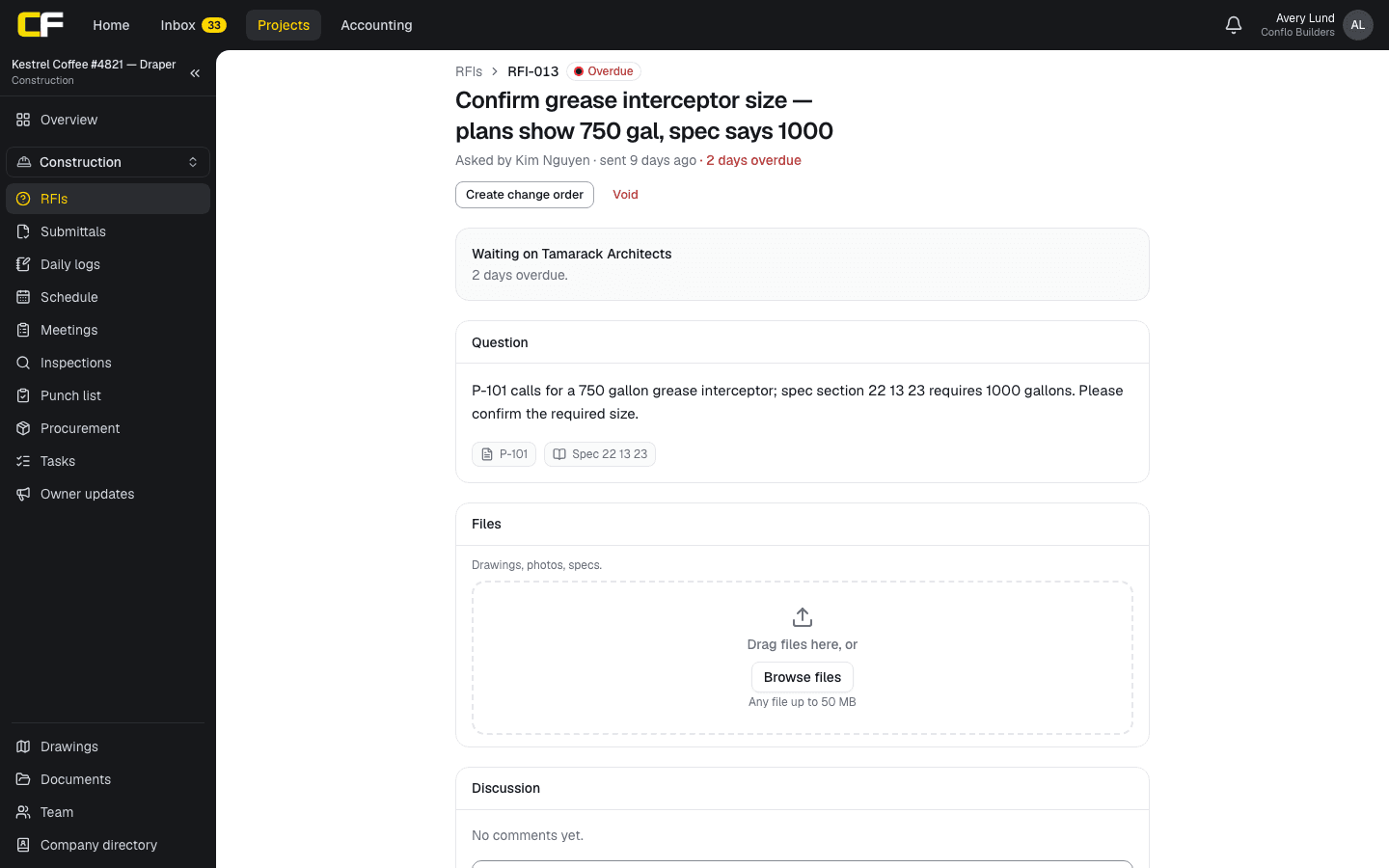
In Conflo's RFIs, each RFI gets its number automatically, names the sheet and spec section it is about, and goes to the reviewers you pick with a due date. The log shows who each one is waiting on and how many days it has been open, its manager marks the official answer when it closes, and the log exports as a PDF.
The bottom line
An RFI is a written question that gets a written answer, numbered so nobody loses it.
Keep it to one question, propose an answer, and let a change order carry any cost.
Sources
- 16.2 Request for Information — City of Los Angeles, Bureau of Engineering, Project Delivery Manual. Read October 22, 2026.
- FAR 52.236-21, Specifications and Drawings for Construction — Acquisition.gov, U.S. General Services Administration. Read October 22, 2026.
Questions
Who answers an RFI?
The architect or engineer responsible for the part of the design in question, sometimes with the owner. The general contractor sends it and returns the answer to the trades.
How long does an RFI response take?
The contract or the project's procedures set it. Many teams put a requested date on each RFI and track days open in the RFI log.
Is an RFI a change order?
No. An RFI asks what the documents mean. If the answer adds work, cost or time, the change is priced and approved in a change order.
Related
Construction
How to Write an RFI in Construction (With an Example)
How to write an RFI in construction: the parts of a good request for information, a filled-in example, common mistakes, and how the RFI log works.
· 9 min read
Definition
RFI vs Submittal: What Is the Difference?
An RFI asks the design team what the documents mean; a submittal shows how the contractor will meet them. The difference, side by side, with an example.
· 3 min read
Construction
How Should an Architect Respond to an RFI?
How the design team answers an RFI: check it against the documents, answer the question asked, cite the sheet and spec, and say if it changes the work.
· 8 min read
Template
Free RFI Template With a Filled-In Example
A free RFI template in Word, no email needed: every field a good request for information needs, a response section, and a filled-in example on page two.
· 4 min read
Role hub
The General Contractor's Guide: Bid to Closeout
What a general contractor is responsible for at every phase of a commercial job, from bidding and buyout to RFIs, change orders, pay apps and closeout.
· 8 min read