
How Drywall and Framing Subs Bid Commercial Work
By Wyatt Cooper · Published · 6 min read
Key takeaways
- Most money lost on a commercial drywall bid sits at the trade lines: blocking and backing, firestopping at rated walls, and the finish level the spec calls for.
- Read Division 09 for the finish levels by area: a federal spec defaults to Level 5 unless it says otherwise, which costs far more than Level 4.
- Firestopping is often its own spec section with installer qualifications and inspection before concealment; include it, exclude it, or price it as an alternate, but say which.
- List each trade-line item in the bid, included or excluded, so the GC can level it and nothing falls between you and the next trade.
A drywall and framing sub bids commercial work from the partition types, the reflected ceiling plans and Division 09: framing, board, finishing and accessories, priced by wall type and area. The money is won or lost at the trade lines, so state plainly who furnishes blocking and backing, who firestops rated walls and penetrations, and which finish level each area gets, and price each gap you take on.
Read the specs for the expensive lines
Finish level is the first thing to find. The federal unified guide specification for gypsum board (UFGS 09 29 00) has board taped and finished to GA 214, the Gypsum Association's levels of finish: Level 1 in plenums above ceilings, Level 2 for board under ceramic tile, Level 3 under heavy wall covering, Level 4 for flat paint and light textures without critical lighting, and "unless otherwise specified", Level 5, with a skim coat over the whole surface. A bid priced at Level 4 everywhere on a spec that defaults to Level 5 is short.
The same spec has you verify before hanging board that "all blocking, headers and supports are in place" for fixtures, grab bars and similar items, and the framing section (UFGS 09 22 00) lists backing plates of fire-retardant-treated wood blocking for fixture attachment. Who furnishes and installs that blocking is the most common gap on a tenant job.
Firestopping is usually a separate section. The federal one (UFGS 07 84 00) requires an installer approved under FM 4991, a UL certified firestop contractor, or one qualified by the manufacturer with at least three years' experience, and says firestop "must be inspected and approved prior to final completion and enclosing" of assemblies that would hide it. If you don't hold those qualifications, exclude it in writing.
Where the scope gaps are
| Item | Often carried by | The gap | What to write |
|---|---|---|---|
| In-wall blocking for casework, TVs, grab bars, toilet accessories | Drywall/framing, or the casework or accessory installer | Each assumes the other | "Blocking included at locations shown on the interior elevations" or excluded |
| Head-of-wall joints at rated walls | Drywall, or the firestop sub | The joint between wall and deck | Included, with the listed system, or excluded |
| Firestopping at MEP penetrations | Each MEP trade, or one firestop sub | Nobody seals the hole | Excluded, unless you are the firestop contractor |
| Finish level by area | Drywall | Level 4 priced where Level 5 is specified | The level for each area, by spec paragraph |
| Access panels | Drywall installs; MEP trades furnish | Who buys them | Install only, furnished by others |
| Ceiling grid and tile | Acoustical ceiling sub, sometimes the drywall sub | Missing from both bids | Included or excluded |
| Patching after MEP trades | Drywall, at a cost | Free repairs after other trades cut in | Patching after others billed as extra work |
A worked example: pricing the gaps
A made-up sub, Northfork Interiors, is bidding a three-floor medical office fit-out. Its base takeoff covers framing, board and Level 4 finish. Reading the documents, its estimator finds three items the base doesn't carry, and prices them as separate lines so the GC can see them.
Northfork Interiors — added lines on the fit-out bid
- Blocking at casework, monitors and grab bars
- 140 locations × $38 = $5,320
- Head-of-wall firestop joint at 1-hour corridor walls
- 620 linear feet × $9.50 = $5,890
- Level 5 finish at corridor walls (spec paragraph on uniform surface)
- 3,200 square feet × $0.85 more than Level 4 = $2,720
- Added to the base bid
- $5,320 + $5,890 + $2,720 = $13,930
- Excluded in writing
- Firestopping at MEP penetrations; ceiling grid and tile; furnishing access panels
Showing the $13,930 as lines rather than burying it does two things. The GC can level Northfork against a bidder that left those items out, instead of seeing Northfork as $13,930 high. And if the GC gives the blocking to the casework installer, it can take that line out without reopening the whole bid. That's how GCs level sub bids.
Billing a framing and drywall job
Split the schedule of values by floor or area and by operation, so each month matches what the GC can walk: framing, board (hang), finishing, and accessories, per floor. Stored materials, such as board delivered to the floor, can be billed where the contract allows it; the AIA's A201–2017 §9.3.2 allows materials suitably stored on site, and off site only with the owner's advance approval. The arithmetic is in how a sub fills out a pay app and how retainage is calculated.
Repair work after other trades cut in is a change, not part of the base, unless your subcontract says otherwise. Track each one with a photo and price it as a change order shows.
How it works in Conflo
A trade bid in Conflo lists the GC's scope items, and you mark each one included or excluded, with an optional amount to break it out, alongside your base bid, alternates, exclusions and qualifications. When the GC's scope items name the trade-line items (blocking, head-of-wall joints, finish level), your answer to each is on the bid, and an item you leave out shows as missing on the GC's leveling sheet.
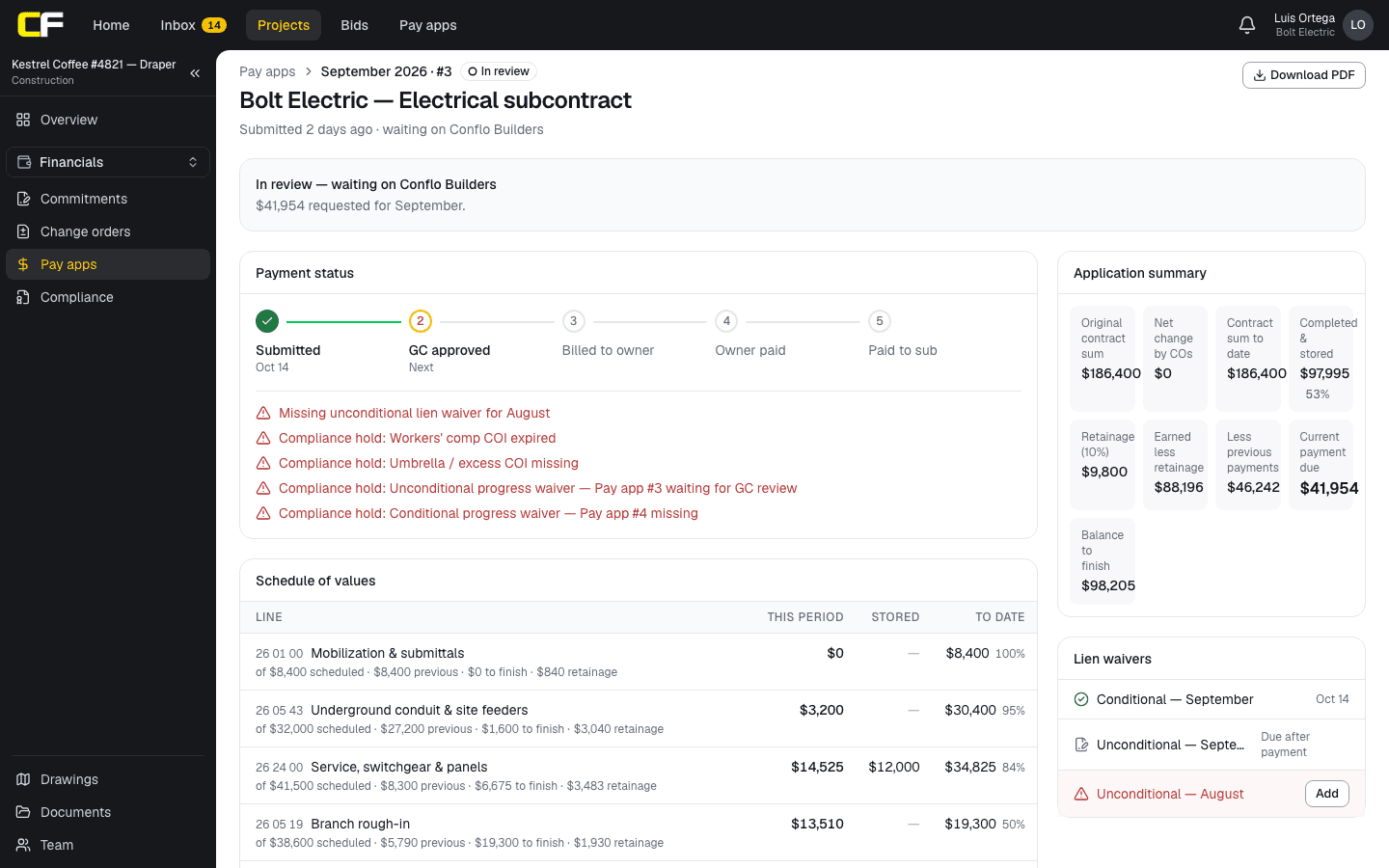
Under contract, you bill in pay apps against your schedule of values: percent complete this period and materials stored for each line, with retainage and previous billing worked out. The GC approves it or sends back only the lines that are wrong, each with a note.
The bottom line
Bid drywall and framing from the partition types and Division 09, then go hunting at the trade lines: blocking, firestopping and finish levels. Price each gap you take on as its own line and exclude the rest in writing.
Subcontractors invited by a GC use Conflo free. Join the waitlist to bid and bill your next job in it.
Sources
- UFGS 09 29 00, Gypsum Board (August 2024, change 1) — Whole Building Design Guide (USACE, NAVFAC, AFCEC). Read October 16, 2026.
- UFGS 09 22 00, Supports for Plaster and Gypsum Board — Whole Building Design Guide (USACE, NAVFAC, AFCEC). Read October 16, 2026.
- UFGS 07 84 00, Firestopping (May 2010, change 1) — Whole Building Design Guide (USACE, NAVFAC, AFCEC). Read October 16, 2026.
- Summary: A201–2017, General Conditions of the Contract for Construction — AIA Contract Documents. Read October 17, 2026.
Questions
What are the levels of drywall finish?
The Gypsum Association's GA 214 sets numbered levels of finish; specs commonly call for Level 1 in plenums up to Level 5, a skim coat over the whole surface. Level 4 is common for flat paint; Level 5 is used under gloss or semigloss paint and harsh lighting. The spec says which level goes where.
Who is responsible for in-wall blocking?
Whoever the contract documents and the GC's scope sheet say. It is often the framing sub, sometimes the installer of the item being hung. If it isn't clear, ask a question during bidding and state your assumption in the bid.
Should a drywall sub include firestopping?
Only if it holds the qualifications the spec requires and has priced the listed systems. Head-of-wall joints at rated walls are often with drywall; penetration firestopping is often with the MEP trades or a firestop specialist. Say which you carry.
How do you bill drywall work on a pay app?
Against a schedule of values split by floor or area and by operation (framing, hanging, finishing), billing the percent complete on each line each month, plus stored materials where the contract allows them, less retainage.
Related
Bidding
How Do You Level Subcontractor Bids?
Level subcontractor bids by pricing every scope gap, exclusion and missing addendum so each bid covers the same work, then compare the leveled totals.
· 9 min read
Money
How Does a Subcontractor Fill Out a Pay Application?
A subcontractor's pay app bills percent complete and stored materials per schedule-of-values line, less retainage and prior payments, with a lien waiver.
· 9 min read
Money
How Do You Price a Change Order?
Price a change order from direct cost (burdened labor, materials, equipment, sub quotes), then the markups and time your contract allows. Worked example.
· 9 min read
Bidding
How Painting Subs Bid and Bill Commercial Work
How commercial painting subs take off by surface and coating system, price from production rates, clarify damage by others and bill prime and finish coats.
· 12 min read
Bidding
How Insulation Subs Bid and Bill Commercial Work
How insulation subs bid commercial work: the thermal, firestopping and mechanical insulation splits, takeoff units, submittals and an SOV by floor.
· 10 min read
Role hub
The Subcontractor's Guide: Bidding to Getting Paid
Every step of a commercial job from the subcontractor's seat: bidding, the subcontract, submittals, RFIs, change orders, pay apps, retainage and closeout.
· 9 min read