
What Is Retainage in Construction?
By Wyatt Cooper · Published · 3 min read
Key takeaways
- Retainage (or retention) is earned money held back from each progress payment, commonly 5% or 10%, and paid once the work is complete and the contract's conditions are met.
- The contract sets the rate, and on many jobs a statute caps it: Texas public works, for example, allow at most 10% under $5 million and 5% at $5 million or more.
Retainage, also called retention, is a percentage of each progress payment that the owner holds back from the general contractor, and the GC from its subcontractors, until the work is complete. It is earned money paid later, as security that the job is finished. The contract sets the rate, often 5% or 10%, within any limit set by law.
How retainage works
Retainage is calculated on the value of work completed and materials stored to date, so the amount held grows with the job. Many contracts reduce it partway (often at 50% complete) and release the balance at substantial or final completion, once punch-list work, closeout documents and lien waivers are in.
The law often limits it. Federal contracting officers should not withhold retainage without cause, and it may not exceed "10 percent of the approved estimated amount" (FAR 32.103); under the payments clause, they retain only when satisfactory progress has not been made (FAR 52.232-5(e)). Texas public works cap it at 10% on contracts under $5 million and 5% at $5 million or more, and forbid a prime from holding a higher percentage from a sub than is held from the prime (Texas Government Code § 2252.032). Check your contract and your state's law.
Example
Retainage on a pay application
- Completed and stored to date
- $100,000.00
- Retainage (10%)
- $10,000.00
- Earned less retainage
- $90,000.00
- Less previous payments
- $54,000.00
- Current payment due
- $36,000.00
The arithmetic: 10% of $100,000.00 is $10,000.00; $100,000.00 − $10,000.00 = $90,000.00; less $54,000.00 already paid leaves $36,000.00. Try your own figures in the retainage calculator, or see a full three-month example in how to calculate retainage.
Retainage vs. withholding and backcharges
Retainage is a fixed percentage of earned money, held on every payment by agreement and paid later. A withholding holds back a specific amount for a specific reason, such as defective work or a missing lien waiver. A backcharge deducts a cost the payer incurred on the contractor's behalf, and is not paid back. For getting held retainage paid, see how a subcontractor gets retainage released.
How it works in Conflo
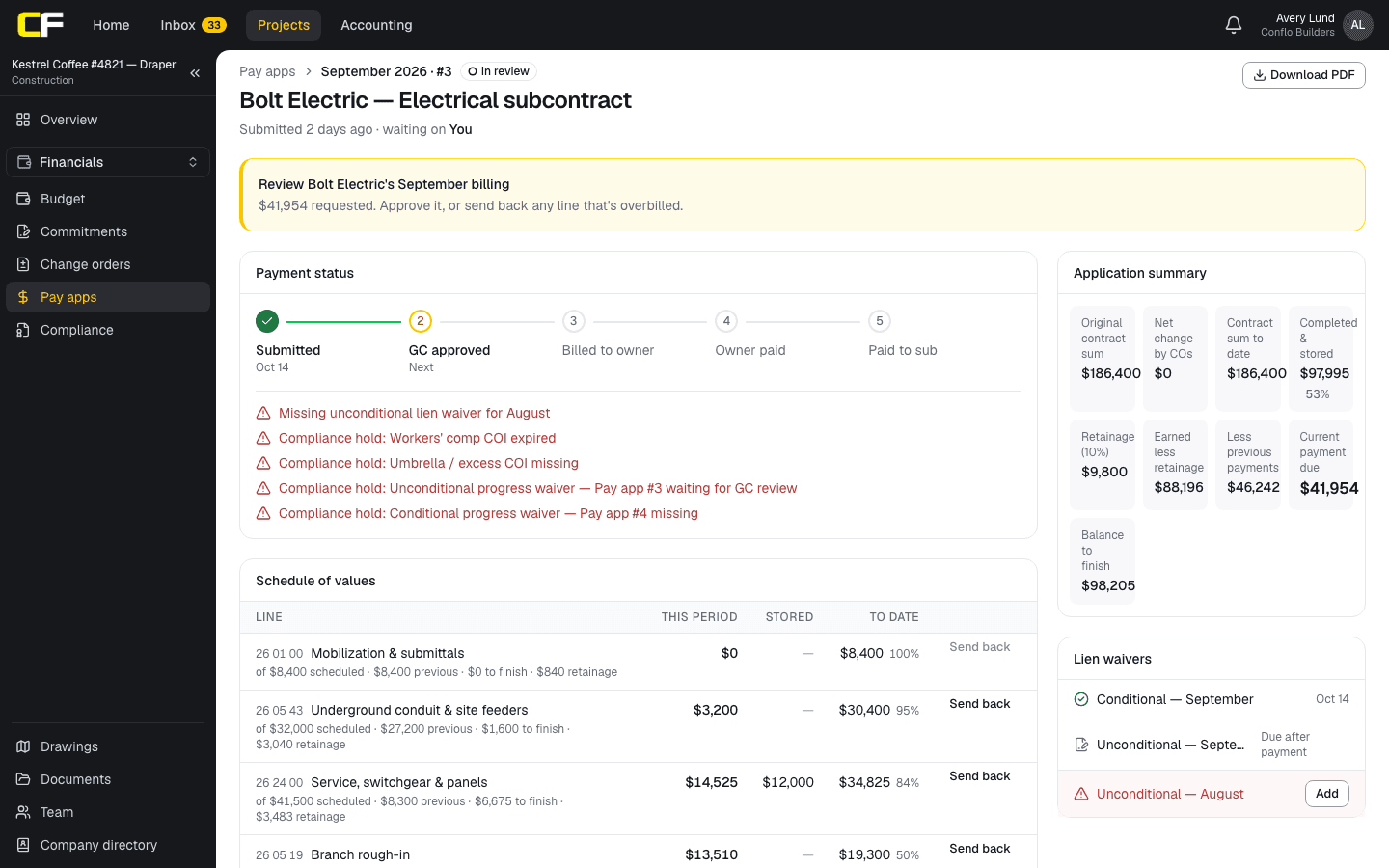
On Conflo's pay apps, each contract carries one retainage percentage, calculated on work completed and stored to date and shown on the summary and on each line. A retainage reduction and a release step are not built yet.
The bottom line
Retainage is money earned and held: a percentage of every progress payment, paid when the work is done.
Know your rate, your reduction rule and your release conditions before the first pay application.
Sources
- FAR 32.103, Progress payments under construction contracts — Acquisition.gov, U.S. General Services Administration. Read October 16, 2026.
- FAR 52.232-5, Payments under Fixed-Price Construction Contracts — Acquisition.gov, U.S. General Services Administration. Read October 17, 2026.
- Texas Government Code § 2252.032, Retainage — Texas Legislature. Read October 16, 2026.
Questions
Is retainage the same as retention?
Yes. Retainage and retention are two names for the same thing: a percentage of each progress payment held until the work is complete.
What is a typical retainage percentage?
Ten percent and five percent are common, but the contract sets it, and many statutes cap it. Federal construction holds it only with cause, up to 10%.
When is retainage paid?
When the contract's release conditions are met, usually at substantial or final completion with punch-list work, closeout documents and lien waivers done. Some statutes set a deadline.
Related
Money
How Do You Calculate Retainage on a Pay App?
Retainage is a percentage of work completed and stored to date, held back each pay period. How to calculate it, reduce it, release it, with an example.
· 9 min read
Money
How Does a Subcontractor Get Retainage Released?
Finish your scope, close your punch items, send closeout documents and a written release request with the waiver asked for, and know your state's deadline.
· 6 min read
Template
Retainage Calculator for Pay Applications
Free retainage calculator: enter work to date and the rate to get retainage held, previous payments and the amount due, including a rate reduction.
· 3 min read
Role hub
The General Contractor's Guide: Bid to Closeout
What a general contractor is responsible for at every phase of a commercial job, from bidding and buyout to RFIs, change orders, pay apps and closeout.
· 8 min read