
What Is a Scope of Work in Construction?
By Wyatt Cooper · Published · 3 min read
Key takeaways
- A scope of work says which work is one contractor's: its inclusions, its exclusions and the documents it is based on.
- The specifications say how the work must be done; the scope says who does which part of it.
- The same scope should appear in the invitation to bid, the leveling sheet and the subcontract, so the price and the contract cover the same work.
A scope of work is the written description of the work one party agrees to perform under a contract: what is included, what is excluded, and the drawings, specifications and addenda it rests on. In construction, each subcontractor's scope says which items of the job are theirs, so bids price, and subcontracts bind, the same work.
An example scope
Scope of work: Division 09, drywall
- Based on
- Drawings A1.1–A8.1, spec 09 21 16 and 09 22 16, Addendum 1
- Includes 1
- All metal stud partitions and soffits shown, to deck where noted
- Includes 2
- Gypsum board, tape and finish to Level 4; Level 5 at lobby walls
- Includes 3
- In-wall blocking for items on the blocking plan
- Includes 4
- Firestopping at drywall penetrations in rated walls
- Excludes
- Painting; doors and frames (install by others); access panels (furnished by MEP trades)
A good scope names the boundary items, like blocking and firestopping, that two trades could each think belong to the other. The method, trade by trade, is in how to write a scope of work for a subcontractor.
Scope of work vs. specifications and drawings
The drawings and specifications describe the whole building. Read together, they govern: in the federal clause, anything "mentioned in the specifications and not shown on the drawings, or shown on the drawings and not mentioned in the specifications, shall be of like effect as if shown or mentioned in both" (FAR 52.236-21). A scope of work does not add to them; it divides them, saying which part is this contractor's. Federal rules ask the same of the whole invitation: describe the requirements "clearly, accurately, and completely" (FAR 14.101).
In a subcontract, the scope is usually an exhibit to the agreement, such as AIA A401, the contractor–subcontractor agreement (AIA). For what wraps around it, see what a subcontract is.
How it works in Conflo
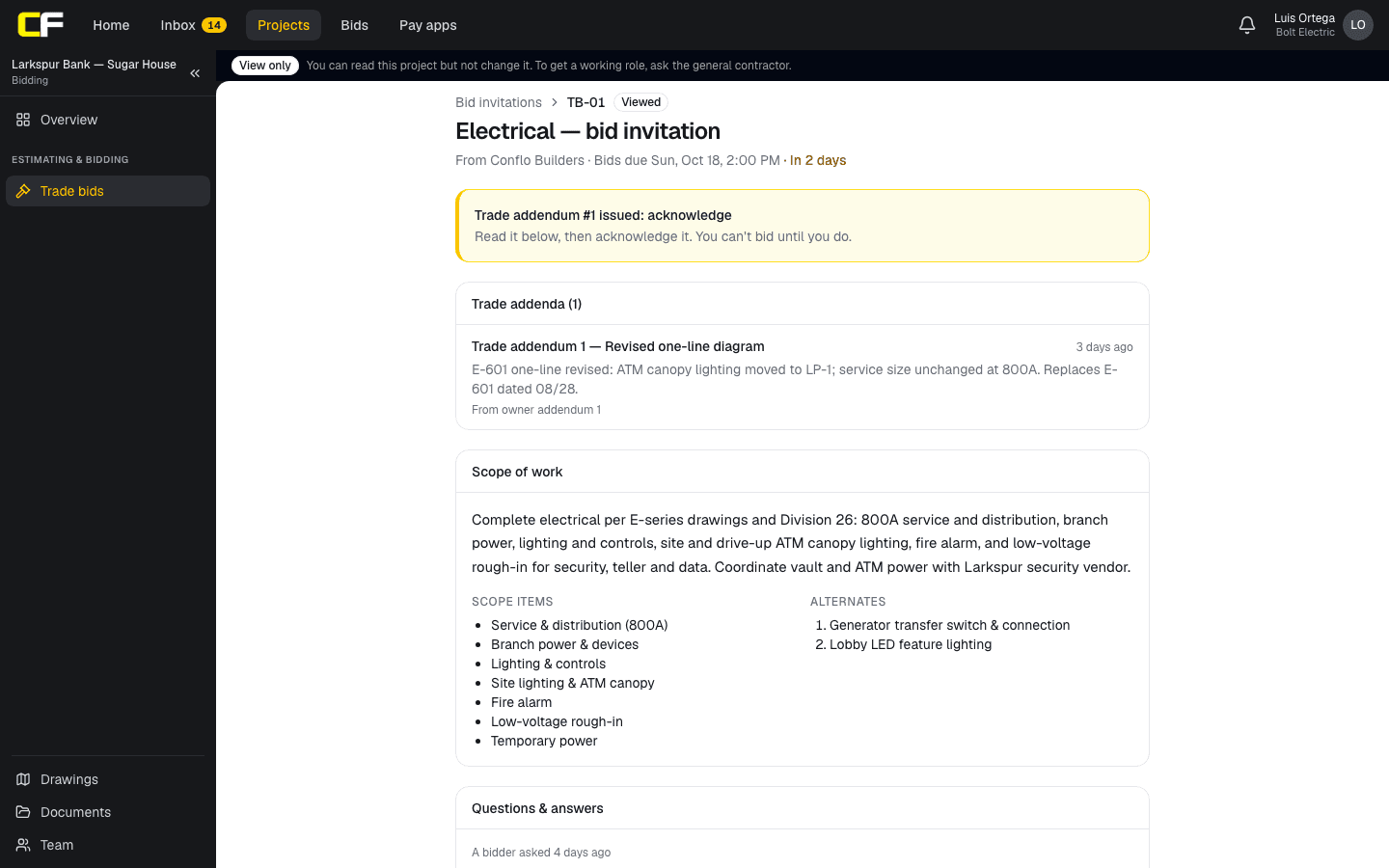
In Conflo's trade bids, each package has a written scope and a list of scope items. Bidders mark each item included or excluded, with an optional breakout price, so gaps show before you level.
The bottom line
A scope of work is the line around one contractor's part of the job: what is in, what is out, and which documents say so.
Write it once, number its items, and carry it unchanged from the invitation to the subcontract.
Sources
- FAR 14.101, Elements of sealed bidding — Acquisition.gov, U.S. General Services Administration. Read October 22, 2026.
- FAR 52.236-21, Specifications and Drawings for Construction — Acquisition.gov, U.S. General Services Administration. Read October 22, 2026.
- List of document synopses by family (A401) — AIA Contract Documents. Read October 22, 2026.
Questions
Is a scope of work the same as a statement of work?
Close. Statement of work (SOW) is the term in government and service contracts; scope of work is what construction usually says for a trade's share of the job. Both define the work the contract covers.
What happens if work is in nobody's scope?
It becomes a gap the GC pays for, often found after award. Name the boundary items in one scope each, and check that every specification section lands in a package.
Related
Bidding
How to Write a Scope of Work for a Subcontractor
Write a subcontractor scope of work from the drawings and specs: a summary, numbered inclusions, named exclusions, alternates and the documents behind it.
· 7 min read
Definition
What Is a Bid Package in Construction?
A bid package is the scope and documents sent out for one price, usually one trade's work. What goes in it, an example, and bid package vs. bid set.
· 3 min read
Definition
What Is a Subcontract?
A subcontract is the GC's contract with a sub for part of the prime contract's work. What it holds, and how it differs from a purchase order.
· 3 min read
Role hub
The General Contractor's Guide: Bid to Closeout
What a general contractor is responsible for at every phase of a commercial job, from bidding and buyout to RFIs, change orders, pay apps and closeout.
· 8 min read