
What Paperwork Does a GC Require From a Sub?
By Wyatt Cooper · Published · 6 min read
Key takeaways
- Expect to send a W-9, a certificate of insurance with its endorsements, your contractor license, and the signed subcontract before you mobilize.
- A certificate of insurance is information only: the GC also wants the additional-insured and waiver-of-subrogation endorsements the subcontract names.
- Without a correct taxpayer identification number on a W-9, a payer may have to withhold 24% of reportable payments: $2,400 on a $10,000 payment.
- Lien waivers are the recurring paperwork: a conditional waiver with each pay app and an unconditional one once the money arrives; in states with statutory waiver forms, use the exact form.
Before a subcontractor starts work, a general contractor usually requires a signed subcontract, a Form W-9, a certificate of insurance showing the coverages and limits the subcontract sets, with the additional-insured and waiver-of-subrogation endorsements, a contractor license where the state requires one, and often a written safety program. Some jobs add bonds or prevailing-wage payroll. Each month the GC also asks for lien waivers with the pay app. Check your subcontract for the exact list.
Why the GC asks for all of it
The GC is passing down its own obligations. The owner's contract makes the GC carry insurance, pay its subs, keep the site safe and deliver a lien-free job; the GC's only way to meet those is to require the same things from each subcontractor. That is why the requests arrive in a bundle at award, and why a missing document can hold a payment months later.
The documents, one by one
| Document | Who issues it | When | What the GC checks |
|---|---|---|---|
| Signed subcontract | GC drafts, sub signs | Before work | Scope, schedule, schedule of values, insurance and payment terms |
| Form W-9 | The sub | Before the first payment | Legal name, tax classification and taxpayer identification number |
| Certificate of insurance | The sub's insurance agent or broker | Before work, and at each renewal | Coverages, limits, policy dates and the certificate holder |
| Endorsements | The insurer, through the agent | With the certificate | Additional insured, waiver of subrogation, primary and non-contributory, as the subcontract asks |
| Contractor license | The state or local licensing board | Before work | License number, classification for the trade, expiry |
| Safety program | The sub | Before work | A written program, and often training records |
| Bonds | The sub's surety | Before work, if required | Performance and payment bond amounts and surety |
| Lien waivers | The sub | With every pay app and after each payment | The right form, amount and through-date |
The W-9 and backup withholding
Form W-9 gives the payer your correct taxpayer identification number so it can file information returns (IRS). The GC keeps it and does not send it to the IRS; it uses the TIN for returns such as Form 1099-NEC. If you do not provide a TIN, or provide an incorrect one, the payer may have to start backup withholding, and the IRS sets that rate at 24% of reportable payments (Instructions for the Requester of Form W-9).
Worked out: on a $10,000 reportable payment, 24% is $2,400 withheld, and you receive $7,600. Send the W-9 with your signed subcontract and it never comes up. If your company is a single-member LLC treated as a disregarded entity, the instructions put the owner's name on line 1 and the LLC's name on line 2.
The certificate of insurance is not the coverage
Most GCs want the certificate on the ACORD 25, the Certificate of Liability Insurance. ACORD itself is clear that a certificate "is NOT an insurance policy, and does not serve to provide, endorse, amend, extend, or alter in any way the terms of an insurance policy"; only an endorsement changes coverage, and naming a contract on the certificate "does not provide coverage" (ACORD certificates FAQ). That is why GCs ask for the endorsements themselves.
- Ask your agent for the certificate and the endorsements together, with the GC (and the owner, if the subcontract says so) as additional insured.
- Match the limits to the subcontract's insurance exhibit before you send it; a certificate below the required limit gets rejected.
- Calendar every policy's expiry date. An expired policy usually puts your payments on hold until the renewal certificate is in.
License, safety program and the rest
Licensing is state law, and in some places local: whether your trade needs a license, and for what size of job, varies. Check the board in the state the project is in. For safety, many GCs ask for a written program. OSHA's Recommended Practices for Safety and Health Programs, with a construction version, are guidance rather than a rule, built on seven core elements from management leadership to communication among host employers and contractors (OSHA); they are a reasonable outline if you need to write one. On prevailing-wage or public jobs, expect certified payroll as well.
A filled-in checklist
Ridgeline Plumbing, Harbor Point Offices, before mobilization
- Subcontract
- Signed and returned
- Form W-9
- Sent with the subcontract
- General liability certificate
- Received; limits match the insurance exhibit
- Additional insured endorsement
- Requested from the agent, due Friday
- Workers' comp certificate
- Received; expires in 5 weeks, renewal calendared
- Auto and umbrella certificates
- Received
- Contractor license
- Plumbing classification, number and expiry sent
- Safety program
- Written program sent
- Payment and performance bond
- Not required on this subcontract
The one open item, the endorsement, is the one most likely to hold the first payment. Chase it before the first pay app, not after. For what each month's billing needs, see how to fill out a pay application as a subcontractor; for the GC's side of the same step, how to buy out a construction job.
How it works in Conflo
When a GC runs Compliance in Conflo, a sub sees only its own company's requirements: general liability, auto, workers' comp and umbrella certificates, W-9s, contractor licenses and lien waivers. Each request arrives with a due date and a note; you turn in the document with its expiry date and the carrier, policy or license number, and the GC approves it or rejects it with a note on what to fix. A missing, expired, rejected or unreviewed document that the GC marks as required for payment puts your company on payment hold, and your pay apps show what is holding payment.
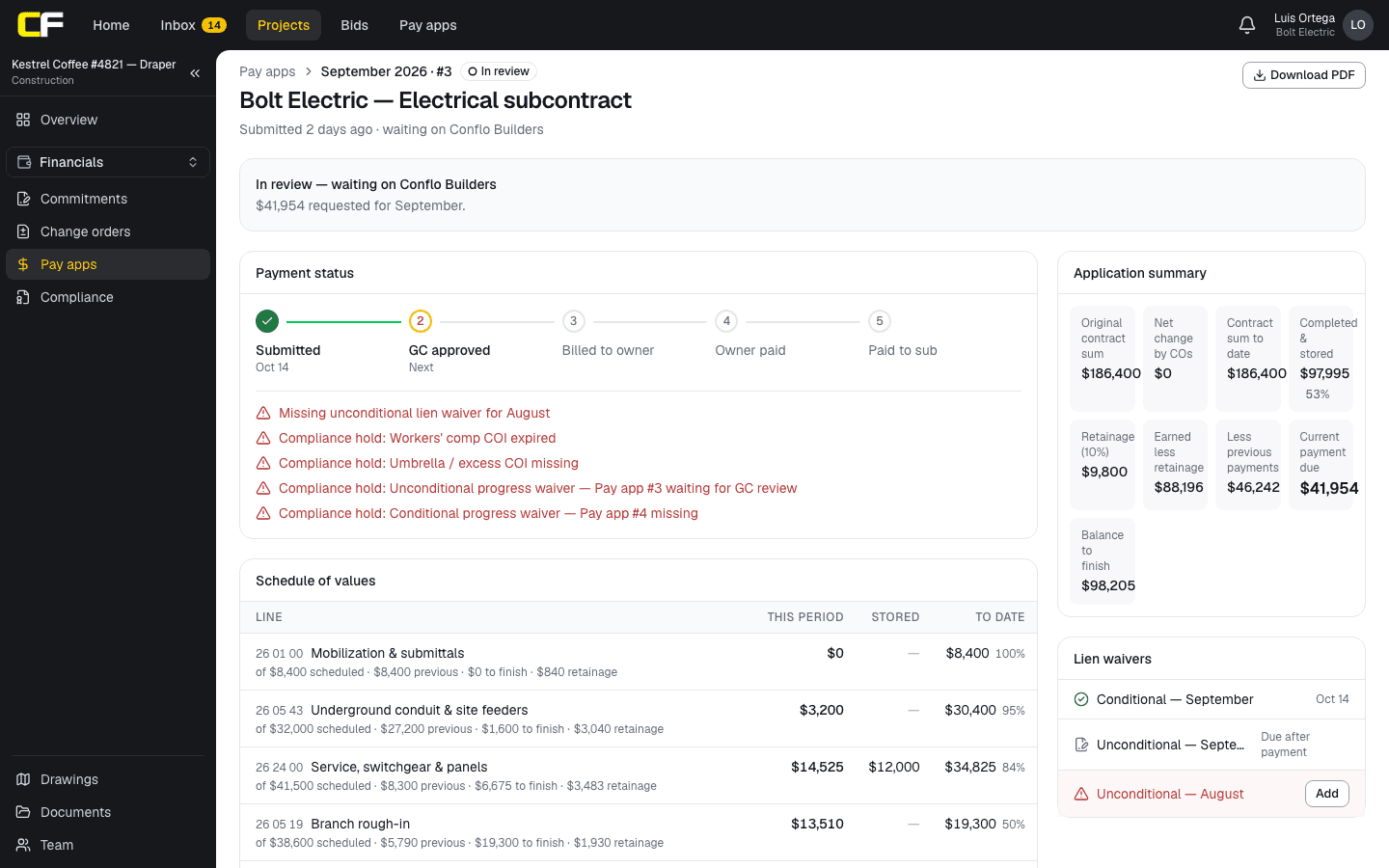
Not tracked in Conflo today: endorsements as their own documents, safety programs and bonds.
The bottom line
The paperwork list is long but predictable: subcontract, W-9, certificate with endorsements, license, safety program, and waivers every month. Send it as a set at award and keep the expiry dates on a calendar.
Most payment holds from compliance are an expired certificate or a missing endorsement. Both are fixed with one call to your agent before the pay app goes in.
Sources
- About Form W-9, Request for Taxpayer Identification Number and Certification — Internal Revenue Service. Read October 16, 2026.
- Instructions for the Requester of Form W-9 (Rev. March 2024) — Internal Revenue Service. Read October 16, 2026.
- Certificates of Insurance: Frequently Asked Questions — ACORD. Read October 16, 2026.
- Recommended Practices for Safety and Health Programs — Occupational Safety and Health Administration. Read October 16, 2026.
Questions
What documents does a subcontractor need before starting work?
Usually a signed subcontract, a Form W-9, a certificate of insurance with the required endorsements, a contractor license where required, and often a written safety program. Some jobs also require bonds. The subcontract lists what that GC needs.
Does the GC send my W-9 to the IRS?
No. The requester keeps the W-9 and uses your taxpayer identification number to file information returns such as Form 1099-NEC.
Is a certificate of insurance enough to be an additional insured?
No. ACORD says a certificate does not change a policy; only an endorsement does. GCs ask for the additional-insured endorsement itself.
Why is my payment on hold for compliance?
Usually because a required document expired, was rejected or was never sent: most often an insurance certificate past its expiry date. Send the renewal and ask the GC to release the hold.
What is the backup withholding rate?
The IRS's instructions for Form W-9 set it at 24% of reportable payments, when a payee fails to give a correct taxpayer identification number or certify as required.
Related
Preconstruction
How Do You Buy Out a Construction Job?
Construction buyout step by step: scope review, leveling, award, the subcontract and its exhibits, compliance documents, and savings against budget.
· 7 min read
Money
How Do You Calculate Retainage on a Pay App?
Retainage is a percentage of work completed and stored to date, held back each pay period. How to calculate it, reduce it, release it, with an example.
· 9 min read
Preconstruction
How Much Insurance Does a Subcontractor Need?
The coverages a subcontract asks for, how a GC sets the limits, and how to check your policies against the insurance exhibit before you sign.
· 7 min read
Preconstruction
How Do You Track Subcontractor COIs and Expirations?
A GC's method for tracking subcontractor certificates of insurance: one log per job, what to record, a 30-day renewal window, and when to hold payment.
· 6 min read
Preconstruction
How Do You Read a Certificate of Insurance (ACORD 25)?
How to read an ACORD 25 certificate of liability insurance box by box, and what a GC checks in each one against the subcontract's insurance exhibit.
· 7 min read
Role hub
The Subcontractor's Guide: Bidding to Getting Paid
Every step of a commercial job from the subcontractor's seat: bidding, the subcontract, submittals, RFIs, change orders, pay apps, retainage and closeout.
· 9 min read