
How Roofing Subs Bid and Bill Commercial Work
By Wyatt Cooper · Published · 6 min read
Key takeaways
- A commercial roofing bid hinges on the warranty the spec requires: the manufacturer's term and coverage decide which systems and which applicators can bid at all.
- Confirm you are an approved applicator at the level that warranty needs before you price, and budget the manufacturer's inspections and warranty fee.
- Build the schedule of values by operation (tear-off, insulation, membrane, flashings and sheet metal) and bill stored membrane and insulation only where the contract allows it.
- Final payment usually waits on the closeout paperwork, and for a roofer that means the manufacturer's warranty in the owner's name.
A commercial roofing sub bids from the roof plan, the details and the Division 07 roofing section, and the spec's warranty requirement comes first: it sets the system, the manufacturer and whether you qualify as its approved applicator. Price the manufacturer's inspections and warranty, fall protection and flashings, then bill by operation monthly and plan closeout around delivering the manufacturer's warranty in the owner's name.
Start with the warranty the spec requires
Commercial roof specs usually require two warranties. In the federal unified guide specification for modified bitumen roofing (UFGS 07 52 00), the membrane manufacturer furnishes a 20-year, no-dollar-limit warranty covering materials and installation workmanship, written to the owner and starting at the owner's acceptance of the roof, and the contractor separately warrants the installation watertight for two or five years. Its guidance notes allow a 5- or 10-year manufacturer warranty on small roofs of minor importance or a one-ply system; your project's spec may set different terms.
That requirement decides who can bid. The same spec asks for proof that the applicator is approved by the manufacturer "at a level capable of providing the specified warranty", with a set number of years as an approved applicator, and five projects of similar size and scope using that manufacturer's products from the last three years. If you can't get the warranty, you can't do the job, however good your price.
| Item | What the spec may require | Price it as |
|---|---|---|
| Manufacturer's warranty | Term (often 20 years), no-dollar-limit, materials and workmanship | The manufacturer's warranty fee, per square or per job |
| Contractor's warranty | Two or five years, watertight, workmanship | Callback allowance in your overhead |
| Manufacturer's inspections | A set number of site visits by its technical representative | Their fee, plus your time on the roof with them |
| Preroofing conference | Held after submittals are approved, before roofing starts | Your foreman's and PM's time |
| Fall protection | OSHA's rules for low-slope and steep roofs | Warning lines, guardrails or fall arrest, by roof |
| Closeout documents | Warranty certificates, inspection reports, as-builts | Office time at the end of the job |
Inspections, the preroofing conference and safety
Plan the manufacturer's site visits into the schedule. The federal spec's guidance sets a minimum of three visits during installation, and suggests more on large roofs by dividing the roof area in squares by 100: a 48,000-square-foot roof is 480 squares, and 480 ÷ 100 = 4.8, so about five visits. It also requires a preroofing conference after submittals are approved and before work starts, covering the drawings and submittals, the installation, the manufacturer's inspection procedure and how other trades' work on the roof is coordinated.
Fall protection is part of the price. OSHA (29 CFR 1926.501) requires workers doing roofing on low-slope roofs with unprotected edges 6 feet or more above a lower level to be protected by guardrails, safety nets, personal fall arrest, or a warning line system combined with one of those or a safety monitor; on roofs 50 feet wide or less, a safety monitoring system alone is allowed. Steep roofs need guardrails with toeboards, nets or personal fall arrest.
A worked example: schedule of values and the first pay app
A made-up sub, Summit Ridge Roofing, holds a $486,000 subcontract for a reroof of a 48,000-square-foot warehouse. It splits the value by operation, with a line for warranty and closeout that the GC agreed to.
| Line | Scheduled value | This period | Billed |
|---|---|---|---|
| Mobilization and submittals | $18,000 | 100% | $18,000 |
| Tear-off and disposal | $42,000 | 100% | $42,000 |
| Insulation and cover board | $128,000 | 50% | $64,000 |
| Membrane | $176,000 | 0% (rolls stored on site: $54,000) | $54,000 |
| Flashings and sheet metal | $84,000 | 0% | $0 |
| Warranty and closeout | $38,000 | 0% | $0 |
| Total | $486,000 | $178,000 |
Pay app 1 — Summit Ridge Roofing
- Completed and stored to date
- $18,000 + $42,000 + $64,000 + $54,000 = $178,000
- Less retainage at 10%
- $17,800
- Current payment due
- $178,000 − $17,800 = $160,200
- With it
- Delivery tickets for the stored membrane, and the lien waiver the GC asks for
The $54,000 of membrane is billable only if the contract allows stored materials; the AIA's A201–2017 §9.3.2 allows materials "delivered and suitably stored at the site". Store rolls the way the manufacturer requires, because wet or damaged material can't go into a warranted roof. The method is in how a sub fills out a pay app and how retainage is calculated.
Closeout and the final payment
Final payment and retainage release usually wait on closeout documents, and the roofer's are the manufacturer's warranty in the owner's name, the contractor's warranty, the manufacturer's inspection reports and any as-built roof plan. A201–2017 §12.2.2.1 also gives the owner a one-year correction period after substantial completion, in addition to any special warranty the documents require. Get the manufacturer's final inspection on the calendar before the punch list walk, so open items are closed once.
How it works in Conflo
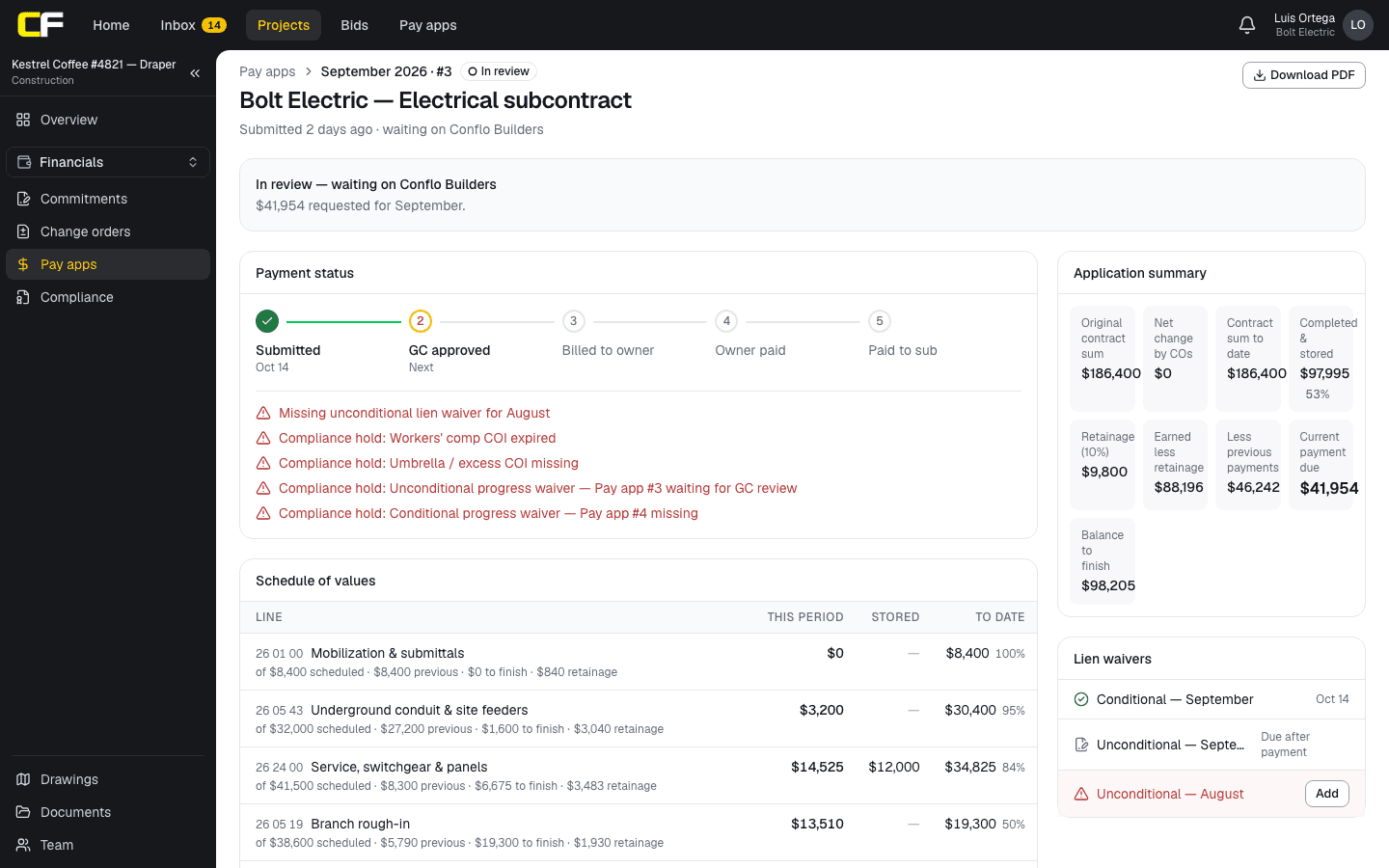
In a Conflo trade bid, you submit a base bid, mark each of the GC's scope items included or excluded, price alternates and write exclusions and qualifications, which is where the warranty you are offering and your approved-applicator status go. Under contract, you bill in pay apps by percent complete and stored materials per line, and the GC approves it or sends back the lines that are wrong.
At closeout, the GC requests documents such as the warranty letter by spec section, and a sub sees only what its own company still owes. The GC logs each warranty in Warranties with its start date and term, and the subcontractor sees the warranties its company stands behind and when each one ends.
The bottom line
Read the warranty requirement before anything else: it sets the system, the manufacturer and whether you can bid. Price the inspections, warranty fee and fall protection, bill by operation with stored materials where allowed, and plan closeout around delivering the manufacturer's warranty.
Subcontractors invited by a GC use Conflo free. Join the waitlist to bid and bill your next roof in it.
Sources
- UFGS 07 52 00, Modified Bituminous Membrane Roofing (August 2025) — Whole Building Design Guide (USACE, NAVFAC, AFCEC). Read October 16, 2026.
- 29 CFR 1926.501, Duty to have fall protection — Occupational Safety and Health Administration. Read October 16, 2026.
- Summary: A201–2017, General Conditions of the Contract for Construction — AIA Contract Documents. Read October 17, 2026.
Questions
What warranty does a commercial roof usually need?
Two, in many specs: the membrane manufacturer's warranty (the federal guide spec uses 20 years, no dollar limit, materials and workmanship) and the roofing contractor's own workmanship warranty, often two years. Your project's spec sets the terms.
What is an approved applicator?
A roofing contractor the manufacturer has authorized to install its system and qualify it for the manufacturer's warranty. Specs often require approval at the level of the warranty specified, years of experience with that manufacturer and similar recent projects.
Can a roofer bill for materials stored on the roof?
Where the contract allows stored materials. AIA A201–2017 allows payment for materials delivered and suitably stored at the site. Keep them protected as the manufacturer requires and send delivery tickets with the pay app.
When does a roofing sub get its retainage back?
Usually at or after substantial completion and closeout, once warranties, inspection reports and lien waivers are delivered. Check your subcontract and your state's law for the timing and any partial release.
Related
Money
How Does a Subcontractor Fill Out a Pay Application?
A subcontractor's pay app bills percent complete and stored materials per schedule-of-values line, less retainage and prior payments, with a lien waiver.
· 9 min read
Money
How Do You Calculate Retainage on a Pay App?
Retainage is a percentage of work completed and stored to date, held back each pay period. How to calculate it, reduce it, release it, with an example.
· 9 min read
Closeout
How Do You Build a Punch List?
Build a punch list by walking the job room by room before substantial completion, logging each item with location, trade, photo and due date. With example.
· 9 min read
Bidding
How Glazing Subs Bid and Bill Commercial Work
How glazing subs bid curtain wall and storefront: takeoff units, the clarifications that protect you, the engineering and mockup submittals, and billing.
· 10 min read
Role hub
The Subcontractor's Guide: Bidding to Getting Paid
Every step of a commercial job from the subcontractor's seat: bidding, the subcontract, submittals, RFIs, change orders, pay apps, retainage and closeout.
· 9 min read