
How Do You Calculate Retainage on a Pay App?
By Wyatt Cooper · Published · 9 min read
Key takeaways
- Retainage is held on the total completed and stored to date, so each period's new retainage is the to-date figure minus what was already held.
- There is no single national rule: the contract sets the percentage, and statutes cap it on many jobs, such as Texas public works at 10% or 5%.
- A common reduction cuts the rate after 50% complete; in the example below, dropping from 10% to 5% releases $8,084.75 in the third pay period.
- A subcontractor's retainage usually mirrors the prime contract's, and some statutes forbid a GC holding a higher percentage from a sub than the owner holds from the GC.
To calculate retainage, multiply the value of work completed and materials stored to date by the contract's retainage percentage. Subtract that from the completed-and-stored total to get the amount earned less retainage, then subtract previous payments to find the amount due this period. The percentage comes from the contract, often within a limit set by state or federal law, and many contracts reduce it at 50% complete and release the balance at completion. Check your contract and your state's law.
Retainage is money earned but held until the work is done
Retainage (also called retention) is a portion of each progress payment that the paying party keeps until the work is finished. It gives the owner leverage to get punch-list items, closeout documents and warranty paperwork delivered, and a cushion if the contractor does not finish.
It flows down the chain. The owner holds retainage from the general contractor, the general contractor holds it from each subcontractor, and subcontractors often hold it from their own sub-tiers. Retainage is not a discount: it is money the contractor has earned and will be paid, later. On a pay application in the common G702/G703 layout, it appears on the summary page and, on many forms, on each line of the continuation sheet.
The contract sets the percentage, and the law often caps it
There is no single national retainage rule. The percentage is whatever the contract says, within any limit the law imposes on that job. Ten percent and five percent are common in contracts, but neither is universal. A few examples of how the law steps in:
- Federal construction contracts. Retainage is withheld only with cause: the contracting officer "should not withhold funds without cause", decides case by case, and may not exceed "10 percent of the approved estimated amount" (FAR 32.103). The payments clause allows retainage of up to 10% only when progress is unsatisfactory and requires release at substantial completion, apart from amounts needed to protect the government (FAR 52.232-5).
- Texas public works. With some exceptions, a governmental entity may not withhold more than 10% of the contract price on a contract under $5 million, or more than 5% on a contract of $5 million or more, and the limit applies to any item in a schedule of values, including materials delivered on site (Texas Government Code § 2252.032). The subchapter does not apply to contracts estimated at under $400,000 or to TxDOT contracts under Transportation Code chapter 223 (§ 2252.033); dam contracts stay at 10% whatever their value, and some entities funded by the Texas Water Development Board are outside the limits.
- Private work. Many states also regulate retainage on private projects; others leave it to the contract. Check the statute for the state the project is in, not the state your office is in.
Treat the contract and the statute together: the lower limit wins.
Calculate retainage on everything completed and stored to date
The formula has four steps. Do them on totals to date, not on this period alone, so rounding never drifts.
- Completed and stored to date = work completed on previous applications + work completed this period + materials presently stored.
- Retainage = completed and stored to date × retainage percentage, rounded to the cent.
- Total earned less retainage = completed and stored to date − retainage.
- Current payment due = total earned less retainage − previous payments (the total of earlier certificates).
Retainage held this period is the to-date retainage minus the to-date retainage on the last application. If the rate drops, that number is negative: retainage is being released.
Stored materials carry retainage too
Materials delivered and stored, but not yet installed, are usually billed on the pay application and are usually subject to retainage. Federal contracts allow payment for material delivered to the site and, where the contract says so, stored off site with proof of title (FAR 52.232-5). The Texas public-works limit expressly covers "materials and equipment delivered on site to be installed".
Some contracts set a different retainage rate on stored materials, or require insurance certificates, bills of sale or photos before stored material is paid. Read the payment article before you bill it.
A worked example across three pay periods
A fictional electrical subcontractor, "Eastfield Electric", has a $486,250.00 subcontract on a fictional library, the "Larkin Avenue Library". The subcontract sets retainage at 10%, reducing to 5% on all work to date once the work is more than 50% complete and the GC approves the reduction.
- 1Pay app 1$121,437.50 to date (24.97%), including $18,250.00 of switchgear stored on site; 10% held: $12,143.75
- 2Pay app 2$231,906.80 to date (47.69%); still under 50%, so 10% held: $23,190.68
- 3Pay app 3$302,118.60 to date (62.13%); reduction approved, 5% held: $15,105.93, so $8,084.75 is released
- 4Completion5% of $486,250.00 = $24,312.50 held, released with final payment once the contract's conditions are met
| Line | Pay app 1 | Pay app 2 | Pay app 3 |
|---|---|---|---|
| A. Completed and stored to date | $121,437.50 | $231,906.80 | $302,118.60 |
| B. Retainage rate | 10% | 10% | 5% |
| C. Retainage held to date (A × B) | $12,143.75 | $23,190.68 | $15,105.93 |
| D. Total earned less retainage (A − C) | $109,293.75 | $208,716.12 | $287,012.67 |
| E. Previous payments (prior D) | $0.00 | $109,293.75 | $208,716.12 |
| F. Current payment due (D − E) | $109,293.75 | $99,422.37 | $78,296.55 |
| G. Retainage held this period (C − prior C) | $12,143.75 | $11,046.93 | −$8,084.75 (released) |
Row G is the check. In pay app 2, $23,190.68 − $12,143.75 = $11,046.93 more is held. In pay app 3, $15,105.93 − $23,190.68 = −$8,084.75: the reduction releases $8,084.75.
Work this period in pay app 3 is $302,118.60 − $231,906.80 = $70,211.80. Add the released retainage: $70,211.80 + $8,084.75 = $78,296.55, the same as row F. Pay app 2 checks the same way: $231,906.80 − $121,437.50 = $110,469.30 of work, less $11,046.93 held, is $99,422.37. Percentages complete are rounded to two decimals.
Reduce at 50% and release at completion, as the contract says
Contracts handle the halfway point in different ways:
- Reduce the rate on everything (as in the example): retainage on all work to date drops to the lower rate and the difference is released.
- Stop withholding on new work: the amount held at 50% stays fixed and nothing more is withheld, so at 10% the job ends with about 5% of the contract sum held.
- No reduction: the full rate is held to the end.
Most reductions are not automatic: they need the owner's or architect's approval, satisfactory progress and sometimes the surety's consent. Federal rules allow retainage to be adjusted as the contract nears completion to recognize better than expected performance (FAR 32.103).
Release usually needs substantial or final completion, a closed punch list, closeout documents and final lien waivers. Some contracts keep back an amount for unfinished punch work. Statutes may set a deadline to pay released retainage; check your state's.
The sub's side: retainage passed down
A subcontractor's retainage normally mirrors the prime contract: if the owner holds 10% from the GC, the subcontract says 10%. Some statutes put a ceiling on that: on Texas public works the prime contractor "may not withhold from a subcontractor a greater percentage of retainage than the percentage that may be withheld from the prime contractor" (§ 2252.032(d)).
On federal projects, the Prompt Payment Act requires subcontracts to carry payment clauses obliging the prime to pay subs within 7 days of being paid, and allows retainage only as the subcontract specifies (31 U.S.C. § 3905).
For subs, three habits help: track retainage held by job and by GC, ask when the owner reduces or releases retainage on the prime contract, and send your release request with closeout documents attached. For the whole monthly bill, see how a subcontractor fills out a pay application.
How it works in Conflo
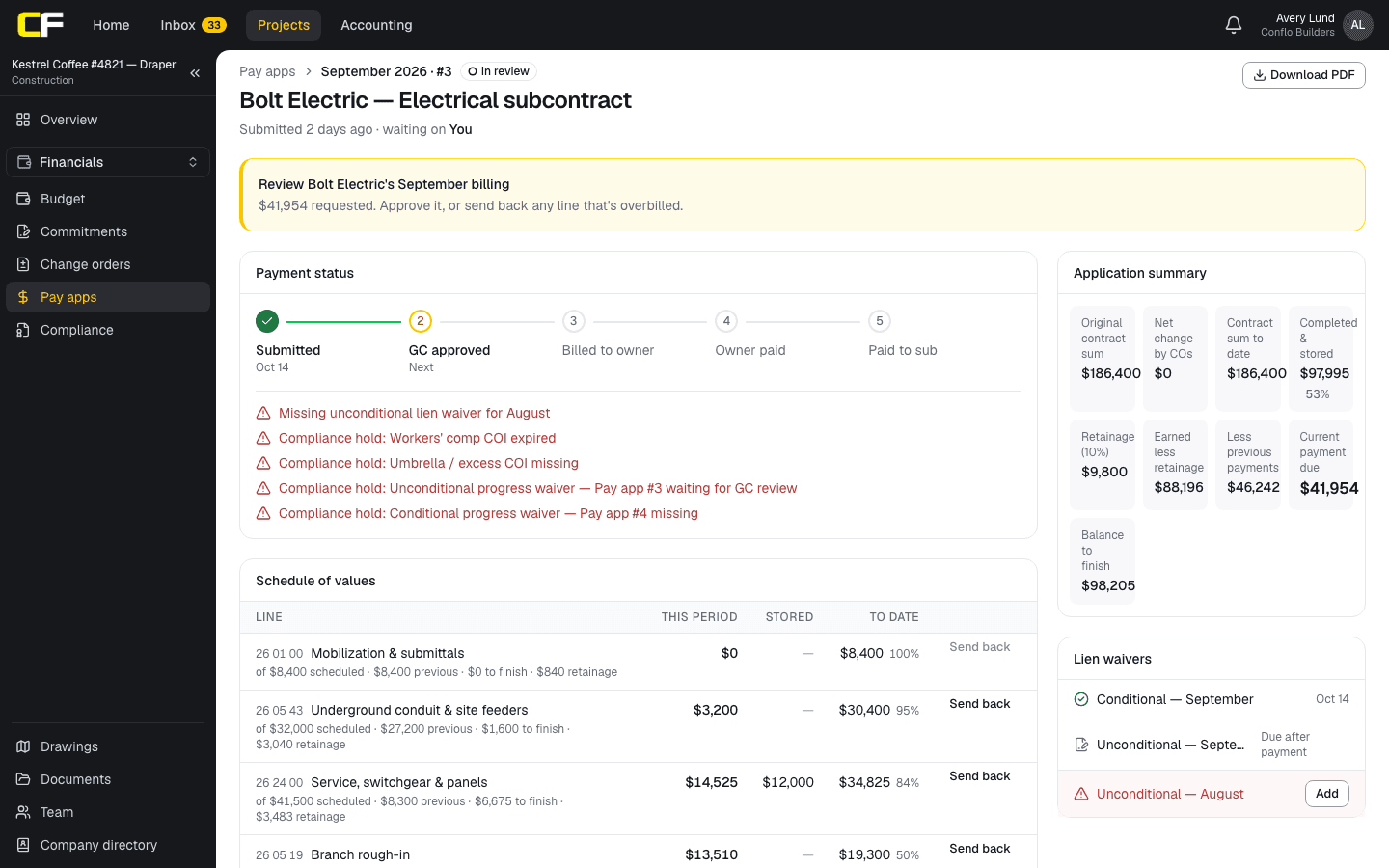
On Conflo's pay applications, each contract (the owner's prime contract or a subcontract) carries one retainage percentage, from 0 to 20%. Retainage is calculated on work completed and stored to date, rounded once on the total and spread across the lines so the continuation sheet adds up to the summary to the cent. Previous payments are net of retainage, and the current payment due follows from them. The owner pay app shows a "This period" panel with the work, stored materials and retainage held this period.
A subcontract signed through Conflo opens the sub's billing contract with the same retainage percentage. Not built yet: a retainage reduction partway through a job, a separate rate for stored materials, and a retainage release step.
The bottom line
Retainage is simple arithmetic on a number that keeps growing: hold the percentage on everything completed and stored to date, and let the period figure fall out of the difference. The hard parts are legal and contractual: which percentage, when it drops, and when it must be paid.
Before the first pay application, find the retainage clause in your contract and the statute for the project's state, and write down the rate, the reduction rule and the release conditions.
Sources
- FAR 32.103, Progress payments under construction contracts — Acquisition.gov, U.S. General Services Administration. Read October 16, 2026.
- FAR 52.232-5, Payments under Fixed-Price Construction Contracts — Acquisition.gov, U.S. General Services Administration. Read October 16, 2026.
- Texas Government Code §§ 2252.032–2252.033, Retainage and exemptions — Texas Legislature. Read October 17, 2026.
- 31 U.S.C. § 3905, Payment provisions relating to construction contracts — U.S. Government Publishing Office (govinfo), United States Code, 2023 edition. Read October 17, 2026.
Questions
How do you calculate retainage on a pay application?
Multiply work completed and materials stored to date by the contract's retainage percentage. Subtract that from the to-date total, then subtract previous payments to get the amount due. This period's retainage is the to-date retainage minus the to-date retainage on the last pay app.
Is retainage always 10 percent?
No. The contract sets the percentage, and many statutes cap it. On federal construction it is withheld only with cause and may not exceed 10%, and Texas public works allow at most 10% under $5 million and 5% at $5 million or more. Private jobs in some states have their own limits.
Is retainage held on stored materials?
Usually, yes. Stored materials are billed as part of work completed and stored to date, so the retainage percentage applies to them unless the contract sets a different rate. Some statutes, such as Texas's public-works rule, expressly include materials delivered on site.
What happens to retainage at 50 percent complete?
Only what the contract says. Some contracts drop the rate on all work to date and release the difference, some stop withholding on new work, and some hold the full rate to the end. Reductions usually need the owner's approval.
Can a GC hold more retainage from a sub than the owner holds from the GC?
It depends on the contract and the state. Some statutes forbid it: on Texas public works the prime contractor may not withhold a greater percentage from a subcontractor than may be withheld from the prime. Check your subcontract and your state's law.
Related
Definition
What Is Retainage in Construction?
Retainage is a percentage of each construction progress payment held back until the work is complete. Definition, an example, and how it differs.
· 3 min read
Template
Retainage Calculator for Pay Applications
Free retainage calculator: enter work to date and the rate to get retainage held, previous payments and the amount due, including a rate reduction.
· 3 min read
Money
Retainage Laws in the Five Largest Construction States
Retainage caps and release deadlines in California, Texas, Florida, New York and North Carolina, from each state's statutes, private and public.
· 10 min read
Money
How Does a Subcontractor Get Retainage Released?
Finish your scope, close your punch items, send closeout documents and a written release request with the waiver asked for, and know your state's deadline.
· 6 min read
Role hub
The General Contractor's Guide: Bid to Closeout
What a general contractor is responsible for at every phase of a commercial job, from bidding and buyout to RFIs, change orders, pay apps and closeout.
· 8 min read