
How Do You Assemble a Construction Closeout Package?
By Wyatt Cooper · Published · 9 min read
Key takeaways
- Build the closeout log at buyout, from the specifications: one line for every document each company owes, by spec section.
- The usual package is record drawings, O&M manuals, warranties, attic stock, training records, test reports and final lien waivers, plus whatever Division 01 adds.
- Request documents months before substantial completion and review each one as it arrives; a warranty with the wrong start date or an O&M manual for the wrong model is not done.
- Organize the package the way the owner asked, usually by spec section, and deliver it with a transmittal so the date is on the record.
To assemble a closeout package, list every closeout document the specifications require, by spec section and by the company that owes it, at buyout. Request each one well before substantial completion, review it when it arrives, and send back anything incomplete with the reason. Organize the approved documents by spec section in the owner's format, then deliver the package with a transmittal. Final payment usually waits for it.
What goes in a closeout package
The closeout package is everything the owner needs to run, maintain and repair the building, and everything that proves the job is paid and finished. The specifications say what is owed: Division 01 (often Section 01 77 00, Closeout Procedures, and 01 78 00, Closeout Submittals) sets the general rules, and each technical section lists its own closeout submittals.
| Document | Who provides it | What to check before you accept it |
|---|---|---|
| Record (as-built) drawings | Each trade with design-affecting work, and the GC | Changes, RFI answers and field moves are drawn in; the owner's file format |
| O&M manuals | Each sub that installed equipment | The installed model numbers, not the whole catalog; maintenance schedules; parts lists |
| Warranties | The GC, each sub, and manufacturers through the subs | Owner named, scope and term match the spec, start date agreed, signed |
| Attic stock (spare materials) | Flooring, ceiling, paint, tile and similar trades | Quantities per the spec, labeled, delivered with a signed receipt |
| Owner training records | Mechanical, electrical, controls and other system trades | Agenda, attendance sheet, and a recording if the spec requires one |
| Test, balance and commissioning reports | The balancing agency, commissioning agent and trades | Final reports, not drafts; deficiencies closed |
| Final lien waivers | The GC, each sub and major suppliers | Final, not progress; amounts and dates match the last payment |
| Permits signed off, certificate of occupancy | The GC | Copies of the final inspections and conditions, if any |
Owners add their own lists. San Diego State University's closeout procedures, for one, ask at substantial completion for a turnover letter with the warranty start date, the current punch list, a 24/7 contact list of subcontractors for warranty items, O&M manuals for critical equipment, balance reports, the training attendance sheet and the certificate of occupancy; then at closeout for final warranty letters, final as-built drawings in DWG and PDF, all O&M manuals, attic stock and signed-off permits.
Build the closeout log at buyout, from the specs
Do not wait for the last month. When you write each subcontract, read the closeout article of every spec section in its scope and write down what that company owes: one line per document, per section, per company. Put the list in the subcontract or its exhibit so it is not a surprise at the end, and so a sub's final payment can wait on it.
Read the warranty requirements closely. Federal construction contracts, for example, have the contractor obtain "all warranties that would be given in normal commercial practice" and, if the contracting officer directs, have them executed in writing for the government's benefit, with the contractor's own warranty running one year from final acceptance (FAR 52.246-21). On AIA documents, warranties start at substantial completion unless the certificate says otherwise (AIA's G704 summary). Know which date your warranties use before you accept them.
- 1GC project managerWrites each company's closeout list from the specs into its subcontract at buyout
- 2GC project managerRequests each document with a due date once the trade's equipment is approved and installed
- 3SubcontractorTurns in each document for its own scope, with its manufacturers' warranties
- 4GC project managerReviews each one: approves it, or sends it back with the reason
- 5ArchitectReviews the package for completeness, where the contract asks for it
- 6GCDelivers the approved package to the owner with a transmittal
Request early, and review each document as it arrives
Request the documents for a trade as soon as its equipment is submitted and installed, not at substantial completion: an O&M manual can be compiled from approved product data, and a warranty form can be agreed long before its start date. Give each request a due date, and review what comes in the week it arrives.
- O&M manuals: does it cover the model installed, with the maintenance schedule and parts list, or is it a catalog?
- Warranties: does it name the owner, the right scope and term, and the agreed start date? Is it signed?
- As-builts: are the changes, RFI answers and field moves drawn in, in the format the owner asked for?
- Lien waivers: is it the final waiver, for the right amount and date?
Send back anything that is not right with a one-line reason, and track how often a company resubmits. The closeout log works like a punch list for paper: one item per document, an owner, a due date, and nothing closed until you have checked it.
A worked example: a fictional office fit-out
The job is fictional: "Cedar Row Offices", a two-floor tenant fit-out built by a fictional GC, Pinecrest Builders. Three weeks before substantial completion, the closeout log stands like this. All companies are fictional.
| Spec section | Company | Documents owed | Approved | To review | Outstanding |
|---|---|---|---|---|---|
| 01 78 00 Closeout submittals | Pinecrest Builders (GC) | 3: warranty, final lien waiver, as-builts | 2 | 1 | 0 |
| 08 71 00 Door hardware | Keystone Doors | 4: O&M, warranty, attic stock, final lien waiver | 3 | 0 | 1 |
| 09 91 23 Interior painting | Bramble Painting | 3: warranty, attic stock, final lien waiver | 3 | 0 | 0 |
| 22 00 00 Plumbing | Rook Plumbing | 4: O&M, as-builts, warranty, final lien waiver | 2 | 0 | 2 |
| 23 00 00 HVAC | Northgate Mechanical | 5: O&M, as-builts, warranty, owner training, final lien waiver | 1 | 2 | 2 |
| 26 00 00 Electrical | Halvorsen Electric | 4: O&M, as-builts, warranty, final lien waiver | 3 | 1 | 0 |
| Total | 6 companies | 23 | 14 | 4 | 5 |
The arithmetic: 3 + 4 + 3 + 4 + 5 + 4 = 23 documents; approved 2 + 3 + 3 + 2 + 1 + 3 = 14, to review 1 + 0 + 0 + 0 + 2 + 1 = 4, outstanding 0 + 1 + 0 + 2 + 2 + 0 = 5, and 14 + 4 + 5 = 23. The package is 14 / 23 = 61% approved, rounded.
The log tells the superintendent where to spend the week: Northgate Mechanical owes the most (two outstanding, two to review, and owner training not yet held), and Rook Plumbing's O&M manual and as-builts are both still out. Bramble Painting is done.
Organize, deliver and get paid
Assemble the approved documents in the order the owner asked for, which is usually by spec section. Hawaii's public works guide specification, for example, splits the O&M manual into facility information, primary systems information and product data, with the product data "organized by the divisions and sections of the construction specifications" so the owner can find the exact product installed (Hawaii DAGS TG 01770). Many owners now ask for electronic files; San Diego State, for one, asks for the final as-builts in DWG and PDF.
Deliver it with a transmittal listing every document, and keep the receipt. Final payment usually waits for the package and the closed punch list; on federal fixed-price construction, final payment follows "completion and acceptance of all work", a properly executed voucher, and a release of all claims (FAR 52.232-5). Check your contract for its own conditions. Owners, see what an owner should get at closeout.
How it works in Conflo
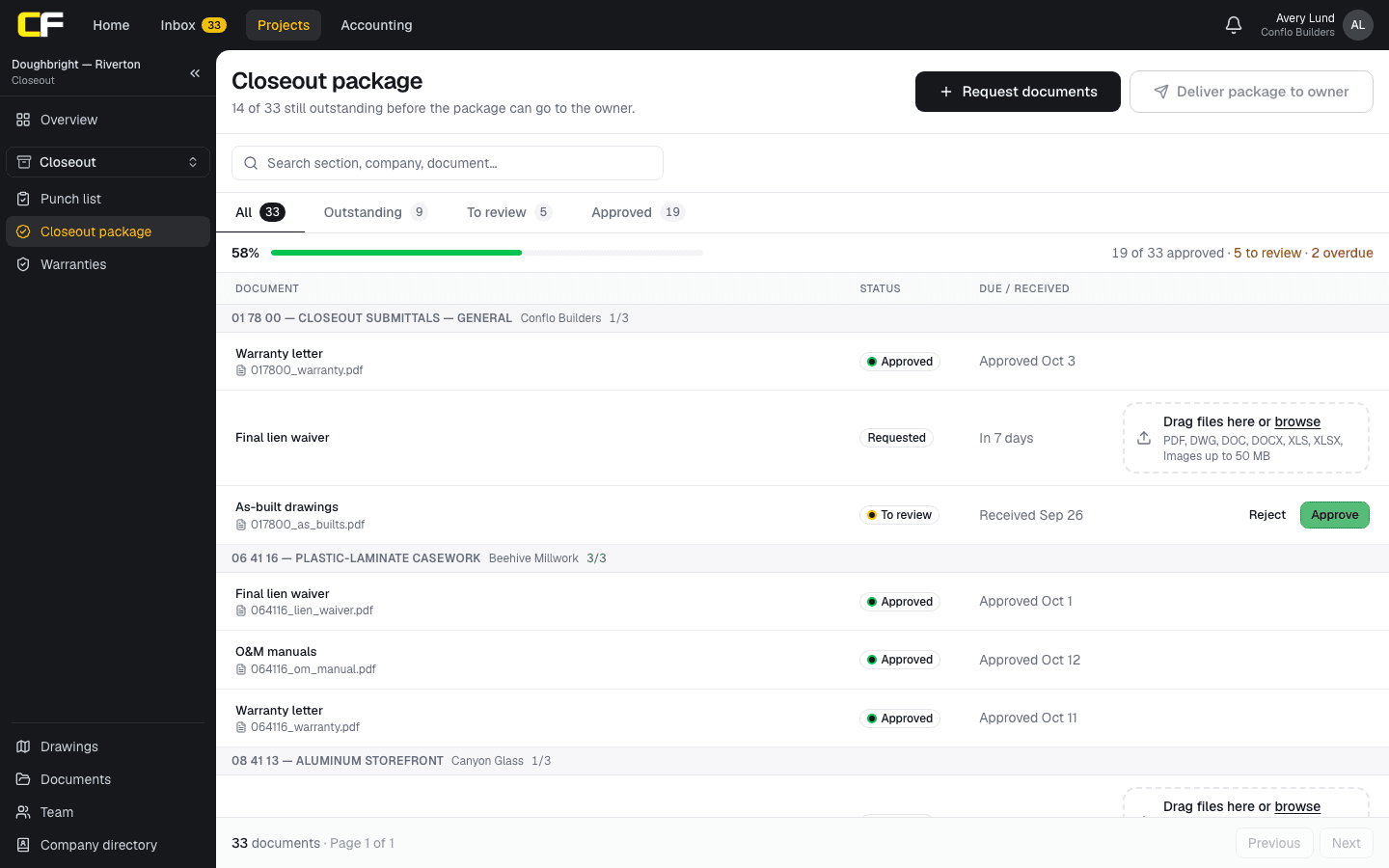
In Conflo's closeout package, the GC requests documents by spec section: enter the section and its title, pick the company that owes it, tick each document type owed (O&M manuals, as-built drawings, warranty letter, attic stock, owner training, final lien waiver) and set one due date; each becomes its own item. Each sub sees only what its company owes and turns in the file; the GC can also turn one in on a sub's behalf.
The GC approves each document or sends it back with a note the sub sees until it resubmits. The package is grouped by spec section, shows the percent approved, how many are waiting on review and how many are overdue, and can be delivered to the owner only when every item is approved; the date and who delivered it are recorded. Warranties are logged separately with their start date and term, and Conflo works out each expiration and flags those ending within 90 days. Limits today: the six document types are fixed, so test reports, keys or permits are not their own types, and the package is delivered as a record, not compiled into one bound file.
The bottom line
A closeout package is assembled at buyout, not at the end: write down every document each company owes, request it as the work is installed, and review it the week it arrives.
If your log is mostly approved by substantial completion, final payment follows the punch list instead of waiting months for paper.
Sources
- Facilities Design Guidelines, Section 01 77 00: Closeout Procedures — San Diego State University, Facilities Planning. Read October 16, 2026.
- Technical Guide TG 01770: Closeout Procedures — Hawaii Department of Accounting and General Services, Public Works Division. Read October 16, 2026.
- FAR 52.246-21, Warranty of Construction — Acquisition.gov, U.S. General Services Administration. Read October 16, 2026.
- FAR 52.232-5, Payments under Fixed-Price Construction Contracts — Acquisition.gov, U.S. General Services Administration. Read October 16, 2026.
- Summary: G704–2017, Certificate of Substantial Completion — AIA Contract Documents (The American Institute of Architects). Read October 16, 2026.
Questions
What is included in a construction closeout package?
Usually record (as-built) drawings, O&M manuals, warranties, attic stock with a signed receipt, owner training records, test and balance reports, final lien waivers, and signed-off permits or the certificate of occupancy. Your specifications, mainly Division 01, set the exact list.
When should you start the closeout package?
At buyout, when you write the closeout list from the specs into each subcontract. Request documents as each trade's equipment is approved and installed, so most are approved by substantial completion.
Who is responsible for the closeout package?
The general contractor assembles and delivers it to the owner. Each subcontractor owes the documents for its own scope, and manufacturers' warranties usually come through the sub that bought the equipment.
Does final payment wait for the closeout package?
Usually. Many contracts make the closeout documents, the closed punch list and final lien waivers conditions of final payment. Read your contract's final payment article for the exact conditions.
How should the closeout package be organized?
The way the owner asks, which is usually by specification section, so a facilities manager can find the O&M manual and warranty for a piece of equipment by its section. Many owners ask for electronic files, such as bookmarked PDFs.
Related
Closeout
What Should an Owner Get at Project Closeout?
The owner's closeout checklist: what you should get at substantial completion and before final payment, and how to check each document.
· 7 min read
Closeout
How Do You Build a Punch List?
Build a punch list by walking the job room by room before substantial completion, logging each item with location, trade, photo and due date. With example.
· 9 min read
Definition
What Is Substantial Completion?
Substantial completion is when the work is complete enough for the owner to use it as intended. What it triggers: retainage, warranties, delay damages.
· 3 min read
Closeout
How Does a Subcontractor Keep As-Built Drawings?
How a subcontractor keeps as-built drawings: one marked-up set, red, green and blue, updated weekly, buried work dimensioned, turned in on time.
· 6 min read
Role hub
The General Contractor's Guide: Bid to Closeout
What a general contractor is responsible for at every phase of a commercial job, from bidding and buyout to RFIs, change orders, pay apps and closeout.
· 8 min read