
How Do You Bid a GC's Job as a Subcontractor?
By Wyatt Cooper · Published · 7 min read
Key takeaways
- Bid the jobs you can win and build: the right trade, size, location and timing, for a GC who pays and whose bid has a real chance with the owner.
- Price the GC's scope items, not just the drawings, and answer in the GC's bid form: base bid, a breakout per item, alternates, exclusions and qualifications, and the addenda you priced.
- The GC will level your bid against the others, so every exclusion you leave unpriced gets the GC's own number, and that number is rarely in your favor.
- Acknowledge every addendum and meet the bond and insurance requirements; on federal sealed bids, a missed amendment can be waived only if the bid shows it was received or its effect on price was negligible.
To bid a general contractor's job as a subcontractor, get on the GC's bid list, then decide whether the job fits your trade, size, crew and schedule. Read the invitation, scope items and every addendum, walk the site and ask questions before the deadline. Take off and price the work, add overhead and profit, and submit in the GC's format: base bid, item breakouts, alternates, clear exclusions and qualifications, and the addenda acknowledged, before the due time.
What happens to your bid after you send it
Knowing what the general contractor does with your number tells you how to write it. On bid day the GC's estimator collects every bid for your trade and levels them: each bid is read against one list of scope items, and anything you excluded gets a plug, the GC's own estimate of its cost. The leveled totals are compared, the apparent low bidder is asked to confirm its scope, and the winning number goes into the GC's own bid to the owner.
- 1General contractorInvites subs in the trade from its bid list
- 2SubcontractorDecides to bid or declines, then reads the scope, documents and addenda
- 3SubcontractorAsks questions, prices the work and submits in the GC's format
- 4General contractorLevels every bid against one scope list, plugging gaps
- 5General contractorReviews scope with the apparent low bidder
- 6General contractorAwards, then writes the subcontract
On some public jobs this is written into the rules. One North Carolina construction manager-at-risk contract has trade bids opened publicly, tabulated, and the apparent low bidder's documentation reviewed to verify its scope; a bid that failed to account for all the costs of its scope may be disqualified, and the package goes to the lowest verified bid (NC State University, CM-at-Risk General Provisions). Private GCs are not bound by those rules, but the comparison works the same way.
Decide which jobs to bid
Every bid costs estimating time, so choose. Get on the bid lists of the GCs you want to work for (GCs keep lists of subs by trade and invite from them), then judge each invitation before you price it.
| Question | Why it matters |
|---|---|
| Is it your trade and your size? | A job far larger than your usual work strains cash, crew and bonding. |
| Can you staff it when it starts? | The schedule in the invitation is a commitment once you are awarded. |
| Can you meet the bond and insurance requirements? | A required bond you cannot get makes the bid a waste of time. |
| Do you know this GC? | Payment record, how it handles changes and retainage, and whether it shops numbers. |
| Does the GC have a real chance with the owner? | Negotiated work or a short list is worth more effort than a ten-GC public bid. |
| Is there time to price it properly? | A rushed takeoff is how scope gets missed. |
If the answer is no, decline promptly. A GC who knows early can invite someone else, and remembers that you told it.
Read the invitation and ask before the deadline
- Read the scope items the GC lists. They are the rows your bid will be compared on.
- Check the drawing set date, the specification sections for your trade, and the addenda issued so far.
- Note what the GC says is not in your package, and look for boundary items it did not mention: firestopping, blocking, cutting and patching, equipment connections, temporary work.
- Walk the site if a walk is offered. Conditions you have seen are conditions you can price.
- Ask questions in writing before the questions deadline. The answer goes to every bidder, so it is also how you find out what others asked.
A worked example: pricing a fictional electrical bid
The job is fictional: "Coyle Avenue Office", a three-story office. A fictional electrical contractor prices the GC's electrical package from its own takeoff.
| Line | How it is figured | Amount |
|---|---|---|
| Labor | 1,840 hours × $78.00 per hour (wages, burden and benefits) | $143,520.00 |
| Material | From the takeoff and supplier quotes | $96,300.00 |
| Equipment | Lifts and tools rented for the job | $7,200.00 |
| Low-voltage sub-tier | Quote from a low-voltage contractor | $18,600.00 |
| Direct cost | $143,520 + $96,300 + $7,200 + $18,600 | $265,620.00 |
| Overhead 10% | 10% × $265,620.00 | $26,562.00 |
| Cost with overhead | $265,620.00 + $26,562.00 | $292,182.00 |
| Profit 6% | 6% × $292,182.00 | $17,530.92 |
| Total | $292,182.00 + $17,530.92 | $309,712.92 |
| Base bid | Rounded down to the nearest hundred | $309,700 |
The contractor then breaks the $309,700 out across the GC's eight scope items, prices the two alternates separately, and gives the bond as its own add as its surety quoted it, so the GC can level the bid without guessing. The rates and percentages here are an example, not a benchmark: use your own labor rates, overhead and margin.
Submit a bid the GC can compare
- Answer in the GC's format. If it asks for a breakout per scope item, give one; it is the difference between your number and the GC's plug.
- Price exclusions instead of only listing them where you can. An unpriced exclusion gets the GC's number. See how to write a sub proposal a GC can level.
- Acknowledge every addendum by number. On federal sealed bids, a failure to acknowledge an amendment can be waived only when the bid clearly shows the bidder received it or the amendment has no more than a negligible effect on price, quantity, quality or delivery (FAR 14.405).
- Meet the bond requirement. On federal prime contracts, a bid guarantee is required whenever a performance bond or a performance and payment bond is required (FAR 28.101-1), and it is at least 20% of the bid price, up to $3 million (FAR 28.101-2). A GC's requirement for its subs is set in its own invitation; check it and your subcontract.
- Submit before the due time, in the time zone stated. A late bid is easy to refuse.
After bid day, expect a scope review call if you are low. Confirm in writing what you included, and price anything the GC thinks is missing. If you are not low, ask where you were; some GCs will tell you.
How it works in Conflo
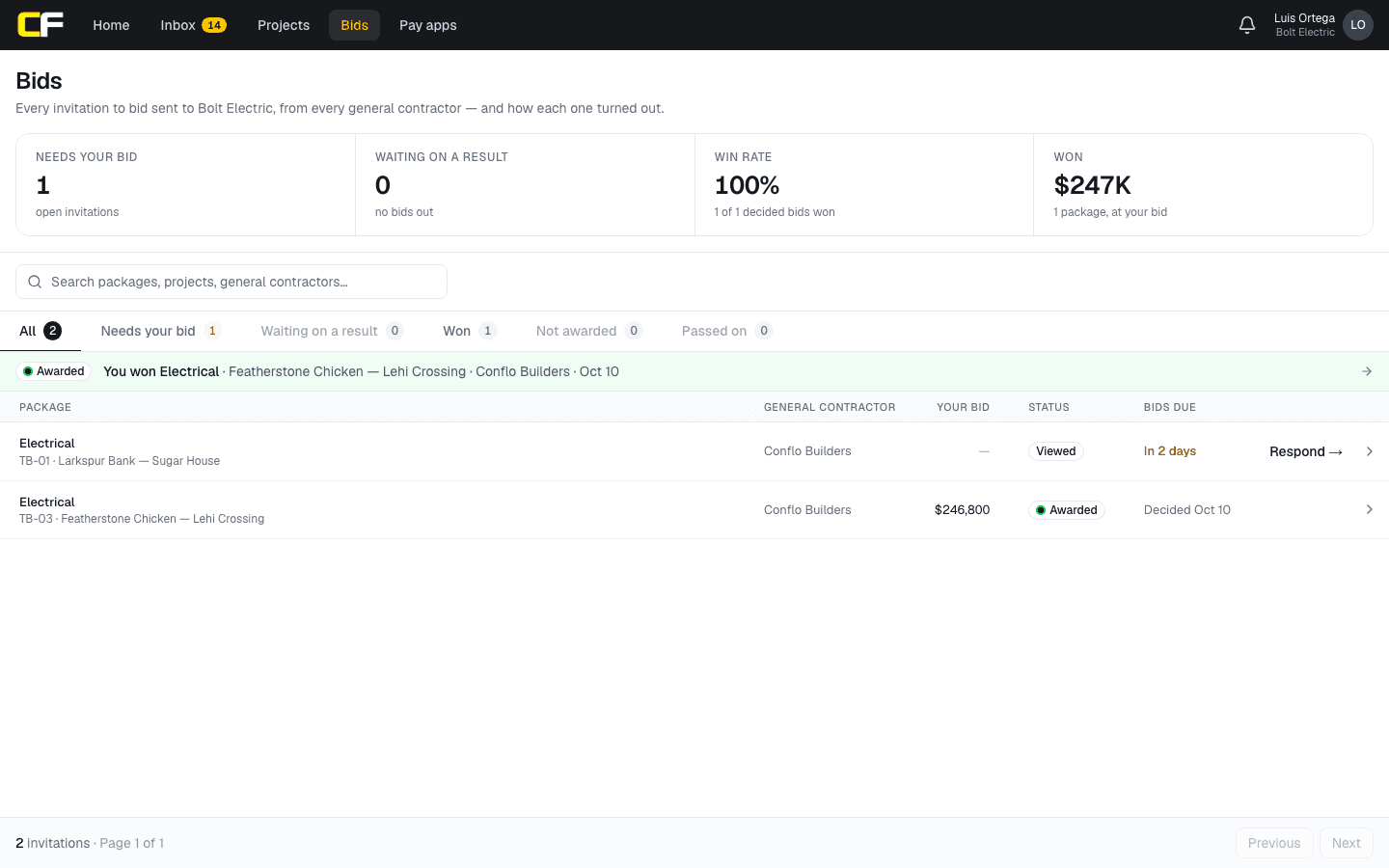
When a general contractor invites you to a trade bid in Conflo, the email links to the invitation; if you are not on Conflo yet, the link sets up a free account. Your Bids page lists every invitation sent to your company, from every GC, with tabs for needs your bid, waiting on a result, won, not awarded and passed on.
On the invitation you tell the GC whether you will bid or decline, read the scope, scope items and alternates, ask questions (answers go to every bidder without your name), and acknowledge each trade addendum before you can submit. The bid itself is a base bid, each scope item marked included or excluded with an optional breakout, alternates, exclusions and qualifications. You can revise it until bids close, and you see whether you were awarded. Conflo does not do your takeoff or price your work; you bring the number.
The bottom line
Winning sub bids is selective bidding plus clear answers: the right jobs, priced from the GC's scope items, with every exclusion priced or explained and every addendum acknowledged.
The GC will level your number either way. Give it your breakouts and it uses your prices; leave gaps and it uses its own.
Sources
- Section II, General Provisions (Construction Manager-at-Risk), part 3, Principal Trade & Specialty Contracts — NC State University Facilities. Read October 16, 2026.
- FAR 14.405, Minor informalities or irregularities in bids — Acquisition.gov, U.S. General Services Administration. Read October 16, 2026.
- FAR 28.101-1, Policy on use (Bid guarantees) — Acquisition.gov, U.S. General Services Administration. Read October 16, 2026.
- FAR 28.101-2, Solicitation provision or contract clause (Bid guarantees) — Acquisition.gov, U.S. General Services Administration. Read October 16, 2026.
Questions
How do subcontractors get invited to bid?
General contractors invite subs from their own lists, usually by trade. Introduce your company to the estimators at the GCs you want to work for, keep your trade, contacts, insurance and W-9 current with them, and bid their jobs reliably when invited.
What should a subcontractor bid include?
A base bid, a breakout for each scope item the GC lists, prices for the alternates, clear exclusions and qualifications, the addenda you priced, bond and insurance as the invitation requires, and how long the price is good for.
Should a subcontractor bid every job it is invited to?
No. Bid the jobs that fit your trade, size, crew, bonding and schedule, for GCs you want to work for. Decline the rest promptly so the GC can invite someone else.
What happens if my bid excludes something the GC needs?
The GC adds its own estimate of that work, a plug, to your bid when it levels the bids. If its plug is higher than your price would have been, you can lose a job you would have won with the item priced.
Related
Bidding
How to Write a Sub Proposal a GC Can Level
Write a subcontractor bid proposal the GC can level: match its scope items, break out prices, price exclusions, and see what the GC does with each line.
· 7 min read
Bidding
How Do You Level Subcontractor Bids?
Level subcontractor bids by pricing every scope gap, exclusion and missing addendum so each bid covers the same work, then compare the leveled totals.
· 9 min read
Money
How Does a Subcontractor Fill Out a Pay Application?
A subcontractor's pay app bills percent complete and stored materials per schedule-of-values line, less retainage and prior payments, with a lien waiver.
· 9 min read
Bidding
How Do You Send an Invitation to Bid to Subs?
What an invitation to bid to subs includes, how to send it, and how to run questions and addenda so every bid prices the same scope, with an example.
· 7 min read
Bidding
How Does a Subcontractor Get on a GC's Bid List?
How a subcontractor gets onto a general contractor's bid list: who to contact, the capability sheet and prequal packet to send, and how to stay invited.
· 6 min read
Role hub
The Subcontractor's Guide: Bidding to Getting Paid
Every step of a commercial job from the subcontractor's seat: bidding, the subcontract, submittals, RFIs, change orders, pay apps, retainage and closeout.
· 9 min read