
How Does a Subcontractor Write a Change Order Request?
By Wyatt Cooper · Published · 9 min read
Key takeaways
- A change order request is the subcontractor's priced proposal to the GC; it becomes a change order only when it is signed.
- Give written notice before you price anything: the federal changes clause, for example, allows no adjustment for costs incurred more than 20 days before written notice of a constructive change.
- Price it the way the GC will check it: labor hours at a burdened rate, materials with tax, equipment, then the markup your subcontract allows, applied once.
- In the worked example, $3,114.15 of direct cost becomes a $3,581.27 request with one working day, and the GC adds its own markup on top before it goes to the owner.
To write a change order request as a subcontractor, send written notice as soon as you learn of the change, then submit a priced request to the GC: what changed and why, the document that caused it, the scope in plain words, direct cost by labor, materials and equipment, the markup your subcontract allows, the days of schedule impact, and the backup. The GC adds its markup and passes it to the owner. Check your subcontract's deadlines.
A request, not a change order
A change order request (some contracts say change order proposal or potential change order) is your offer to do changed work for a price and a number of days. It is not a change to your subcontract until someone with authority signs it. Until then, the work may be at your own risk.
On most commercial jobs the request runs up the chain. You send it to the GC; the GC reviews it, adds its own markup and sends it to the owner (often through the architect); the owner signs a change order with the GC; and the GC then signs a matching change to your subcontract. AIA publishes a contractor–subcontractor version of its change order form for that last step (G701S), which, once executed, indicates agreement on the change in price and time.
- 1SubcontractorGives written notice, then sends the priced request with backup
- 2GCChecks scope and price, adds its markup, sends it to the owner
- 3Owner and architectReview it and sign the change order, or reject it with a reason
- 4GCSigns the matching change to the subcontract
- 5SubcontractorBills the change on the next pay application
Give notice before you price anything
The deadline that loses most changes is notice, not price. The federal changes clause is a clear example: no adjustment is made for costs incurred more than 20 days before the contractor gives written notice of a constructive change, and the contractor must assert its right to an adjustment within 30 days of a written change order (FAR 52.243-4). Private subcontracts set their own periods, and a subcontract often gives the sub less time than the prime contract gives the GC, so the GC can meet its own deadline.
Notice can be short: the date, what happened, who directed it, and that you consider it a change and will price it. Send it in writing, keep a copy, and keep working only as your subcontract directs.
What goes in the request
| Part | What to write | Why the GC needs it |
|---|---|---|
| Reason and cause | The RFI answer, bulletin, owner direction or field condition, with its number and date | Who pays depends on the cause |
| Scope | What you will add, delete or change, in words a stranger could follow | The GC prices its own work and the owner's review from it |
| Direct cost | Labor hours and burdened rate, materials with tax, equipment | The GC checks each group against its own numbers |
| Markup | The overhead and profit rate your subcontract allows, applied once | A rate above the contract's is the first thing cut |
| Time | Working days added or saved, and why they affect the schedule | A request signed with no days usually settles the time question |
| Backup | Quotes, invoices, crew hours, marked-up drawings, photos | The owner asks the GC for it; the GC asks you |
| Validity | How long the price holds | Material prices move; a dated price protects you |
If the request answers an RFI, name the RFI number and quote the answer. It is the fastest way to show the work is a change and not something already in your scope.
Price it the way the GC will check it
Build the price in groups the GC can compare line by line, the same way it prices its own change orders. Labor is hours by trade times the burdened rate (base wage plus payroll taxes, insurance, benefits and fringes, from your payroll records). Materials are quantities times supplier prices, plus tax and delivery. Equipment is the rental invoice or your company's rates.
Then add only the markup your subcontract allows, once. Public specifications show how fixed these can be: Caltrans' force-account rules, for example, add 35% to labor (after a labor surcharge), 15% to materials and equipment, and 10% to subcontracted work (Caltrans payment module). Expect the GC to add its own markup on your total, at the rate its prime contract allows for subcontracted work; that is not double-counting, because it covers the GC managing your change.
To check the arithmetic, run your numbers through the change order pricing calculator: put your own work in the labor, materials and equipment fields and your markup in the own-work rate.
A worked example: two hand sinks added to a fictional clinic
The job is fictional: "Alder Street Medical Office". The owner adds two hand sinks in exam rooms after the walls are framed and rough-in is done, by an owner's directive the architect issues as a bulletin. A fictional plumbing sub, "Copperline Plumbing", gives written notice the next day and prices it. Its fictional subcontract allows 15% overhead and profit on its own work.
| Line | Basis | Amount |
|---|---|---|
| Labor | 2 plumbers × 10 h = 20 h × $82.40 burdened | $1,648.00 |
| Materials | $1,236.50 + 7.25% tax ($89.64625 → $89.65) | $1,326.15 |
| Equipment | Core drill and press tool rental | $140.00 |
| Direct cost | $1,648.00 + $1,326.15 + $140.00 | $3,114.15 |
| Overhead and profit | 15% × $3,114.15 = $467.1225 | $467.12 |
| Change order request total | $3,114.15 + $467.12 | $3,581.27 |
| Time | Drywall close-up in two rooms waits one day | 1 working day |
Each line is rounded to the cent where shown. If the GC's prime contract allows 5% on subcontracted work, it would add $179.06 (5% × $3,581.27 = $179.0635) and carry $3,760.33 to the owner, before any insurance or bond the prime contract allows.
Change order request 007 — Add two hand sinks, exam rooms 104 and 106
- Project
- Alder Street Medical Office (fictional)
- To
- The GC's project manager
- Cause
- Architect's bulletin 3, owner-directed; notice sent the next day
- Scope
- Furnish and install two wall-hung hand sinks with supply, waste and vent from the existing rough-in; core two slab penetrations; test
- Direct cost
- $3,114.15 (labor 20 h × $82.40 = $1,648.00; materials $1,326.15 with tax; equipment $140.00)
- Markup
- 15% overhead and profit, $467.12
- Total
- $3,581.27
- Time
- 1 working day; drywall close-up in rooms 104 and 106 waits for the rough-in inspection
- Price valid
- 30 days
- Backup
- Supplier quote, crew hours and rates, rental invoice, bulletin 3 sketch
Why requests get sent back
- Late notice: the work was done before anyone was told, and the contract's notice period ran out.
- In scope already: the drawings or specs showed the work; quote the document that did not.
- A lump sum with no breakdown: the GC cannot defend a number it cannot check.
- Markup above the contract's rate, or markup on markup.
- No days, or days with no reason they affect the schedule.
- No backup: quotes and crew hours are the first thing the owner asks for.
Once the change is signed, bill it as its own line on your pay application, and remember that retainage is usually held on it like the rest of your contract.
How it works in Conflo
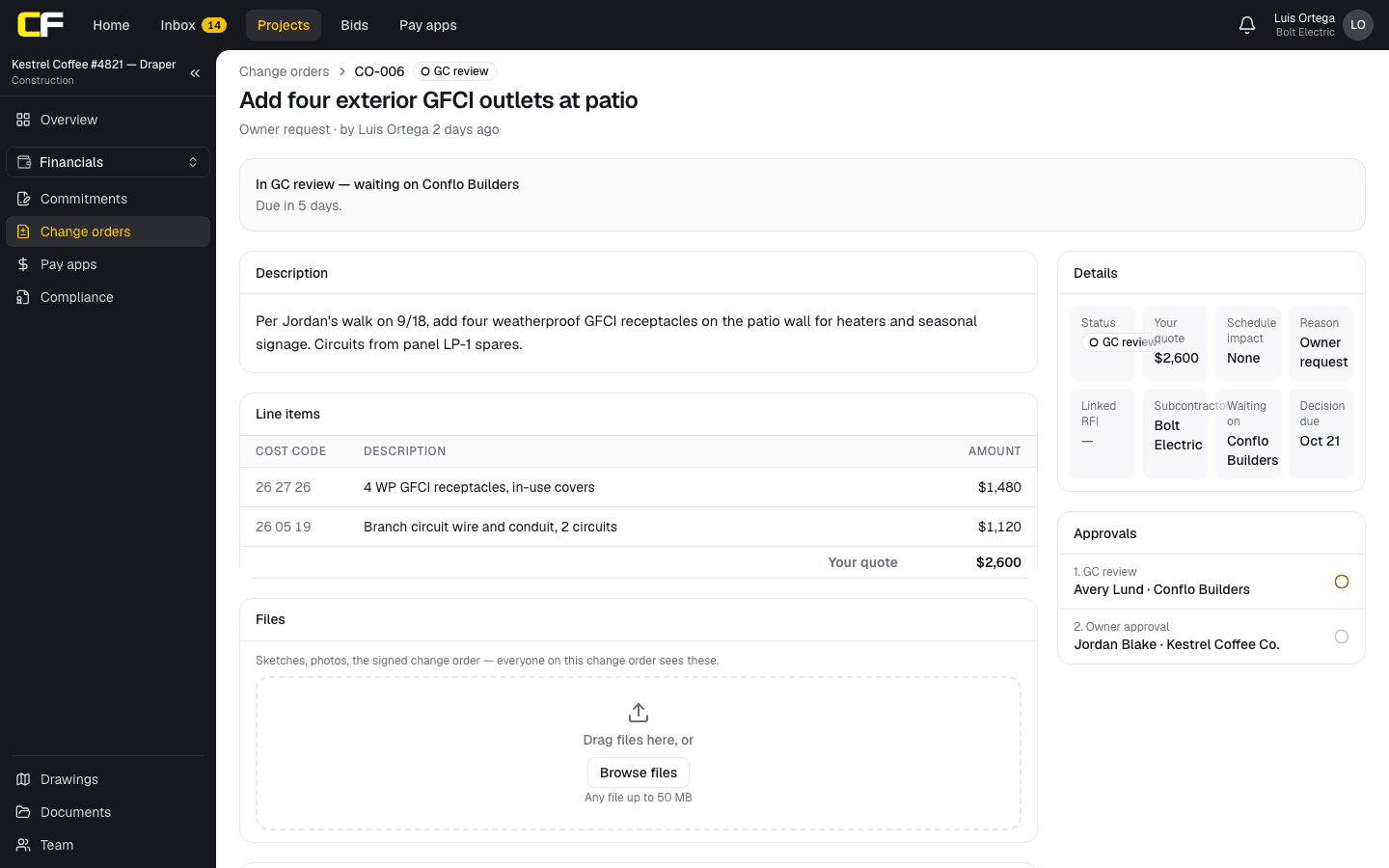
In Conflo a subcontractor can write a change order for its own scope: a title, the reason (RFI, owner request, field condition or design error), the RFI it came from, priced lines with cost codes, the schedule days and a due date. The sub's lines are its quote, its cost for the work. It goes to the GC's review, where the GC sets its markup, then to the owner for approval.
The sub sees its own quote, never the GC's markup or the owner price. A Files section is shared with everyone on the change order, and a Cost backup section is seen only by the GC and that sub. Once the owner approves, the quote is added to the sub's commitment at its cost and the change flows into pay apps. Limits today: lines are amounts, without separate fields for labor hours, materials or equipment, and the sub cannot set a markup of its own; put your overhead and profit in the line amounts.
The bottom line
A change order request that gets signed is sent early and reads like an estimate: notice in writing, the cause and its document, scope in plain words, direct cost by group, the contract's markup applied once, days with a reason, and backup. Leave the GC nothing to rebuild.
Read your subcontract's changes article and notice period before the first change arrives, and write every request the same way.
Sources
- FAR 52.243-4, Changes — Acquisition.gov, U.S. General Services Administration. Read October 16, 2026.
- Local Assistance Module 8: Payment (January 2026), force account under Standard Specifications 9-1.04 — California Department of Transportation (Caltrans). Read October 16, 2026.
- Summary: G701S–2017, Change Order, Contractor-Subcontractor Version — AIA Contract Documents. Read October 16, 2026.
Questions
What is the difference between a change order request and a change order?
A change order request is the subcontractor's or contractor's priced proposal for changed work. A change order is the signed agreement that changes the contract's price, time or both. The request becomes binding only when the parties with authority sign a change order.
Should a subcontractor start changed work before the change order is signed?
Only as the subcontract directs. Many contracts require you to proceed with directed changes and settle the price later; others say no work without a signed change. Either way, give written notice first and keep records of the hours and costs.
How much markup can a subcontractor add to a change order request?
What the subcontract allows. There is no standard rate. Some subcontracts state overhead and profit percentages; public agencies often publish them, such as Caltrans' 35% on labor and 15% on materials and equipment in force-account work. If the contract is silent, the markup is negotiated.
What backup should go with a change order request?
The document that caused the change, supplier quotes or invoices, crew hours and the burdened rates, equipment rental invoices, any lower-tier sub's quote, marked-up drawings or photos, and the reason for any days requested.
How long does a subcontractor have to submit a change order request?
As long as the subcontract says, which is often shorter than the prime contract's period. Federal contracts, for example, use 20 days for notice of a constructive change and 30 days to assert an adjustment after a written change order. Check your subcontract.
Related
Money
How Do You Price a Change Order?
Price a change order from direct cost (burdened labor, materials, equipment, sub quotes), then the markups and time your contract allows. Worked example.
· 9 min read
Money
How Does a Subcontractor Fill Out a Pay Application?
A subcontractor's pay app bills percent complete and stored materials per schedule-of-values line, less retainage and prior payments, with a lien waiver.
· 9 min read
Template
Change Order Pricing Calculator
A free change order pricing calculator (Excel): direct cost, markup on your own and subcontracted work, insurance and bond, to the cent. No email needed.
· 4 min read
Definition
Change Order vs Construction Change Directive
A change order is an agreed change in scope, price and time; a construction change directive orders the work before price or time is agreed.
· 4 min read
Money
How Does a GC Review a Sub's Change Order Request?
Review a sub's change order request like the owner will: is it a change, was notice on time, do hours, prices and markup hold up. Worked example.
· 8 min read
Role hub
The Subcontractor's Guide: Bidding to Getting Paid
Every step of a commercial job from the subcontractor's seat: bidding, the subcontract, submittals, RFIs, change orders, pay apps, retainage and closeout.
· 9 min read