
What Is a Purchase Order in Construction?
By Wyatt Cooper · Published · 3 min read
Key takeaways
- A purchase order (PO) buys goods: materials or equipment delivered to the job, not work installed there.
- The terms that matter on a job are the delivery date, ship-to address, tax, the approved submittal it must match, and what happens if it is late.
- A PO becomes a contract when the supplier accepts it, in writing or by shipping.
A purchase order (PO) in construction is a contract to buy materials or equipment from a supplier at stated prices, quantities and delivery terms. Unlike a subcontract, a PO usually covers goods delivered, not work installed on site, so it centers on the delivery date, ship-to address, tax, the approved submittal and what happens if the material arrives late.
What a construction PO says
Purchase order 14: Type A fixtures
- Supplier
- Northgate Lighting Supply
- Item
- 40 Type A LED troffers, per approved submittal 26 51 00-01
- Price
- 40 × $185.00 = $7,400.00
- Sales tax 7%
- $518.00
- Total
- $7,918.00
- Deliver by
- June 9, to the site, Gate 2
Federal small-purchase rules list the basics any PO should carry: the quantity or scope ordered, "a determinable date by which delivery" is required, inspection, and delivery terms (FAR 13.302-1). And an order is an offer: "a contract is established when the supplier accepts the offer," which it may do in writing or "by furnishing the supplies" (FAR 13.004). Get the acceptance in writing when the delivery date matters.
PO vs. subcontract
Federal rules count a PO as a kind of subcontract (FAR 44.101), but on the job they work differently. A subcontract buys installed work, with labor on site, insurance, retainage and progress billing. A PO buys material: usually no labor on site, no retainage, paid on delivery and invoice. Material the GC buys for a sub to install is often bought on a PO during buyout, and material stored before installation can be billed on a pay application.
How it works in Conflo
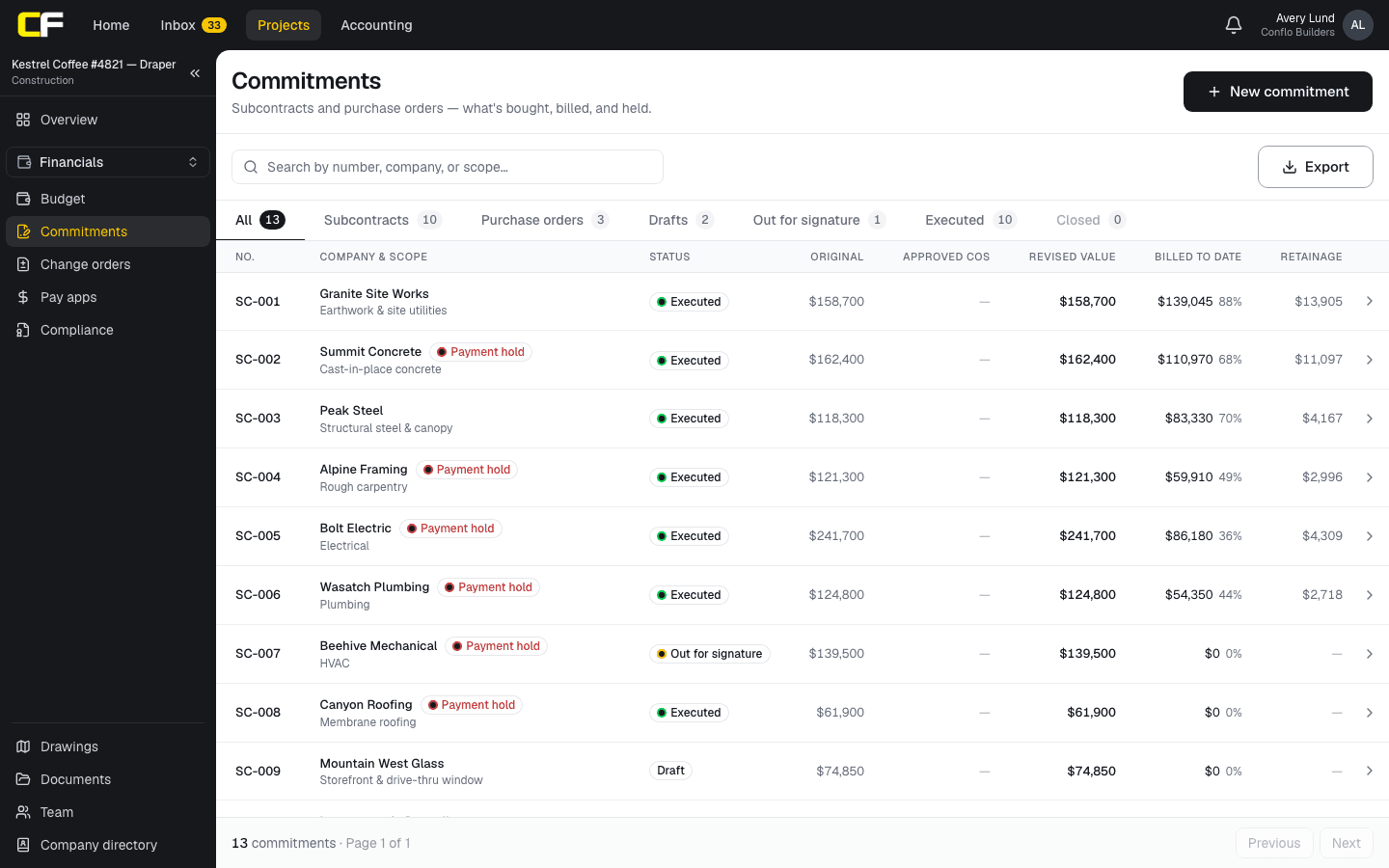
In Conflo's commitments, purchase orders sit beside subcontracts. A PO carries a delivery date, a tax rate and a ship-to address, and POs are numbered on their own sequence.
The bottom line
A purchase order buys material on stated terms; it is a contract once the supplier accepts it.
Tie every PO to the approved submittal and a delivery date you can hold the supplier to.
Sources
- FAR 13.004, Legal effect of quotations — Acquisition.gov, U.S. General Services Administration. Read October 22, 2026.
- FAR 13.302-1, Purchase orders: general — Acquisition.gov, U.S. General Services Administration. Read October 22, 2026.
- FAR 44.101, Definitions (subcontract) — Acquisition.gov, U.S. General Services Administration. Read October 22, 2026.
Questions
Does a PO need retainage?
Usually not. Material suppliers are typically paid in full on delivery and invoice, unless the PO says otherwise.
Is a supplier's quote a contract?
Usually not. Under federal rules a quotation is not an offer: the order is the offer, and the contract forms when the supplier accepts it. Private deals can differ, so put every term that matters in the PO.
Related
Definition
What Is a Subcontract?
A subcontract is the GC's contract with a sub for part of the prime contract's work. What it holds, and how it differs from a purchase order.
· 3 min read
Preconstruction
How Do You Buy Out a Construction Job?
Construction buyout step by step: scope review, leveling, award, the subcontract and its exhibits, compliance documents, and savings against budget.
· 7 min read
Definition
What Is a Pay Application in Construction?
A pay application is a contractor's monthly request for payment against the schedule of values, less retainage and earlier payments. With an example.
· 3 min read
Preconstruction
How Do You Write a Purchase Order for Materials?
What a construction purchase order for materials includes: items, delivery and freight terms, submittal release, stored materials and a worked example.
· 7 min read
Role hub
The General Contractor's Guide: Bid to Closeout
What a general contractor is responsible for at every phase of a commercial job, from bidding and buyout to RFIs, change orders, pay apps and closeout.
· 8 min read