
How Does a Subcontractor Fill Out a Pay Application?
By Wyatt Cooper · Published · 9 min read
Key takeaways
- A sub's pay application bills each schedule-of-values line by percent complete, adds stored materials, then subtracts retainage and earlier payments to reach the amount due.
- Many GCs use the AIA G702 and G703 layout or their own form; AIA designed G702 for a contractor with a direct agreement with the owner.
- In the worked example below, $52,470.23 of new work and stored materials brings a payment due of $47,223.21 after 10% retainage.
- Send the lien waiver your GC asks for with every pay app: conditional for this payment, unconditional for the last one, on your state's statutory form where one exists.
To fill out a pay application as a subcontractor, start from the schedule of values in your subcontract. For each line, enter work completed this period (usually as a percent complete) and materials stored, add previous billing to get the total to date, and add executed change orders as their own lines. Subtract retainage at your subcontract's rate and your previous payments to get the amount due. Attach the lien waivers and backup your GC requires, and submit by the subcontract's due date.
Your GC's form and due date come from the subcontract
A pay application (pay app) is your monthly bill to the general contractor for work done to date. The GC uses it to build its own pay application to the owner, so your pay app has to arrive in the GC's format and on the GC's schedule. Find three things in your subcontract before the first billing:
- The form. Many GCs use a layout based on the AIA G702 (Application and Certificate for Payment) and G703 (Continuation Sheet). The AIA's summary of G702 describes it as designed for a project where the contractor has a direct agreement with the owner, so many GCs adapt the layout for subs or use their own form. Use whatever your subcontract or the GC's billing instructions require.
- The due date. Often a set day each month, so the GC can bill the owner on time. Late pay apps commonly roll to the next month's billing.
- The attachments. Lien waivers, certified payroll on prevailing-wage jobs, stored-material backup, insurance certificates.
Build the schedule of values once, and bill against it every month
The schedule of values (SOV) splits your subcontract sum into lines: mobilization, each phase of work, major materials, closeout. It is usually agreed with the GC at the start and is not changed without the GC's agreement. It starts from the scope the GC leveled your bid against.
Good SOV lines are small enough to measure and match how the work is actually built. Split material and labor on big-ticket items (fixtures, switchgear) so you can bill materials when they arrive and labor when it is installed. Keep closeout (testing, O&M manuals, as-builts) on its own line, because the GC will hold it until those are delivered.
Bill each line by percent complete, then add stored materials
For each SOV line, work out the percent complete to date and enter this period's share. Bill what is in place, not what is planned. A GC's project manager will check your percentages on site.
Stored materials are materials delivered but not yet installed. Many contracts allow billing them, with backup: the supplier invoice, proof they are on site or in a bonded warehouse, and sometimes insurance or a bill of sale. Federal construction contracts allow payment for material delivered to the site, and off site only where the contract allows it and the contractor shows title (FAR 52.232-5). Once installed, stored materials move into work completed.
No line can bill past 100% of its scheduled value. Extra work needs a change order.
Add executed change orders as their own lines
An executed change order (signed by the GC) increases your subcontract sum. Add it to the SOV as a new line with its own scheduled value and bill it like any other line. Do not bill pending or unsigned change orders; many GCs will send the whole pay app back if you do. How the change was priced is in how to price a change order.
Keep a log of change orders by number, with status and amount, and reconcile it with the GC's log every month.
A worked example: pay app 3 for a fictional plumbing sub
The companies and job are fictional. "Marrow Plumbing" has a $268,400.00 subcontract with a GC, "Stonebridge Builders", on the "Fenwick Library Renovation". Retainage is 10%. Change order 1, for added cleanouts, was executed for $6,350.00 and finished this month. This is pay app 3. Previous billing (pay apps 1 and 2) totals $93,786.16.
This period, above-ground rough-in went from 40% to 65% of its $98,215.40 line, so this period is 25%: $98,215.40 × 0.25 = $24,553.85. Fixtures worth $21,566.38 were delivered and invoiced and are stored on site.
| Line | Description | Scheduled value | Previous | This period | Stored | Completed and stored to date | % | Balance to finish |
|---|---|---|---|---|---|---|---|---|
| 1 | Mobilization and submittals | $8,000.00 | $8,000.00 | $0.00 | $0.00 | $8,000.00 | 100.00% | $0.00 |
| 2 | Underground rough-in | $46,500.00 | $46,500.00 | $0.00 | $0.00 | $46,500.00 | 100.00% | $0.00 |
| 3 | Above-ground rough-in | $98,215.40 | $39,286.16 | $24,553.85 | $0.00 | $63,840.01 | 65.00% | $34,375.39 |
| 4 | Fixtures (material) | $71,900.00 | $0.00 | $0.00 | $21,566.38 | $21,566.38 | 29.99% | $50,333.62 |
| 5 | Fixture setting and trim | $31,784.60 | $0.00 | $0.00 | $0.00 | $0.00 | 0.00% | $31,784.60 |
| 6 | Testing, startup and closeout | $12,000.00 | $0.00 | $0.00 | $0.00 | $0.00 | 0.00% | $12,000.00 |
| 7 | CO 1: added cleanouts | $6,350.00 | $0.00 | $6,350.00 | $0.00 | $6,350.00 | 100.00% | $0.00 |
| Totals | $274,750.00 | $93,786.16 | $30,903.85 | $21,566.38 | $146,256.39 | 53.23% | $128,493.61 |
| Item | Calculation | Amount |
|---|---|---|
| Original subcontract sum | Lines 1–6 | $268,400.00 |
| Net change by change orders | CO 1 | $6,350.00 |
| Subcontract sum to date | $268,400.00 + $6,350.00 | $274,750.00 |
| Completed and stored to date | Schedule of values total | $146,256.39 |
| Retainage (10%) | $146,256.39 × 0.10 = $14,625.639 | $14,625.64 |
| Total earned less retainage | $146,256.39 − $14,625.64 | $131,630.75 |
| Less previous payments | $93,786.16 − 10% retainage of $9,378.62 | $84,407.54 |
| Current payment due | $131,630.75 − $84,407.54 | $47,223.21 |
| Balance to finish, including retainage | $274,750.00 − $131,630.75 | $143,119.25 |
The check: new billing this period is $30,903.85 + $21,566.38 = $52,470.23. Retainage on it is $14,625.64 − $9,378.62 = $5,247.02, and $52,470.23 − $5,247.02 = $47,223.21, the same as the current payment due. Percentages are rounded to two decimals. The retainage post covers how the 10% is reduced and released.
Send the lien waivers that travel with the pay app
Most GCs require lien waivers with each pay app, because the owner and lender require them from the GC. Two kinds matter, and each comes in a progress-payment and a final-payment version:
- Conditional waiver: gives up lien rights for a stated amount only when that payment is actually received. Send it with this pay app.
- Unconditional waiver: says you have been paid and gives up lien rights for that amount, whether or not the money clears. Send it only after you are paid, usually with the next pay app for the previous payment.
- 1SubSubmits the pay app with a conditional waiver for this payment and an unconditional waiver for last month's
- 2GC project managerReviews the lines against the work in place; approves or sends back the wrong lines
- 3GCBills the owner on its own pay application, with the subs' waivers behind it
- 4OwnerPays the GC, less the owner's retainage
- 5GCPays the sub, less the sub's retainage, as the subcontract's payment terms say
- 6SubSends the unconditional waiver for that payment with next month's pay app
Several states prescribe the wording. Texas makes a waiver unenforceable unless it substantially complies with the statutory form, and sets four forms: conditional and unconditional, for progress and final payment (Texas Property Code § 53.284). Florida provides statutory progress and final payment forms and says a lien right may not be waived in advance (Florida Statutes § 713.20). Other states differ. Use your state's form where one exists, and never sign an unconditional waiver for money you have not received.
Why pay apps get rejected
- Percentages ahead of the work: the GC's walk does not match your billing.
- Unsigned change orders billed: only executed changes belong on the pay app.
- A missing or wrong lien waiver, or an unconditional waiver for the last payment that never arrived.
- Stored materials without backup: no invoice, no proof of delivery.
- Arithmetic that does not tie: the SOV totals do not match the summary, or previous billing differs from the GC's records.
- Late submission, after the GC's cutoff for this month's owner billing.
- The wrong form, or missing attachments the subcontract lists, such as certified payroll.
When a pay app comes back, fix only the lines the GC flagged and resubmit quickly; most GCs bill the owner on a fixed day.
How it works in Conflo
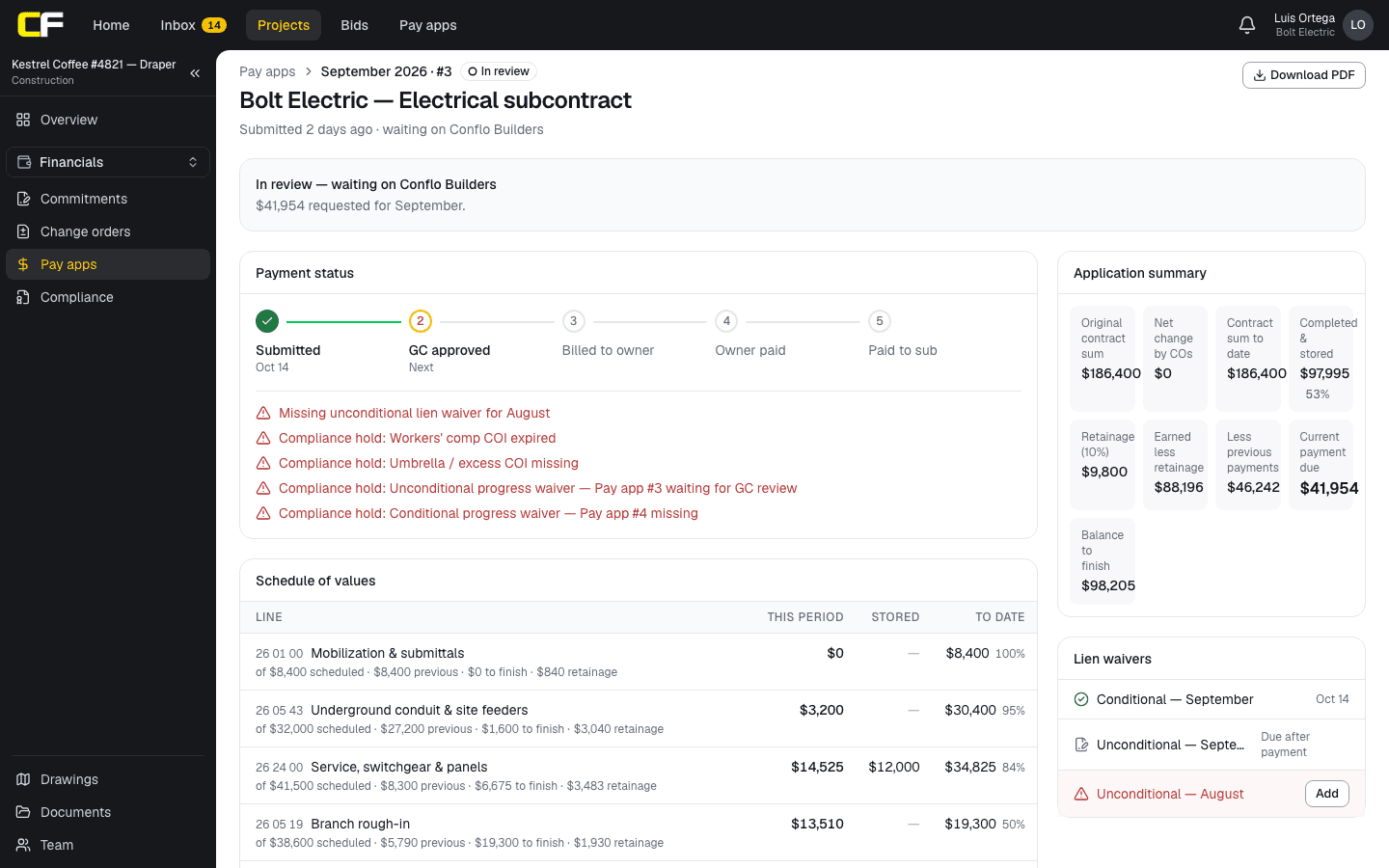
When a GC runs pay apps in Conflo, a subcontractor submits its own pay app to the GC, against the schedule of values from its subcontract, and the GC rolls approved sub billing into the owner pay app. Each month the sub enters this period's percent complete and any stored materials per line; previous billing carries forward and no line can bill past 100%. Retainage, previous payments and current payment due are calculated to the cent. The sub ticks that its conditional lien waiver is included and picks who at the GC reviews it.
The GC approves it or sends back only the wrong lines, each with a note, and the sub revises and resubmits. A payment tracker shows where the money is, from submitted to paid. A PDF prints in Conflo's own layout, not the AIA forms. Limits today: executed change orders raise the subcontract sum but are not yet lines a sub can bill, on the pay app, waivers are recorded as received dates (the signed waiver documents are requested and reviewed in Compliance), and the subcontract's due date is not tracked.
The bottom line
A pay app that gets paid on time is predictable: the GC's form, the agreed schedule of values, honest percentages, stored materials with backup, only executed change orders, the right waiver, and arithmetic that ties. Get those right every month and the GC has no reason to send it back.
Before your first billing, ask the GC for its form, its cutoff date and its waiver requirements in writing.
Sources
- Summary: G702–1992, Application and Certificate for Payment — AIA Contract Documents (The American Institute of Architects). Read October 16, 2026.
- FAR 52.232-5, Payments under Fixed-Price Construction Contracts — Acquisition.gov, U.S. General Services Administration. Read October 16, 2026.
- Texas Property Code § 53.284, Waiver and Release Forms — Texas Legislature. Read October 16, 2026.
- Florida Statutes § 713.20, Waiver or release of liens — The Florida Senate. Read October 16, 2026.
Questions
How does a subcontractor fill out a pay application?
Start from your subcontract's schedule of values. For each line, enter this period's work (usually as percent complete) and stored materials, add previous billing for the total to date, and add executed change orders as lines. Subtract retainage and previous payments to get the amount due, then attach lien waivers and submit on time.
Do subcontractors have to use the AIA G702 and G703?
Only if the subcontract requires it. The AIA designed G702 and G703 for a contractor with a direct agreement with the owner, and many GCs adapt that layout for subs or use their own form. Use the format your subcontract or the GC's billing instructions specify.
Can a subcontractor bill for stored materials?
Often, yes, if the subcontract allows it and you provide backup: the supplier invoice and proof the material is on site or in approved storage. Off-site storage usually needs more, such as proof of title and insurance. Retainage normally applies to stored materials too.
What is the difference between a conditional and an unconditional lien waiver?
A conditional waiver gives up lien rights for an amount only once that payment is received. An unconditional waiver says you have been paid and takes effect whether or not the money clears. Send conditional waivers with a pay app and unconditional ones only after payment. Forms vary by state.
Why do GCs reject subcontractor pay apps?
The usual reasons are percentages ahead of the work in place, unsigned change orders billed, a missing or wrong lien waiver, stored materials without backup, totals that do not tie to the summary, and missing the GC's monthly cutoff. Fix only the flagged lines and resubmit quickly.
Related
Template
Free Pay Application Template With Schedule of Values
A free Excel pay application: a summary sheet and a schedule of values with change orders, stored materials and retainage, calculated. No email needed.
· 4 min read
Money
How Do You Fill Out a Conditional Lien Waiver?
Fill out a conditional lien waiver field by field: the claimant, customer, through date, check details and exceptions, tied to the pay app's figures.
· 8 min read
Money
How Can a Subcontractor Get Paid Faster?
Subcontractors get paid faster by billing on the GC's cutoff, sending clean pay apps and waivers, and using the prompt-pay dates that start the clock.
· 6 min read
Money
How Do You Bill a Change Order on a Pay App?
Add an executed change order to your pay app: its own line, the new contract sum, partial billing, deducts and retainage, with a worked example.
· 7 min read
Money
How Do You Bill for Stored Materials on a Pay App?
Bill delivered but uninstalled materials: the backup owners ask for, on site vs off site, and how stored amounts move to installed work. Worked example.
· 7 min read
Role hub
The Subcontractor's Guide: Bidding to Getting Paid
Every step of a commercial job from the subcontractor's seat: bidding, the subcontract, submittals, RFIs, change orders, pay apps, retainage and closeout.
· 9 min read