
How Does a GC Review a Sub's Change Order Request?
By Wyatt Cooper · Published · 8 min read
Key takeaways
- Review a sub's request in the order the owner will challenge it: is it a change at all, was notice given in time, is the scope clear, then the price.
- Check each priced group against something you can see: hours against the work and the crew, materials against quotes, equipment against what is already on site.
- Hold the sub to the markup its subcontract allows, applied once, and add your own markup only on the total you accept.
- In the worked example, a $6,947.46 request becomes $6,214.08 after four hours of base-scope work and the markup are corrected, and the GC carries $6,524.78 to the owner.
To review a subcontractor's change order request, first decide whether the work is a change: compare it with the subcontract scope, the drawings and the document the sub cites. Then check that notice was given on time, that the scope is clear, and that labor hours, material prices, equipment and markup are supported and allowed by the subcontract. Write down every adjustment, send it back or accept it, and add your own markup only once you agree the cost.
Why the GC's review comes first
A subcontractor's change order request is a proposal, not a change. The GC is the only party who can test it against both contracts: the subcontract the sub signed and the prime contract with the owner. If you pass a weak request up the chain, the owner or architect will cut it, and you either absorb the difference or go back to the sub weeks later. Reviewing it properly once is faster than arguing it twice.
The review has two halves. Entitlement asks whether the sub is owed anything at all. Quantum asks how much. Settle entitlement first; pricing work that is already in the sub's scope wastes everyone's time. Where this fits in the rest of the job is in the general contractor's guide and the project lifecycle.
- 1SubcontractorGives notice, then sends the priced request with backup
- 2GCChecks entitlement, notice and scope; checks and corrects the price
- 3GCSends it back with reasons, or accepts the cost and adds its own markup
- 4Owner and architectReview the GC's change order and approve or reject it
- 5GCIssues the matching change to the subcontract
Step 1: Is it a change, and was notice on time?
Read the cause the sub cites (an RFI answer, a bulletin, an owner direction, a field condition) and then read the sub's scope: the subcontract's scope article, its exhibits, the drawings and specification sections it lists, and the bid it was awarded on, including exclusions. If the drawings showed the work, it is not a change, however reasonable the request looks.
Then check notice. Your subcontract sets the period, and it usually points at the prime contract's. The federal changes clause shows why the dates matter: except for defective specifications, no adjustment is made for costs incurred more than 20 days before the contractor gives written notice of a change by direction, and the contractor must assert its right to an adjustment within 30 days of a written change order or of its notice, unless the Government extends the period (FAR 52.243-4, paragraphs (d) and (e)). If the sub's notice was late, you may be late with the owner too.
Step 2: Check the price group by group
| Part | What to check | Common correction |
|---|---|---|
| Scope | Every item is new or changed work, described so the owner can follow it | Remove items the base scope already covers |
| Labor hours | Hours fit the quantity and the crew; your superintendent agrees | Reduce hours for base-scope or duplicated tasks |
| Labor rate | Burdened rate matches the subcontract's rate sheet or payroll records | Use the agreed rate, not a premium rate |
| Materials | Quantities match the drawing; prices match quotes or invoices; tax is right | Ask for the supplier quote |
| Equipment | Rental is needed for this change and not already on site for base work | Remove equipment already paid for |
| Markup | Rate is the subcontract's, applied once, on the right base | Cut to the allowed rate; no markup on markup |
| Time | Days added are on the path to completion, with a reason | Ask for the schedule logic |
Where your contract sets no markup, a public agency's published rates are a reasonable reference. Caltrans' force-account rules, for example, add 35% to labor (after a labor surcharge), 15% to materials and equipment, and 10% to subcontracted work (Caltrans payment module). The method you are checking against is in how to price a change order; the change order pricing calculator rebuilds a request's total from its groups in a minute.
A worked example: added circuits on a fictional office fit-out
The job is fictional: "Halvorsen Office Fit-Out". The architect's bulletin 6 adds eight dedicated circuits for a new copy room. A fictional electrical sub, "Brightline Electric", gave written notice four days after the bulletin and sent change order request 011. Its fictional subcontract allows 15% overhead and profit on its own work and a labor rate of $96.50 an hour.
| Line | Requested | Accepted by the GC | Reason |
|---|---|---|---|
| Labor | 32 h × $96.50 = $3,088.00 | 28 h × $96.50 = $2,702.00 | The base drawings already show the panel feeder pull; 4 h removed |
| Materials | $2,140.00 + 8.25% tax ($176.55) = $2,316.55 | $2,316.55 | Matches the supplier quote |
| Equipment | Scissor lift, $385.00 | $385.00 | Lift is for the copy room ceiling only; accepted |
| Direct cost | $5,789.55 | $5,403.55 | |
| Overhead and profit | 20% = $1,157.91 | 15% = $810.53 | Subcontract allows 15% (15% × $5,403.55 = $810.5325) |
| Total | $6,947.46 | $6,214.08 | $733.38 less |
| Time | 2 working days | 1 working day | Only the copy room circuits wait; the rest of the floor proceeds |
The arithmetic: $2,702.00 + $2,316.55 + $385.00 = $5,403.55, and $5,403.55 + $810.53 = $6,214.08. If the fictional prime contract allows the GC 5% on subcontracted work, the GC adds $310.70 (5% × $6,214.08 = $310.704) and carries $6,524.78 to the owner.
Review of change order request 011 — Copy room circuits
- Project
- Halvorsen Office Fit-Out (fictional)
- From
- The GC's project manager
- Entitlement
- Accepted: bulletin 6 adds the copy room circuits; notice received four days after it
- Labor
- Reduced from 32 h to 28 h; the panel feeder pull is on base sheet E-201
- Markup
- Reduced from 20% to 15%, per the subcontract's changes article
- Accepted cost
- $6,214.08 and 1 working day
- Next step
- Resubmit at $6,214.08, or send backup for the 4 h by Friday
Send it back or accept it, in writing
- If you change a number, say which line, by how much and why, with the document that supports you. A bare lower number starts an argument; a reason ends one.
- If the work is not a change, say so early and cite the drawing or specification section, so the sub can respond before it prices more.
- Keep the sub's backup with the change order. The owner will ask you for it, and you cannot defend a number you cannot show.
- Once the owner signs, issue the matching change to the subcontract promptly, so the sub can bill it on its next pay application.
AIA publishes a contractor–subcontractor change order form for that last step (G701S); once executed, it indicates agreement on the change's terms, including the change in price and time. How the sub then bills the change is in how a subcontractor fills out a pay application.
How it works in Conflo
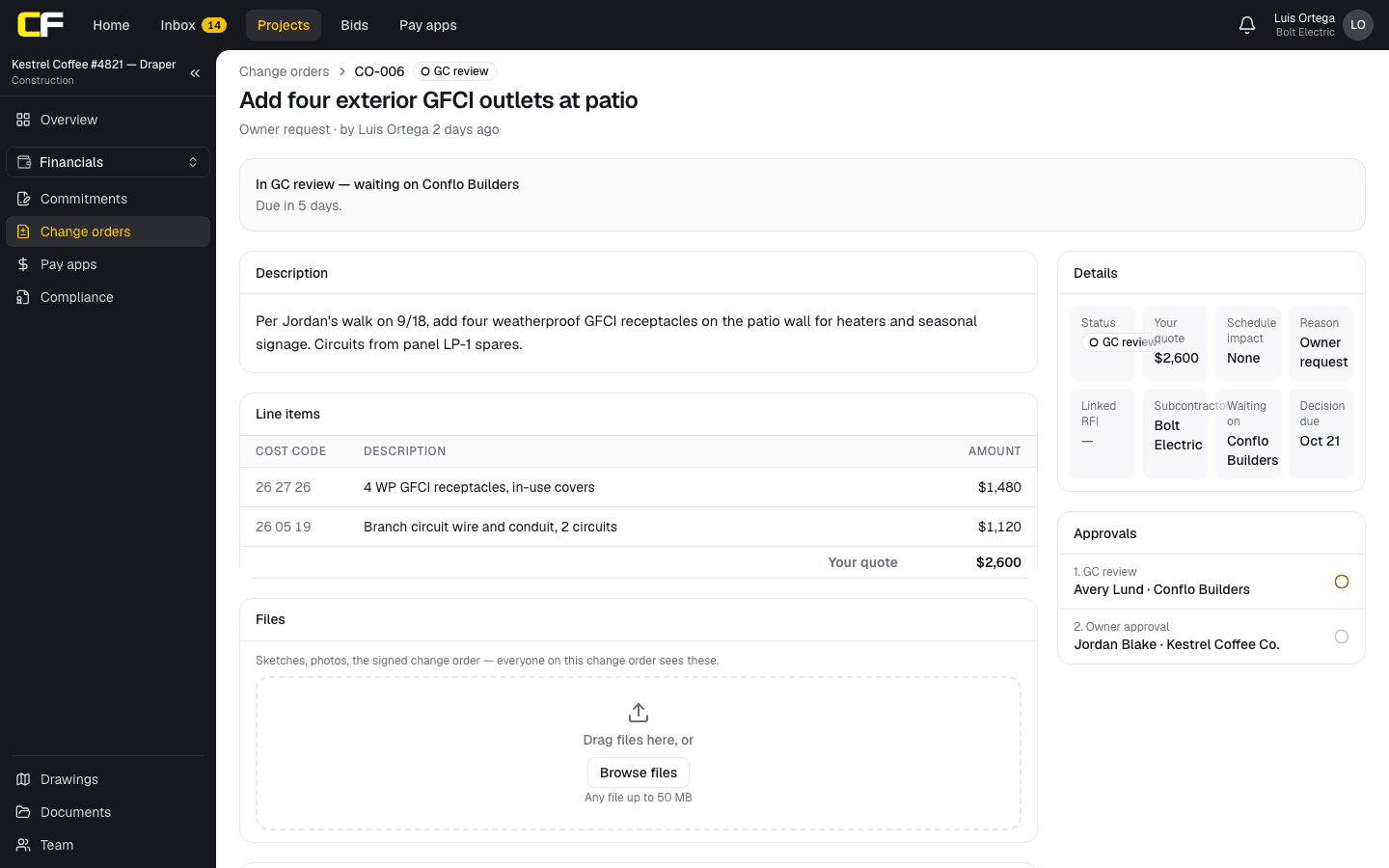
In Conflo a subcontractor sends its change order to the GC person it picks, and the GC's project manager takes it over. The GC reviewer can edit the sub's lines, set the markup (0% to 50%, taken once on the total cost) and send it to the owner approvers they pick, or send it back with a reason, which is required. The owner never sees a quote the GC sent back.
The sub sees its own cost, never the GC's markup or the owner's price. The owner sees each line at the owner's price, with the markup spread across the lines and no cost codes. Cost backup is seen only by the GC and that sub. When the owner approves, the change order is executed: its cost goes into the budget's approved changes by cost code, and the sub's cost shows as an approved change order on its commitment. Limits today: a line is a cost code, a description and one amount, without separate fields for hours, rates or equipment.
The bottom line
Review a sub's change order request in the owner's order: entitlement, notice, scope, then each priced group against something you can see, with the subcontract's markup applied once. Write down every adjustment and its reason.
A request checked this way usually goes to the owner once, and the sub knows exactly what it can bill.
Sources
- FAR 52.243-4, Changes — Acquisition.gov, U.S. General Services Administration. Read October 22, 2026.
- Local Assistance Module 8: Payment (January 2026), force account under Standard Specifications 9-1.04 — California Department of Transportation (Caltrans). Read October 22, 2026.
- Summary: G701S–2017, Change Order, Contractor-Subcontractor Version — AIA Contract Documents. Read October 22, 2026.
Questions
What should a GC check first on a subcontractor's change order request?
Whether the work is a change at all. Compare the request with the subcontract scope, its exhibits, the drawings and the bid's exclusions. If the base documents show the work, the request fails before price matters.
Can a GC reject a change order request for late notice?
It depends on the subcontract and the law that applies. Many subcontracts make written notice within a set period a condition of any adjustment, and federal contracts allow no adjustment for costs incurred more than 20 days before notice of a change by direction.
How much markup should a GC allow on a sub's change order request?
What the subcontract says, applied once to the direct cost. If it is silent, the rate is negotiated; published public rates, such as Caltrans' force-account markups, are a reasonable reference.
Does the GC add its own markup on top of the sub's?
Usually yes, at the rate the prime contract allows on subcontracted work, applied to the sub's accepted total. It covers the GC's cost of managing the change and is not double-counting if each markup is applied once.
What backup should a GC ask the sub for?
The document that caused the change, crew hours and the rate basis, supplier quotes or invoices, equipment rental invoices, any lower-tier quote, and the schedule reason for any days requested.
Related
Money
How Does a Subcontractor Write a Change Order Request?
A sub's change order request: notice first, then scope, priced direct cost, your markup, days and backup the GC can pass to the owner. Worked example.
· 9 min read
Money
How Do You Price a Change Order?
Price a change order from direct cost (burdened labor, materials, equipment, sub quotes), then the markups and time your contract allows. Worked example.
· 9 min read
Template
Change Order Pricing Calculator
A free change order pricing calculator (Excel): direct cost, markup on your own and subcontracted work, insurance and bond, to the cent. No email needed.
· 4 min read
Money
How Do You Issue a Subcontract Change Order?
Issue a subcontract change order the sub can sign and bill: what goes on it, the revised subcontract sum, time, and the reservation of claims. Example.
· 8 min read
Role hub
The General Contractor's Guide: Bid to Closeout
What a general contractor is responsible for at every phase of a commercial job, from bidding and buyout to RFIs, change orders, pay apps and closeout.
· 8 min read