
How Can a Subcontractor Get Paid Faster?
By Wyatt Cooper · Published · 6 min read
Key takeaways
- Most sub payment delay is built into the chain: the GC bills the owner once a month, the owner has weeks to pay, and the sub is paid days after the GC is.
- A complete pay app submitted before the GC's cutoff, with the waivers and backup the subcontract asks for, avoids the commonest reason for waiting a month more.
- Prompt payment statutes put a clock on each link, such as seven days for the GC to pay subs after being paid in California, Texas, New York and North Carolina private work.
- Two dates prove a late payment: when your request was received and when the GC was paid, so ask for the second one and keep both.
A subcontractor gets paid faster by fitting the GC's billing cycle: submit a complete pay application before the GC's monthly cutoff, with the lien waivers, backup and approved change orders it needs, so nothing is sent back. Then know the prompt payment deadline that applies, often seven days after the GC is paid, track when the owner pays the GC, and follow up in writing citing the statute and the interest owed when a payment is late.
Why subs wait: the payment chain
A sub is usually paid out of the owner's payment to the GC. Each month the GC collects sub pay apps, builds its own application, sends it to the owner (and often an architect or lender), and pays subs once the owner pays. Each step has its own timing, and a sub's money waits for all of them.
- 1Sub, September 25Submits its September pay app to the GC before the GC's cutoff
- 2GC, October 1Submits the owner pay application; the owner receives the written payment request
- 3Owner, by November 5Pays the GC within 35 days after receiving the request (§ 28.002(a)); here it pays on October 30
- 4GC, by November 6Pays the sub its share within seven days after receiving the owner's payment (§ 28.002(b))
The count: October 1 plus 35 days is November 5; October 30 plus seven days is November 6. If the GC pays late, the unpaid amount bears interest at 1.5% per month starting the day after it was due (Tex. Prop. Code §§ 28.002 and 28.004). A sub that misses the September 25 cutoff usually waits for the next month's application, which adds about a month.
Seven habits that shorten the wait
- Know the cutoff. Ask the GC for its monthly billing date and the date it submits to the owner, and put both on your calendar for the whole job.
- Send a clean pay app. Bill against the approved schedule of values, only approved change orders, and stored materials with the backup the contract asks for: how to fill out a pay application as a subcontractor.
- Send the waivers with it. A conditional waiver for this period and the unconditional for last month's payment are common conditions of payment: how to fill out a conditional lien waiver.
- Keep compliance current. An expired insurance certificate or missing W-9 can hold a payment that is otherwise approved.
- Get change orders signed before you bill them. Unapproved work is the line most often sent back; see how to price a change order.
- Ask when the GC was paid. Prompt-pay clocks for subs usually start when the GC receives the owner's payment.
- Follow up in writing, with dates. Name the statute, the due date and the interest, politely and early.
The prompt-pay deadlines that start the clock
| Job | GC must pay the sub | If late | Statute |
|---|---|---|---|
| Federal construction | Within 7 days out of amounts paid to the prime (required subcontract clause) | Interest at the Treasury rate | 31 U.S.C. § 3905(b) |
| California, private and public | Not later than seven days after each progress payment, unless otherwise agreed in writing | 2% of the amount due per month | Bus. & Prof. Code § 7108.5 |
Some statutes also limit pay-if-paid. North Carolina says payment by the owner "is not a condition precedent for payment to a subcontractor," and an agreement to the contrary is unenforceable (G.S. 22C-2). Texas lets an unpaid contractor or sub suspend work after 10 days' written notice in some cases (§ 28.009); read the conditions before you rely on it. Sources: 31 U.S.C. ch. 39, Cal. Bus. & Prof. Code § 7108.5. Texas is in the payment chain above; the deadlines for New York, North Carolina and Florida, and for the owner paying the GC, are in what prompt payment acts require.
When a payment is late
- Confirm what was approved. Ask whether any line was sent back and whether a waiver or certificate is missing.
- Ask when the GC was paid, in writing.
- Send a written notice that cites the contract clause and the statute, the due date, the amount and the interest accruing.
- Protect your lien or bond rights in parallel. Deadlines keep running while you wait: see mechanic's lien deadlines.
- Talk to a construction attorney before suspending work or filing anything.
How it works in Conflo
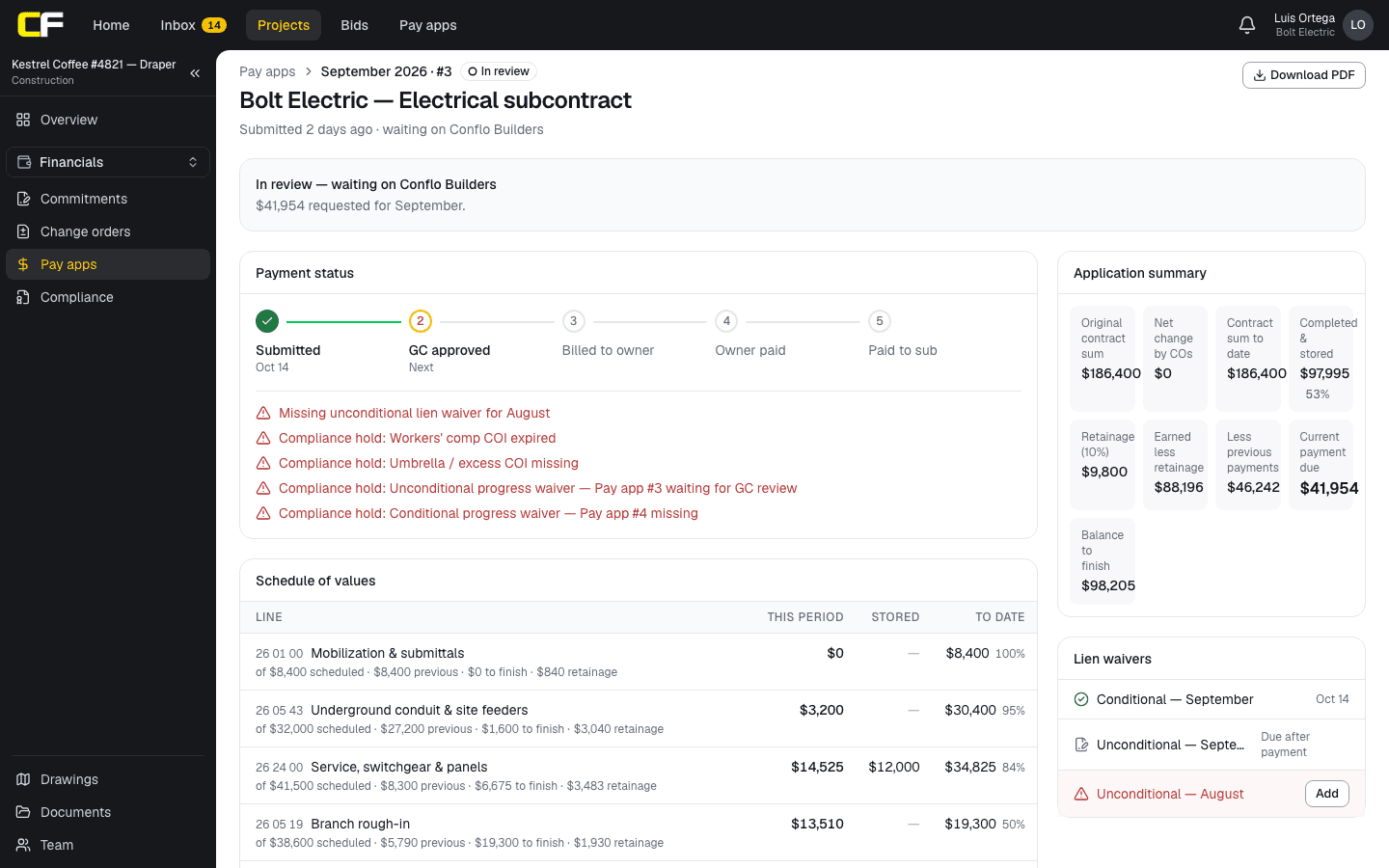
On Conflo's pay applications, a sub bills by percent complete against its schedule of values and can include its conditional lien waiver for the month when it submits. The GC can send back only the lines that are wrong, each with a note, so the sub fixes those and resubmits. The sub's pay app shows a payment tracker with the date of each step, submitted, GC approved, billed to owner, owner paid and paid to sub, and lists by name what is holding payment: lines sent back, a missing waiver or a compliance hold such as an expired insurance certificate.
Not built: prompt-pay deadline alerts, interest calculations or late-payment notices.
The bottom line
Getting paid faster is mostly about not missing a cycle: a complete pay app before the cutoff, waivers and compliance documents in order, and change orders signed before they are billed. After that, the statute's clock and your written dates do the work.
This week, ask each GC you work for for its billing cutoff and how you will learn when the owner pays, and check your contracts' payment clauses against your state's prompt payment statute.
Sources
- Texas Property Code Chapter 28, Prompt Payment to Contractors and Subcontractors — Texas Legislature. Read October 16, 2026.
- California Business and Professions Code § 7108.5 — California Legislative Information. Read October 17, 2026.
- North Carolina G.S. Chapter 22C, Payments to Subcontractors — North Carolina General Assembly. Read October 16, 2026.
- 31 U.S.C. Chapter 39, Prompt Payment (U.S. Code, 2024 edition) — U.S. Government Publishing Office, govinfo. Read October 16, 2026.
Questions
How long does a GC have to pay a subcontractor?
Usually a set number of days after the GC is paid: seven days on federal jobs and under California, Texas private and North Carolina private law, unless a statute allows the contract to say otherwise. Your subcontract and the project's state decide.
Why does my pay app keep getting sent back?
Common reasons are billing past the approved schedule of values, billing change orders that are not yet signed, stored materials without backup, and missing lien waivers or insurance certificates. Fix the specific lines and resubmit before the next cutoff.
Can a subcontractor charge interest on a late payment?
Often, under the governing prompt payment statute: 1.5% per month on Texas private work, 2% per month in California, 1% per month in North Carolina, and the Treasury rate on federal jobs. Check the statute and your contract.
Is pay-if-paid enforceable?
It depends on the state. North Carolina makes an agreement that owner payment is a condition precedent to paying a sub unenforceable (G.S. 22C-2). Other states enforce some versions. Ask a construction attorney in your state.
Related
Money
What Are Prompt Payment Acts in Construction?
Prompt payment acts set how fast owners and contractors must pay and what late payment costs. The federal act and five states' rules, with a timeline.
· 8 min read
Money
How Does a Subcontractor Fill Out a Pay Application?
A subcontractor's pay app bills percent complete and stored materials per schedule-of-values line, less retainage and prior payments, with a lien waiver.
· 9 min read
Money
How Do You Fill Out a Conditional Lien Waiver?
Fill out a conditional lien waiver field by field: the claimant, customer, through date, check details and exceptions, tied to the pay app's figures.
· 8 min read
Money
Pay-if-Paid vs Pay-When-Paid: What Do They Mean?
Pay-if-paid shifts the risk of owner nonpayment to the sub; pay-when-paid only sets timing. How to tell them apart, and three state statutes on them.
· 8 min read
Money
How Do You Make a Miller Act Payment Bond Claim?
A Miller Act payment bond claim, step by step: who can claim, the 90-day notice, the one-year suit deadline from 40 U.S.C. § 3133, with dated timeline.
· 8 min read
Role hub
The Subcontractor's Guide: Bidding to Getting Paid
Every step of a commercial job from the subcontractor's seat: bidding, the subcontract, submittals, RFIs, change orders, pay apps, retainage and closeout.
· 9 min read