
Retainage Laws in the Five Largest Construction States
By Wyatt Cooper · Published · 10 min read
Key takeaways
- By the Census Bureau's 2022 Economic Census, the five states with the most construction work done were California, Texas, Florida, New York and North Carolina.
- All five cap retainage on most public works, mostly at 5%; Texas allows 10% on public contracts under $5 million and 5% at $5 million or more.
- Private work varies most: California capped private retention at 5% for contracts entered on or after January 1, 2026, New York caps it at 5% on covered private jobs, and Texas, Florida and North Carolina set no general private percentage in the statutes read here.
- Each of the five sets release or pass-down deadlines on at least some jobs, such as 7 or 10 days for a California GC to pay subs their share, with a penalty or interest if retainage is paid late.
Retainage laws differ by state and between public and private jobs. In the five states with the most construction, public-works retainage is capped at 5% in California, Florida, New York and North Carolina, and at 10% or 5% in Texas depending on contract size. Private jobs differ more: California and New York cap it at 5% on covered contracts, while Texas, Florida and North Carolina leave the percentage mostly to the contract. Release deadlines and pass-down rules apply on many jobs. Verify the current statute.
How we chose the five states
The Census Bureau's 2022 Economic Census reports the value of construction work by the state where the work was done (Census Bureau, value of construction work by location, 2022). Of $2.85 trillion of construction work done in the United States in 2022, the five largest states were California ($337.3 billion), Texas ($317.4 billion), Florida ($203.9 billion), New York ($144.7 billion) and North Carolina ($99.1 billion). Those are the five below. (The Census Bureau's monthly value-put-in-place series is national and does not break out every state, which is why the Economic Census is used here.)
Retainage caps and release rules, state by state
| State | Public works | Private work | Release and pass-down |
|---|---|---|---|
| California | Max 5% of each payment and 5% of the contract price, owner to GC and GC to sub (Pub. Contract Code § 7201), unless the agency finds a project substantially complex before bid | For contracts entered on or after Jan. 1, 2026: max 5% of each payment and 5% of the contract price (Civ. Code § 8811); exceptions for certain bonding cases and residential projects up to four stories that are not mixed use | Public: released within 60 days after completion; GC pays subs within 7 days of receiving it (§ 7107). Private: owner pays within 45 days after completion (Civ. Code § 8812); GC pays subs within 10 days (§ 8814) |
| Texas | Max 10% if the contract is under $5 million, 5% at $5 million or more, including stored materials; dams 10% (Gov't Code § 2252.032) | No general cap on contract retainage found in Prop. Code chs. 28 or 53; the owner must reserve 10% of the contract price for 30 days after completion for lien claimants (Prop. Code § 53.101) | Public: a prime may not hold a greater percentage from a sub than the entity may hold from the prime (§ 2252.032(d)); no retainage after completion, including the warranty period (§ 2252.032(e)) |
| Florida | A public entity may withhold up to 5% of each progress payment on construction services over $200,000 (§ 255.078) | No statutory percentage; owner and contractor may agree to withhold a portion until substantial completion (§ 715.12(7)) | Private: owner pays the balance, including retainage, within 14 days after substantial completion and the punch list events in § 715.12(7), or interest accrues |
| New York | State and public-authority owners: not more than 5% of each progress payment; up to 10% only where full performance and payment bonds are not required (State Fin. Law § 139-f). Municipalities and other political subdivisions: the same 5% cap under Gen. Mun. Law § 106-b | Owner: no more than 5% of the contract sum; contractor to sub: no more than 5% and never more than the owner actually retains (Gen. Bus. Law § 756-c), on private contracts of $150,000 or more outside excluded residential work | Private: release no later than 30 days after final approval of the work; 1% per month interest if late (§ 756-c) |
| North Carolina | None on projects under $150,000; at $150,000 or more, max 5%, and no further retainage once 50% complete with surety consent and satisfactory performance (G.S. 143-134.1(b1)) | No cap on the owner in Chapter 22C; a contractor may withhold from a sub a reasonable amount for retainage not exceeding the owner's initial percentage (G.S. 22C-4) | Public: owner releases retainage within 60 days after the pay request once substantial completion is certified or the owner occupies; subs paid on the same terms (143-134.1(b1)) |
Every row has conditions the table cannot carry: dollar thresholds, bonding exceptions, federal-funding exceptions and dates a contract must be signed after. The sections below quote the operative words.
California: a new 5% cap on private work
California's biggest recent change is Civil Code § 8811, added by Stats. 2025, ch. 49 (SB 61) and effective January 1, 2026. For a private work of improvement under a contract entered into on or after that date, retention withheld by the owner from the direct contractor, by the direct contractor from a sub and down the chain "shall not exceed 5 percent of the payment," and total retention may not exceed "5 percent of the contract price" (Cal. Civ. Code § 8811). A subcontract may not withhold a higher percentage than the prime contract. The cap does not apply where a sub fails to furnish a bond after timely written notice, or to a residential project that is not mixed use and does not exceed four stories.
Public works have had a 5% cap since 2012 under Public Contract Code § 7201, with release within 60 days after completion and payment to subs within seven days (§ 7107). Private retention is due within 45 days after completion (Civ. Code § 8812). More detail: California retainage law.
Texas: caps on public jobs, a reserve on private ones
On Texas public works, a governmental entity may not withhold more than 10% on a contract under $5 million or more than 5% on a contract of $5 million or more, and the rate applies to every item in the schedule of values, "including materials and equipment delivered on site to be installed" (Tex. Gov't Code § 2252.032). Private contracts set their own retainage, but Property Code § 53.101 separately requires the owner to reserve 10% of the contract price, or of the value of work done, "for 30 days after the work under the contract is completed" (Tex. Prop. Code ch. 53). That reserve protects lien claimants; it is not the same thing as contract retainage. More: Texas retainage law.
Florida, New York and North Carolina
- Florida public. "A public entity may withhold from each progress payment made to the contractor an amount not exceeding 5 percent of the payment as retainage," and the section does not apply to construction services of $200,000 or less or where conflicting federal funding rules apply (Fla. Stat. § 255.078). Other Florida sections also govern public payments; read the one that applies to your owner.
- Florida private. The Construction Contract Prompt Payment Law lets owner and contractor agree to withhold part of each progress payment until substantial completion, then requires the balance, retainage included, within 14 days after the listed completion events (Fla. Stat. § 715.12).
- New York private. On covered private contracts, the owner may retain "no more than five per centum of the contract sum," a contractor may retain no more than 5% from a sub and never more than the owner actually retains, and retainage is due no later than 30 days after final approval of the work (N.Y. Gen. Bus. Law § 756-c). The article covers projects of $150,000 or more and excludes most small residential work.
- New York public. On contracts awarded by the state, a public department or a public benefit corporation, the owner may retain not more than 5% of each progress payment, or up to 10% on contracts that do not require full performance and payment bonds (N.Y. State Fin. Law § 139-f). Municipalities and other political subdivisions fall under Gen. Mun. Law § 106-b, which also caps retainage at 5% of each progress payment, or up to 10% where no performance bond is required.
- North Carolina public. No retainage on projects under $150,000; otherwise at most 5%, stopping at 50% complete if performance is satisfactory and the surety consents (G.S. 143-134.1).
- North Carolina private. A contractor may withhold from a sub "a reasonable amount for retainage not to exceed the initial percentage retained by the owner" (G.S. 22C-4).
Worked example: the same billing under five public-works caps
A fictional subcontractor has billed $400,000.00 of work completed and stored to date on a public school job. The prime contract is worth $3,200,000.00. Here is the most each state's public-works statute would let the owner hold from the prime on that amount, and so the most the prime could normally pass down to the sub, assuming no exception applies and the project is under 50% complete.
Retainage cap check — $400,000.00 billed to date, $3,200,000.00 prime contract
- California (5%)
- $400,000.00 × 5% = $20,000.00
- Texas (under $5 million, 10%)
- $400,000.00 × 10% = $40,000.00
- Florida (over $200,000, 5%)
- $400,000.00 × 5% = $20,000.00
- New York (bonded contract, 5%)
- $400,000.00 × 5% = $20,000.00
- North Carolina ($150,000 or more, before 50% complete, 5%)
- $400,000.00 × 5% = $20,000.00
The arithmetic is the easy part: 5% of $400,000.00 is $20,000.00 and 10% is $40,000.00. The hard part is which cap applies. The contract may set a lower rate than the statute allows, and the lower one wins. For the period-by-period math, see how to calculate retainage on a pay app.
How it works in Conflo
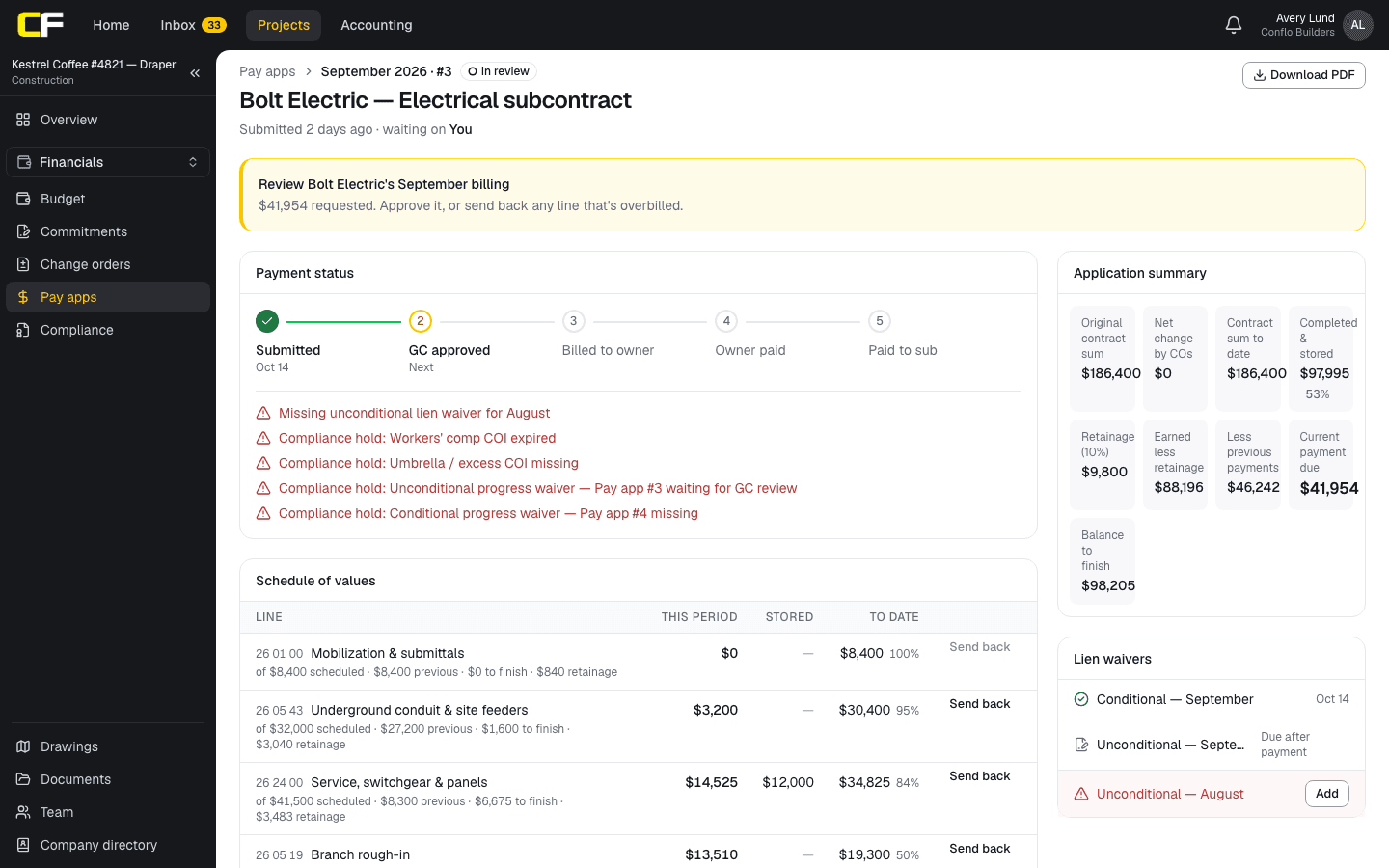
On Conflo's pay applications, each contract carries one retainage percentage, from 0 to 20%, entered when the contract is set up. Retainage is calculated on work completed and stored to date at that rate, so a sub's pay app and the GC's owner pay app each show retainage held to the cent. Conflo does not know your state's cap: you enter the rate your contract and statute allow.
Not built yet: a retainage reduction partway through a job (such as North Carolina's stop at 50% complete), a separate rate for stored materials, a retainage release step and release deadline tracking.
The bottom line
In these five states the public-works rule is usually a hard cap near 5%, while private work ranges from a new 5% cap in California to no statutory percentage at all. The release and pass-down deadlines matter as much as the percentage, because that is where subs wait longest.
Before you sign a subcontract, write down three things from the statute for the project's state: the most retainage that can be held, when it must be released, and how many days the GC has to pass it down.
Sources
- Economic Census: Construction: Value of Construction Work for Location of Construction Work for the U.S. and States: 2022 (EC2223VALCON) — U.S. Census Bureau. Read October 16, 2026.
- California Civil Code § 8811 — California Legislative Information. Read October 17, 2026.
- California Civil Code § 8812 — California Legislative Information. Read October 17, 2026.
- California Public Contract Code § 7201 — California Legislative Information. Read October 17, 2026.
- California Public Contract Code § 7107 — California Legislative Information. Read October 17, 2026.
- Texas Government Code § 2252.032, Retainage — Texas Legislature. Read October 16, 2026.
- Texas Property Code Chapter 53, Mechanic's, Contractor's, or Materialman's Lien — Texas Legislature. Read October 16, 2026.
- Florida Statutes § 255.078 (2026), Public construction retainage — The Florida Senate. Read October 16, 2026.
- Florida Statutes § 715.12 (2026), Construction Contract Prompt Payment Law — The Florida Senate. Read October 16, 2026.
- New York General Business Law § 756-C — New York State Senate. Read October 16, 2026.
- New York State Finance Law § 139-F — New York State Senate. Read October 16, 2026.
- New York General Municipal Law § 106-B — New York State Senate. Read October 17, 2026.
- North Carolina G.S. 143-134.1 — North Carolina General Assembly. Read October 16, 2026.
- North Carolina G.S. Chapter 22C, Payments to Subcontractors — North Carolina General Assembly. Read October 16, 2026.
Questions
What is the maximum retainage by state?
It depends on the state and the kind of job. On public works, California, Florida, New York and North Carolina cap it at 5% (with exceptions), and Texas at 10% under $5 million or 5% at $5 million or more. Private caps exist in California (5% for contracts from January 1, 2026) and New York (5% on covered contracts). Verify the current statute.
Does California limit retainage on private projects?
Yes, for contracts entered into on or after January 1, 2026. Civil Code § 8811 limits retention to 5% of each payment and 5% of the contract price, with exceptions for certain bonding situations and for residential projects up to four stories that are not mixed use.
Is the Texas 10% reserve the same as retainage?
No. Property Code § 53.101 requires a private owner to reserve 10% of the contract price, or of the value of the work, for 30 days after completion to protect lien claimants. Contract retainage is whatever the contract says. They often overlap in practice, but they are separate rules.
Can a GC hold more retainage from a sub than the owner holds from the GC?
Several of these statutes forbid it: California's public and new private caps, Texas public works, New York's private rule and North Carolina's public and private rules all tie the sub's percentage to the prime's. Check your state's exact wording.
Why these five states?
They had the highest value of construction work done in 2022 in the Census Bureau's Economic Census: California, Texas, Florida, New York and North Carolina, in that order.
Related
Money
How Do You Calculate Retainage on a Pay App?
Retainage is a percentage of work completed and stored to date, held back each pay period. How to calculate it, reduce it, release it, with an example.
· 9 min read
Money
California Retainage Law: Private and Public Jobs
California retention rules from the statutes: the new 5% private cap from 2026, the 5% public cap, release deadlines and the 2% monthly penalty.
· 8 min read
Money
Texas Retainage Law: What Property Code Ch. 53 Says
Texas retainage from the statutes: the owner's 10% reserve, notice and lien deadlines for unpaid retainage, and the public-works caps of 10% and 5%.
· 9 min read
Money
How Does a Subcontractor Fill Out a Pay Application?
A subcontractor's pay app bills percent complete and stored materials per schedule-of-values line, less retainage and prior payments, with a lien waiver.
· 9 min read
Role hub
The Subcontractor's Guide: Bidding to Getting Paid
Every step of a commercial job from the subcontractor's seat: bidding, the subcontract, submittals, RFIs, change orders, pay apps, retainage and closeout.
· 9 min read