
How Painting Subs Bid and Bill Commercial Work
By Wyatt Cooper · Published · 12 min read
Key takeaways
- Take off by surface and coating system (square feet of wall, each door frame, linear feet of trim), then turn quantities into hours with your own production rates and into gallons with each product's spread rate.
- Write the trade lines into the bid: the drywall finish level you are painting over, exposed ductwork and pipe in open ceilings, factory-finished items, and that damage by others is a change order, not touch-up.
- Split the schedule of values into prime and finish coats so you can bill the prime coat the month it goes on, and keep a punch and touch-up line so the last return trip has money behind it.
- In the example below, a fictional 24,000-square-foot office fit-out prices at $37,256 of direct cost and $42,844 bid, and its first big pay period bills $18,670 with $1,867.00 retained.
Commercial painting subs bid from the finish schedule and the painting specification: they take off each surface by coating system, convert square feet, door counts and linear feet into labor hours with their own production rates and into gallons with each product's spread rate, then clarify the drywall finish level, exposed mechanical work and damage by others. They bill monthly against a schedule of values split by area and by prime and finish coats, with a final line for punch, touch-up and attic stock.
What a commercial painting scope covers, and what it leaves out
The painting section of the specification (09 90 00 in MasterFormat) lists what gets painted, the coating system for each surface and what is excluded. The federal guide specification is a good model of how detailed that list is (UFGS 09 90 00). It says not to paint surfaces in concealed spaces, defined as "enclosed spaces above suspended ceilings, furred spaces, attic spaces, crawl spaces, elevator shafts and chases", nor "Hardware, fittings, and other factory finished items", unless indicated otherwise. Where a space is painted, it includes "Exposed piping, conduit, and ductwork", their supports and hangers, and grilles and registers. Read your project's version of that list line by line: exposed mechanical work in an open-ceiling office can be a large share of the labor.
Painting is one of the last trades on a job, so it is the one that absorbs everyone else's delay. Where painting sits in the whole job, from bid to closeout, is in the construction project lifecycle; this guide is the painter's part of it.
Take off by surface and coating system
Painters measure what they paint, in the unit that drives the labor. Walls and ceilings are square feet by coating system and by height (a wall you reach from the floor and one you reach from a lift are different prices). Doors and frames are counted each. Trim, handrails and exposed pipe are linear feet. The finish schedule also tells you how many colors there are, and every extra color is another cut line and another setup.
| Surface | Measured in | System, from the spec's paint tables | What changes the price |
|---|---|---|---|
| Gypsum board walls | Square feet, by height band | Primer, intermediate and topcoat (three coats) in the sheen the schedule names | Finish level of the board, number of colors, cut lines at ceilings |
| Gypsum board ceilings and soffits | Square feet | Usually flat, same primer | Height, access around ceiling grid and lights |
| Hollow metal door frames and doors | Each | Metal primer where not shop-primed, then finish coats | Shop-primed or bare, masking hardware |
| Trim, handrails, guardrails | Linear feet | Metal or wood system | Number of pickets and returns |
| Exposed structure, deck, duct and pipe | Square feet of ceiling, or linear feet of pipe | Often a single sprayed dryfall coat over shop primer | Lift rental, masking, overspray protection |
| Concrete masonry walls | Square feet | Block filler, then finish coats | Block filler is a full extra coat and slower |
Labor comes from production rates (square feet per hour per coat, doors per hour), and those are your own: measure them from your crews' past jobs, because no published rate fits every crew and every building. Material is quantity divided by the product's spread rate per coat on its data sheet, times the number of coats. The federal guide specification's interior gypsum board systems, for example, are a primer, an intermediate coat and a topcoat, to a 4-mil total dry film thickness (UFGS 09 90 00). Price the coats the spec calls for, not the two coats you usually do.
Clarifications that keep a painting bid whole
| Trade line | The question | Write in your clarifications |
|---|---|---|
| Drywall finish level | Is the board finished to the level the sheen and lighting need? | Painting priced over the finish level shown; surface defects in the board are by the drywall sub |
| Exposed MEP in open ceilings | Who paints duct, pipe, conduit and hangers? | Included where the spec lists it, by area; factory-finished items excluded |
| Damage by others | Is repainting a wall another trade damaged your touch-up? | Damage by others repaired on a change order, lump sum or time and material |
| Colors | How many colors and accent walls did you price? | The number of colors per area, and a price per added color |
| Sprinkler heads and devices | Who protects them, and who pays for a painted head? | Heads shielded while you paint, as many specs require; replacing heads painted by others excluded |
| Return trips | How many mobilizations are in your price? | Prime, finish and one punch trip included; extra trips at a stated rate |
The drywall-to-paint line is the one most painters lose money on. A wall finished to a lower level than its sheen and lighting need will show every joint under paint, and the painter is the one standing in front of it. Read how drywall and framing subs bid for the finish levels and where they are specified, then name the level you priced over.
Damage by others has an industry standard behind it. The Painting Contractors Association's standard P1 says damage caused by others "will be corrected by the painting and decorating contractor after a change order is received from the contracting entity", on "either a lump sum or time and material basis", and that it is "distinct from touch up" (PCA P1). It also defines how a finished wall is judged: "without magnification at a distance of thirty-nine (39) inches or one (1) meter, or more, under finished lighting conditions and from a normal viewing position." Citing the standard in your clarifications costs nothing and settles arguments later. When the damage comes, price it as you would any change order request.
Brightline Painting, proposal clarifications: Harbor Point office fit-out, levels 2 and 3
- Basis
- Finish schedule and Section 09 90 00, issue for construction set, addenda 1 and 2
- Walls
- Three-coat latex system over Level 4 board; areas specified for Level 5 painted as shown, board finish by others
- Colors
- Five wall colors and one accent per floor included; each added color $350
- Exposed ceilings
- Dryfall, one sprayed coat over shop primer at the open office; lift included
- Excluded
- Factory-finished items, hardware, concealed spaces, wall covering, firestopping
- Damage by others
- Repaired on a change order, per PCA P1
- Trips
- Prime, finish and one punch trip; additional trips $1,100 each
Submittals, colors and site conditions
Painting submittals are light on paper and heavy on color. The federal guide specification asks for product data sheets, color samples and, for textured coatings, a mock-up, and says "Submit manufacturer's samples of paint colors. Cross reference color samples to color scheme as indicated." It also asks the painter to "Tint each coat progressively darker to enable confirmation of the number of coats", which is worth doing on any job where coats will be counted (UFGS 09 90 00). Where a project uses the Master Painters Institute's Approved Products List, the same section says "each coating system is to be from a single manufacturer", so check that your preferred primer and finish come from one maker before you price. How to prepare a submittal covers the package itself.
Colors that say "to be selected" are a schedule risk, not a pricing one: you cannot finish a wall until the color is picked. Note the date you need selections by in your bid, and log the day they arrive. Site conditions matter too: the same guide specification says not to apply coatings when air or substrate conditions are less than 5 degrees F above the dew point, or below 50 degrees F or above 95 degrees F unless pre-approved. An unheated building in winter is a reason not to start, and a reason to send a written notice.
Worked example: from takeoff to bid
The fictional "Brightline Painting" is bidding the two office floors above. The production rates, spread rates and prices below are example figures for this walk-through, not industry rates: use your own. Labor is $62 an hour. Walls are 24,000 square feet of gypsum board in a three-coat system; primer rolls at 250 square feet an hour and each finish coat at 200; every coat spreads at 400 square feet a gallon, primer at $28 a gallon and finish at $42.
| Item | Quantity | Labor hours | Labor | Material and equipment | Total |
|---|---|---|---|---|---|
| Walls, prime and two finish coats | 24,000 SF | 336 | $20,832 | $6,720 | $27,552 |
| Hollow metal door frames | 80 each | 60 | $3,720 | $960 | $4,680 |
| Open ceiling, one dryfall coat | 6,000 SF | 15 | $930 | $1,960 | $2,890 |
| Punch and touch-up, two return trips | 2 trips | 32 | $1,984 | $150 | $2,134 |
| Direct cost | 443 | $27,466 | $9,790 | $37,256 |
How the wall line is built: prime 24,000 ÷ 250 = 96 hours; finish 24,000 ÷ 200 = 120 hours a coat, × 2 = 240; 96 + 240 = 336 hours × $62 = $20,832. Material: 24,000 ÷ 400 = 60 gallons a coat; 60 of primer × $28 = $1,680 and 120 of finish × $42 = $5,040, together $6,720. Frames: 80 × 0.75 hour = 60 hours, and 80 × $12 of material = $960. The open ceiling sprays at 400 square feet an hour, 6,000 ÷ 400 = 15 hours; the dryfall spreads at 300 square feet a gallon, so 6,000 ÷ 300 = 20 gallons at $38 = $760, plus a $1,200 lift. Punch: 2 trips × 16 hours = 32 hours.
Checks: 336 + 60 + 15 + 32 = 443 hours, and 443 × $62 = $27,466; $6,720 + $960 + $1,960 + $150 = $9,790; $27,466 + $9,790 = $37,256. With 15% overhead and profit, $37,256 × 0.15 = $5,588.40, rounded to $5,588, so the bid is $37,256 + $5,588 = $42,844.
A schedule of values that bills coat by coat
Painting is billed late in the job, often in only three or four pay periods, so how the schedule of values is split decides whether you get paid for what is on the wall. Split walls into prime and finish coats so a primed floor bills that month, keep frames and ceilings on their own lines, and put the last trip on a punch line. Brightline's $42,844 bid becomes:
| Line | Scheduled value | This period | Percent this period |
|---|---|---|---|
| 1. Mobilization, submittals and color samples | $1,800 | $0 | 0% (billed earlier) |
| 2. Walls, prime coat | $9,600 | $9,600 | 100% |
| 3. Walls, finish coats | $21,400 | $6,420 | 30% |
| 4. Door frames | $5,300 | $2,650 | 50% |
| 5. Open ceiling | $3,200 | $0 | 0% |
| 6. Punch, touch-up and attic stock | $1,544 | $0 | 0% |
| Total | $42,844 | $18,670 |
Checks: $1,800 + $9,600 + $21,400 + $5,300 + $3,200 + $1,544 = $42,844. This period: 30% of $21,400 = $6,420 and 50% of $5,300 = $2,650; $9,600 + $6,420 + $2,650 = $18,670. Retainage at 10% is $1,867.00, so the period adds $16,803.00 to the payment due.
Paint is local and short-lead, so stored material is rarely worth billing; where a large order of a specialty coating is delivered early, bill it as stored only if your subcontract allows it, as a sub's pay application explains. The real money problem is retainage: a painter finishes in the last weeks, so the retainage on its whole contract waits for the job's final payment, behind punch lists that are mostly other trades' damage. Ask before you sign when retainage on your work is released, and run the numbers with how to calculate retainage.
Closeout for the painting trade
- Maintenance instructions for each coating system, which the federal guide specification lists as an operation and maintenance submittal.
- A final color schedule: manufacturer, color name and number, sheen, and where each is used. It is what the owner uses for every repaint.
- Attic stock in the quantity and containers the specification asks for, labeled and signed for.
- Any coating warranty the specification calls for, and your workmanship warranty.
- A punch list that separates your touch-up from damage by others, so the second goes on a change order.
- Final lien waiver and the retainage release request.
The federal guide specification also has the painter demonstrate that doors, cabinets and operable windows still move freely after the coatings have cured, "prior to invoicing for final payment" (UFGS 09 90 00). Painted-shut hardware is a classic last-week call. For everything else a sub owes from bid to final payment, see the subcontractor's guide.
How it works in Conflo
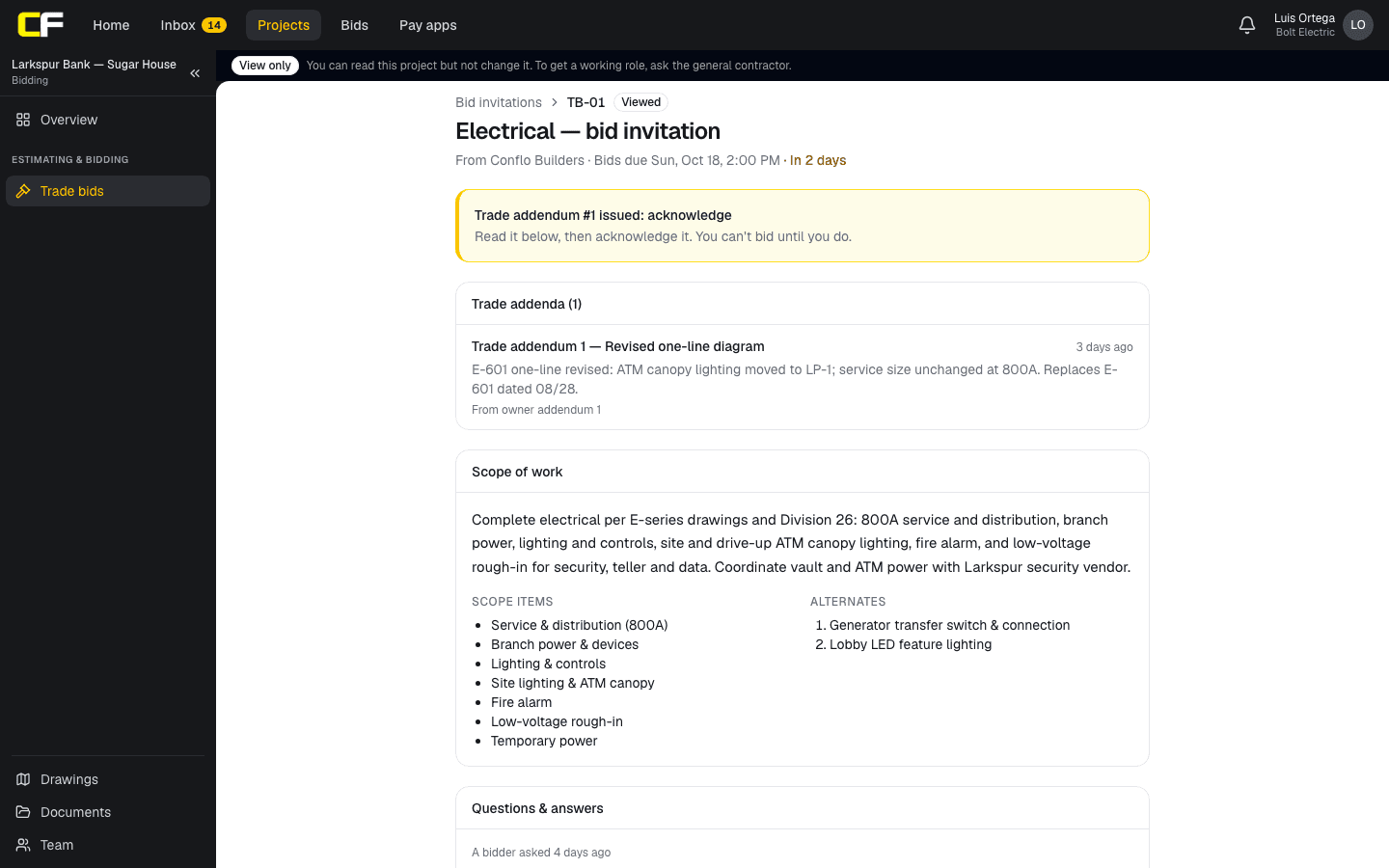
When a GC sends a painting package through Trade bids in Conflo, you answer the invitation, ask your questions on it (the answers go to every bidder without your name) and acknowledge each trade addendum before you submit. Your bid is a base amount, each of the GC's scope items marked included or excluded with an optional breakout, alternates, and your exclusions and qualifications, which is where the clarifications above go; you can attach your proposal and revise until bids close. There is no unit-price field, so put prices per added color or per extra trip in your qualifications.
Under contract, you bill in Pay apps against your schedule of values: each month the percent complete this period for each line, and any materials stored. Previous billing carries forward, no line can go past 100%, retainage is worked out at the contract's rate, and the GC approves the pay app or sends back only the lines it disputes, each with a note. Lines are dollar amounts, so the prime-and-finish split has to be in the lines themselves.
The bottom line
A painting bid is a takeoff by surface and system, your own production rates, and a short list of clarifications at the drywall line, the open ceiling and damage by others. Bill coat by coat so the prime coat is paid the month it goes on.
Before your next bid, add the six trade lines in the clarifications table to your proposal template, with a price per added color and per extra trip.
Sources
- UFGS 09 90 00, Architectural Paints and Coatings (August 2026) — Whole Building Design Guide (USACE, NAVFAC, AFCEC). Read October 22, 2026.
- PCA P1, Touch Up Painting and Damage Repair: Financial Responsibility and Definition of a Properly Painted Surface — Painting Contractors Association. Read October 22, 2026.
Questions
How do you take off a commercial painting job?
Measure each surface by coating system: square feet of walls and ceilings by height, each door and frame, linear feet of trim, rails and exposed pipe. Count the colors on the finish schedule. Then turn quantities into hours with your production rates and into gallons with each product's spread rate and coat count.
Is damage by other trades the painter's touch-up?
No. The Painting Contractors Association's standard P1 says damage caused by others is repaired after a change order from the contracting entity, on a lump sum or time and material basis, and is distinct from touch-up of the painter's own work.
How should a painting schedule of values be split?
By area and by coat: prime and finish coats as separate lines, frames, ceilings and exposed structure on their own lines, plus lines for submittals and samples and for punch, touch-up and attic stock, so each stage bills when it is done.
Can you paint in an unheated building?
Check the specification and the product data. The federal guide specification says not to apply coatings below 50 degrees F, above 95 degrees F, or within 5 degrees F of the dew point unless pre-approved by the Contracting Officer and the manufacturer.
Related
Bidding
How Drywall and Framing Subs Bid Commercial Work
How drywall and metal framing subs bid commercial work: the scope gaps at blocking, firestopping and finish levels, priced in a worked example.
· 6 min read
Role hub
The Subcontractor's Guide: Bidding to Getting Paid
Every step of a commercial job from the subcontractor's seat: bidding, the subcontract, submittals, RFIs, change orders, pay apps, retainage and closeout.
· 9 min read
Money
How Does a Subcontractor Fill Out a Pay Application?
A subcontractor's pay app bills percent complete and stored materials per schedule-of-values line, less retainage and prior payments, with a lien waiver.
· 9 min read