
BuildingConnected Alternatives for Sending Bids
By Wyatt Cooper · Published · 6 min read · Last checked
Key takeaways
- Pick the alternative by your real problem: finding new bidders, the cost of the tool, or keeping the bid connected to the job after award.
- Conflo publishes its prices, lets only the GC pay, and never counts a job you are still bidding against the plan; it has no network of new bidders.
- PlanHub says general contractors get free, unlimited access to post projects and invite subs, and publishes its subcontractor prices.
- Email and a spreadsheet cost nothing and work for a handful of bidders, but leave the leveling, addenda and award history in your inbox.
The main alternatives to BuildingConnected for sending bids are Conflo, PlanHub and plain email with a spreadsheet. Conflo publishes its prices, lets subs bid free, and carries the award into buyout and pay apps, but has no bidder network. PlanHub gives general contractors free access to post projects and reach its network. Email and a spreadsheet are free and fine for a few bidders. If you need BuildingConnected's network and qualification tools, it may still be the right choice.
Start with why you are leaving
BuildingConnected is Autodesk's bid-management product. Autodesk describes access to "over 1,000,000 construction professionals" on its network, bid leveling, custom bid forms and subcontractor qualification through TradeTapp, and lists every product on its pricing page as Request a Quote (BuildingConnected, pricing). GCs look elsewhere for three different reasons, and each points to a different alternative:
- The price is not published, or the quote is more than the bidding step is worth to you.
- You invite the same subs every time and do not need a large network.
- The bid lives in one system and the job in another, so the award is retyped into buyout, the subcontract and the budget.
The alternatives side by side
| Conflo | PlanHub | Email and a spreadsheet | BuildingConnected | |
|---|---|---|---|---|
| What the GC pays | Free for 1 active project; Team $599 a month; Business $1,499 a month; Enterprise by quote. Bidding jobs never count. | Essentials is free; Pro, Premier and Enterprise prices are not published. | Nothing beyond your email and office software. | Request a Quote. |
| What the sub pays | Nothing, on any GC's project. | A free profile for direct invitations within a local radius; Premier from $1,999 a year for a 50-mile radius. | Nothing. | A free Bid Board to accept and submit bids; Bid Board Pro, the paid upgrade, is Request a Quote. |
| Network of new bidders | None: your directory and the contacts you add. | PlanHub says 500,000+ contractors. | None. | Over 1,000,000 (product page); 1.5 million or more (pricing page). |
| Leveling | Grid by scope item, flagged missing scope, private adjustments, median and outliers. | Basic bid leveling in free Essentials; advanced from Pro. | By hand, in the spreadsheet. | Bid leveling and cost comparison. |
| After award | Buyout, the subcontract signed in Conflo, and the sub's pay apps on the same job. | Not described on the pricing pages. | Retyped into whatever runs the job. | Autodesk Build cost-management integration. |
Conflo: the bid and the job in one place
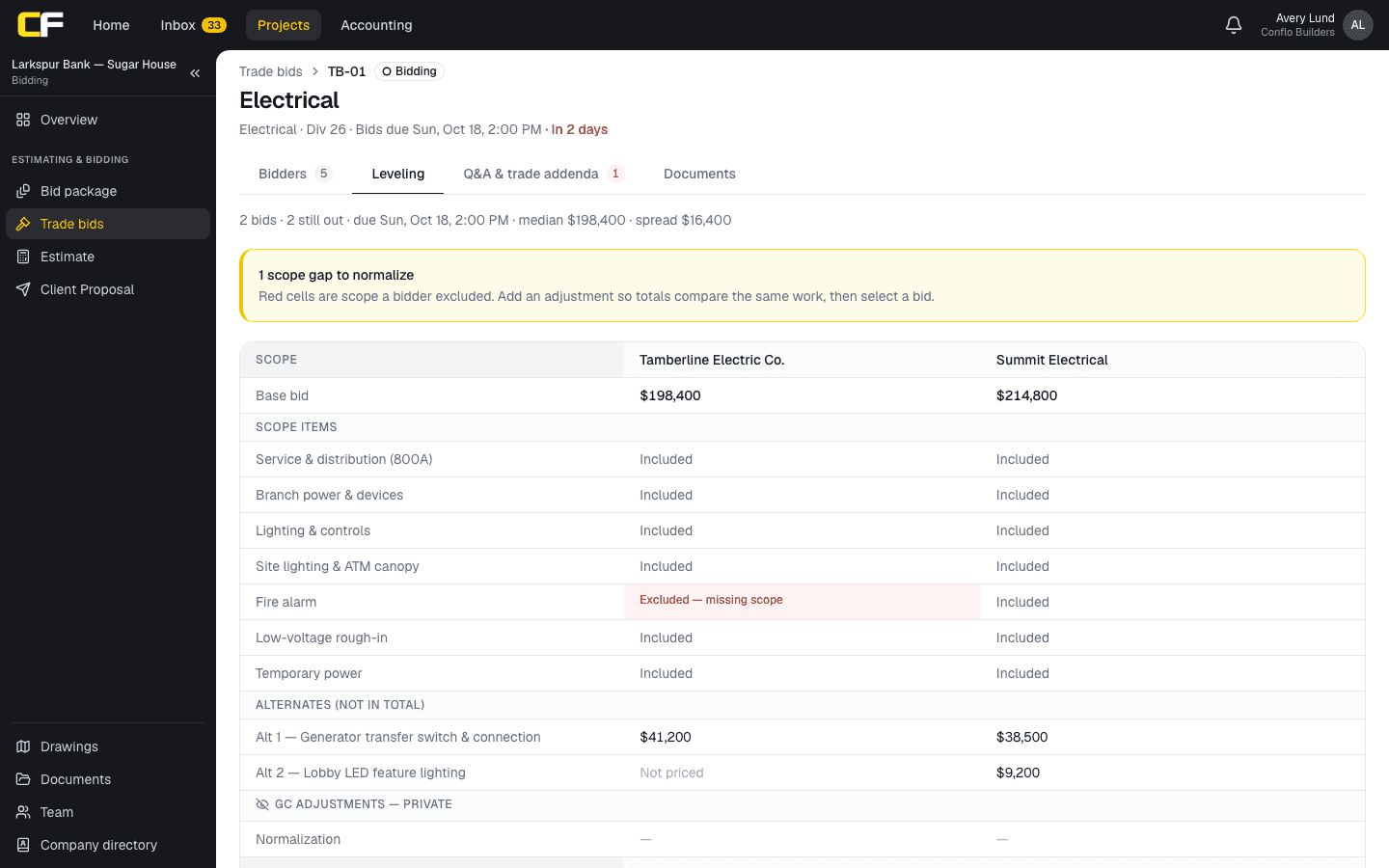
Conflo is construction management software for general contractors, and bidding is its first phase. You build a trade package with a written scope, scope items and alternates, invite subs from your directory, answer questions once for every bidder, issue numbered addenda, then level the bids by scope item. The award carries into buyout against the estimate's budget, then a subcontract the sub signs in Conflo, then pay apps against it.
Prices are on /pricing, and a job you are still bidding never counts against the plan. It has no network of subs you have never worked with and no prequalification questionnaires. The head-to-head, row by row, is in Conflo vs BuildingConnected.
PlanHub: a free GC tier on a bidding network
PlanHub states that "General contractors get free, unlimited access to PlanHub" to post projects, share project files and communicate with multiple subcontractors at once, with Pro, Premier and Enterprise tiers whose prices are set with a product specialist (PlanHub for general contractors). Subcontractors can create a free profile to receive direct invitations and bid within a local radius; wider lead search starts with Premier at $1,999 a year for a 50-mile radius (PlanHub pricing). Pro adds subcontractor prequalification and advanced bid leveling. Choose it when you want a network and a free GC seat more than a connection to the job.
Email and a spreadsheet: fine for a few bidders
Many GCs still bid by email: a scope letter and drawings link per trade, replies into one inbox, and a spreadsheet to level. It costs nothing and every sub can use it. It breaks down when bidders ask the same question twice, an addendum goes to some bidders and not others, or someone has to prove later which bid acknowledged which addendum. If you go this way, keep one row per scope item in the spreadsheet and record each bidder's addendum acknowledgment.
Choose BuildingConnected if…
- You need a bigger pool of new bidders than PlanHub's 500,000+: Autodesk says over 1,000,000 on its network, and email and Conflo have none.
- You prequalify subs with questionnaires and financial review: TradeTapp does this. PlanHub Pro lists subcontractor prequalification too; Conflo and email do not.
- Your company already runs Autodesk Build and wants bids to become contracts there, through the cost-management integration Autodesk describes.
- Your subs already answer invitations on BuildingConnected's free Bid Board, so switching means asking them to learn another tool.
How it works in Conflo
In Trade bids, each bidder sees only its own invitation and bid; answered questions go to every bidder without the asker's name; and a bid must acknowledge the latest addendum before it is submitted. A sub with no Conflo account gets an invitation email with a one-time link that sets up a free account. A bid that arrives by email is entered against the invitation, so it is leveled with the rest in Bid leveling.
The bottom line
There is no single best alternative: a network is the answer if you lack bidders, a free tier is the answer if cost is the problem, and one job record is the answer if retyping the award is. Most GCs who invite the same subs every time need the last one more than the first.
Before you switch, write down how many bidders per trade you invite and how many of them you found through a network last year. That number tells you which kind of tool you need.
Sources
- BuildingConnected: Bid Management Software — Autodesk. Read October 16, 2026.
- BuildingConnected Pricing — Autodesk. Read October 16, 2026.
- Pricing for General Contractors — PlanHub. Read October 16, 2026.
- Subcontractor Pricing — PlanHub. Read October 16, 2026.
- BuildingConnected Glossary of Terms (Internet Archive copy, September 5, 2025) — BuildingConnected (Autodesk). Read October 17, 2026.
Questions
What is the best alternative to BuildingConnected?
It depends on why you are leaving. For a free GC seat on a bidding network, PlanHub says GCs get free access. For published prices and the bid carried into the job after award, Conflo. For a few bidders, email and a spreadsheet.
Is there a free alternative to BuildingConnected for general contractors?
Yes. PlanHub's Essentials tier is free for GCs, Conflo is free for one active project and never counts a job you are bidding, and email costs nothing.
Does Conflo have a bidder network like BuildingConnected?
No. In Conflo you invite subs from your own directory or add a company by email. It does not offer a network of subs you have not worked with.
Do subcontractors pay to bid on a GC's project in Conflo?
No. Subcontractors, suppliers, owners and architects are free in Conflo; only the general contractor pays.
Related
Comparison
Conflo vs BuildingConnected for Bidding
Conflo and BuildingConnected compared for sending trade bids: who pays, published prices, leveling, the bidder network and what happens after award.
· 7 min read
Bidding
How Do You Level Subcontractor Bids?
Level subcontractor bids by pricing every scope gap, exclusion and missing addendum so each bid covers the same work, then compare the leveled totals.
· 9 min read
Money
How Does a Subcontractor Fill Out a Pay Application?
A subcontractor's pay app bills percent complete and stored materials per schedule-of-values line, less retainage and prior payments, with a lien waiver.
· 9 min read
Role hub
The General Contractor's Guide: Bid to Closeout
What a general contractor is responsible for at every phase of a commercial job, from bidding and buyout to RFIs, change orders, pay apps and closeout.
· 8 min read