
How Does a Subcontractor Submit a Final Pay App?
By Wyatt Cooper · Published · 8 min read
Key takeaways
- A final pay application bills every line, including every executed change order, to 100%, and asks for whatever retainage the subcontract releases at final payment.
- Reconcile your change order log with the GC's before you submit, and list any claim you are keeping open, in a stated amount, before you sign a release.
- Send the closeout paperwork with it: final lien waivers, any affidavit of payment the GC asks for, warranties, O&M manuals, as-builts and attic stock.
- In the worked example, $6,550.00 of last work plus $31,190.00 of retainage makes a final payment due of $37,740.00.
To submit a final pay application as a subcontractor, finish the work and punch list, then bill every line on the schedule of values, including executed change orders, to 100%, and request the retainage your subcontract releases at final payment. Reconcile change orders with the GC first. Attach the closeout documents and the final lien waiver, conditional until paid, and list any open claim in a stated amount before you sign any release.
What makes a pay app final
A final pay application is the last bill on a subcontract. It differs from a monthly one in three ways: nothing is left to bill afterward, it usually comes with the release of retainage, and it is paid only against closeout paperwork and releases. The GC needs the same from you that its owner needs from it, so its own final payment depends on yours being complete.
Owner specifications show what is expected. The University of Houston's payment procedures section, a public example, has the contractor submit the final application after completing closeout requirements, with evidence of completion of closeout, insurance certificates where required, an updated final statement accounting for final changes to the contract sum, AIA's G706, G706A and G707 (an affidavit of payment of debts and claims, an affidavit of release of liens, and consent of surety to final payment) and evidence that claims have been settled (Section 01 29 00). Your GC flows down its version of the list.
- 1SubcontractorFinishes the work and the punch list; reconciles change orders with the GC
- 2SubcontractorSubmits the final pay app with closeout documents and a conditional final waiver
- 3GCChecks it, includes it in its own final application to the owner
- 4OwnerPays the GC's final payment, including retainage it releases
- 5GCPays the sub; the sub sends its unconditional final waiver
Reconcile change orders and claims first
Before you put numbers on the final application, match your change order log with the GC's line by line: every executed change order on the schedule of values, no pending ones, deducts included. Anything still in dispute is either settled now or kept open on purpose.
Final payment is where open claims get lost. On federal work, final payment comes after completion and acceptance of all work, a properly executed voucher, and a release of all claims arising under the contract, other than claims in stated amounts that the contractor has specifically excepted from the release (FAR 52.232-5, paragraph (h)). The changes clause adds that no proposal for an equitable adjustment is allowed if asserted after final payment (FAR 52.243-4, paragraph (f)). Your subcontract likely flows down something similar, so write any open claim on the release, with its amount, before you sign.
The final pay app package
| Item | What it is | Tip |
|---|---|---|
| Final pay application | Every line billed to 100%, executed change orders included | Balance to finish should be the retainage only, then zero |
| Retainage release request | The retainage held, as an exact amount | Ask in writing; see the release conditions in your subcontract |
| Final lien waiver | Conditional on receipt of the final payment, then unconditional once paid | Never send an unconditional waiver before the money clears |
| Affidavit of payment | A sworn statement that your own suppliers and lower tiers are paid | List any exceptions; AIA's G706 is one form |
| Lower-tier waivers | Final waivers from your suppliers and sub-subcontractors | Collect them before you submit |
| Closeout documents | Warranties, O&M manuals, as-builts, attic stock, training records | Often the real reason final payment waits |
| Consent of surety | Your bond surety's consent to final payment, if you are bonded | Order it early; sureties take time |
AIA's summary of G706 describes it as a sworn statement, submitted with the final request for payment, that all payrolls, bills for materials and equipment, and other indebtedness connected with the work for which the owner might be responsible have been paid or otherwise satisfied, with any exceptions listed (AIA's G706 summary). Whatever form your GC uses, its exceptions list is where an unpaid supplier goes. The difference between waiver types is in conditional vs unconditional lien waivers.
A worked example: a fictional plumbing sub's final bill
The job and companies are fictional. "Marrow Plumbing" has a subcontract sum to date of $318,450.00: $305,000.00 original plus $13,450.00 of executed change orders. Through its last monthly application it has billed $311,900.00, and the GC holds 10% retainage, $31,190.00. Left to bill: the $6,000.00 closeout line (testing reports, O&M manuals, as-builts) and the last $550.00 of change order 4. The subcontract releases retainage with final payment. Marrow has one open claim: $4,800.00 for acceleration the GC directed in month 7.
| Item | Calculation | Amount |
|---|---|---|
| Subcontract sum to date | $305,000.00 + $13,450.00 | $318,450.00 |
| Completed to date | Every line at 100% | $318,450.00 |
| Retainage | Released at final payment | $0.00 |
| Earned less retainage | $318,450.00 − $0.00 | $318,450.00 |
| Less previous certificates | $311,900.00 − $31,190.00 | $280,710.00 |
| Final payment due | $318,450.00 − $280,710.00 | $37,740.00 |
| Balance to finish | $318,450.00 − $318,450.00 | $0.00 |
The check: the last work billed is $6,000.00 + $550.00 = $6,550.00, and $6,550.00 + $31,190.00 of released retainage = $37,740.00. The $4,800.00 claim is not on the pay application, because it is not an executed change order; Marrow lists it as an exception on its release instead.
Final pay application 12 — Fenwick Library Renovation
- To
- The GC's project manager
- Amount due
- $37,740.00: $6,550.00 of final work and $31,190.00 of retainage
- Change orders
- Executed 1 to 6, $13,450.00 net; reconciled with the GC's log on the 3rd
- Exceptions
- Acceleration claim, month 7, $4,800.00, excepted from the release
- Waivers
- Conditional final waiver for $37,740.00; final waivers from two suppliers
- Closeout
- Test reports, O&M manuals, as-builts, warranty letter, attic stock receipt
Why final payments stall
- A missing closeout document, often the O&M manual or as-builts, holds the whole payment; the GC's side of the same checklist is in how a GC closes out a subcontract.
- A supplier's final waiver is missing, or your affidavit lists no exceptions when a supplier is unpaid.
- The change order log doesn't match the GC's, so the final contract sum is in question.
- An unconditional waiver was asked for before payment; send a conditional one instead.
- The GC is waiting on its own final payment from the owner; check what your subcontract and state law say about timing.
How to chase the retainage itself is in how to get retainage released; the deadlines that can apply to a late payment are in prompt payment acts. The full run from bid to final payment is in the subcontractor's guide and the project lifecycle.
How it works in Conflo
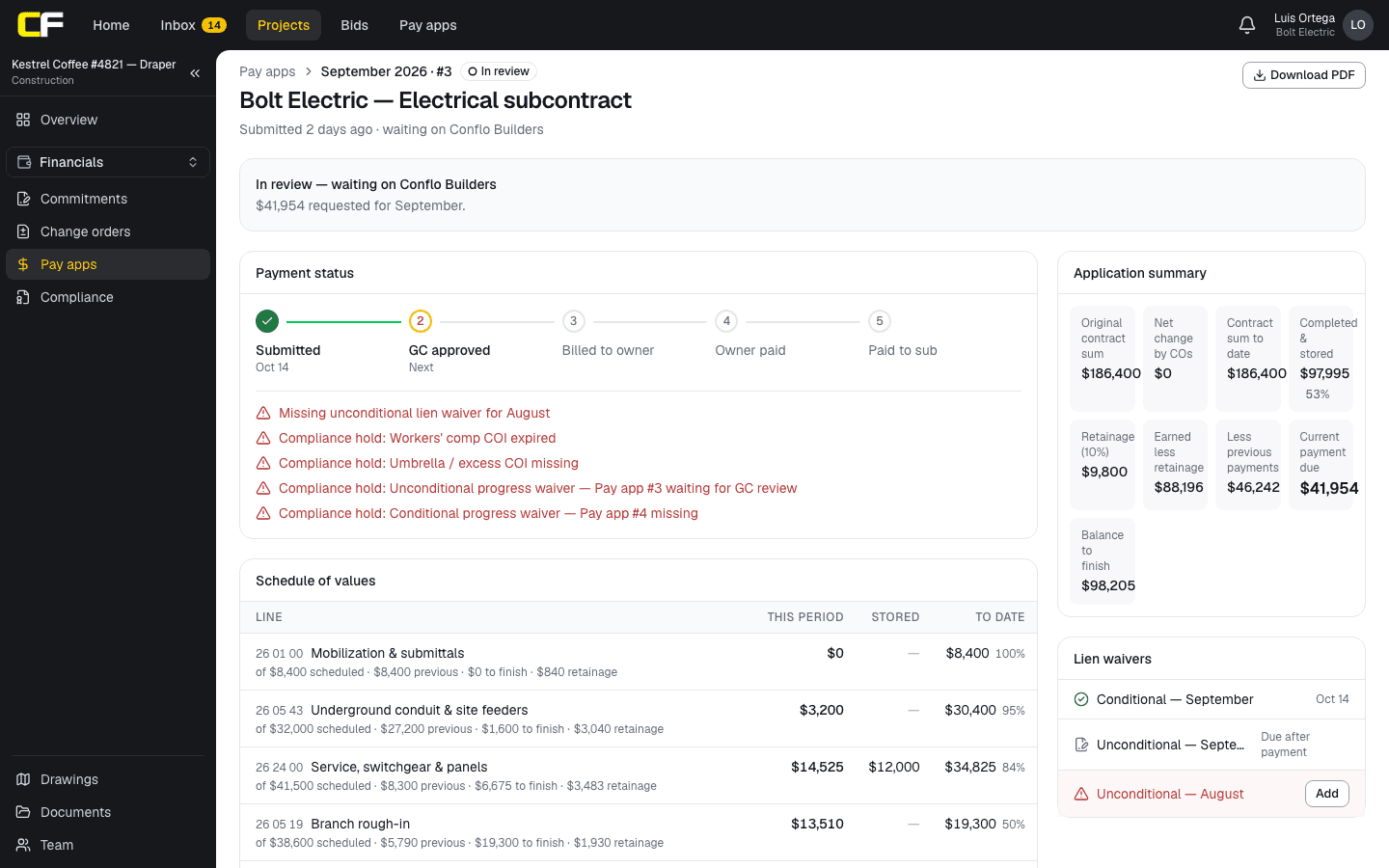
On a Conflo pay app, a sub bills each schedule-of-values line by percent and the form refuses anything past 100%, so a final bill is the application that takes every line to 100%. The summary shows retainage held and the balance to finish. Limits today: there is no separate final pay app type and no retainage release step, so the retainage request goes to the GC outside Conflo, and executed change orders raise the contract sum but are not yet lines you can bill.
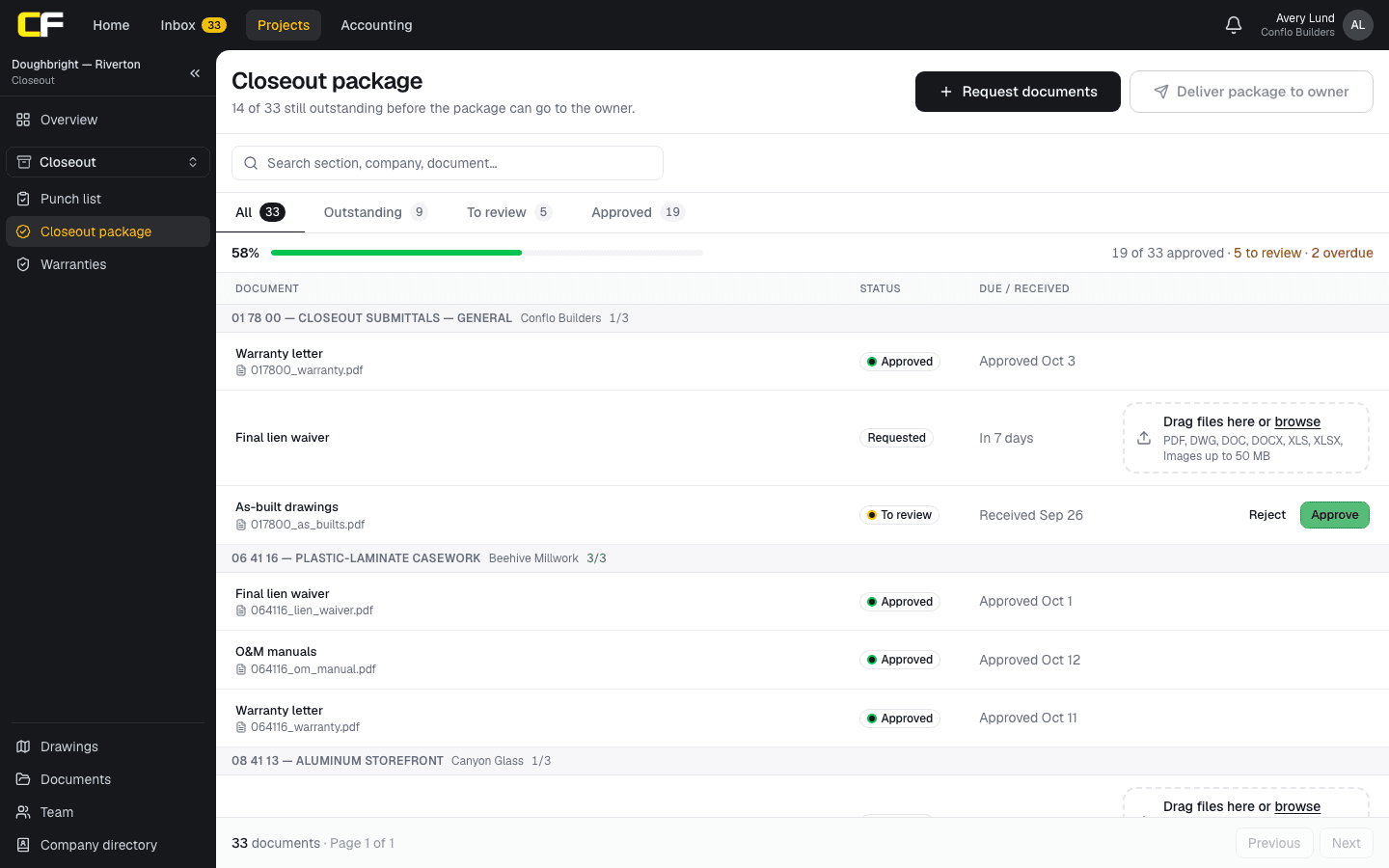
In the closeout package, the GC requests documents from each company: O&M manuals, as-built drawings, a warranty letter, attic stock, owner training and a final lien waiver, each with a due date. The sub turns each one in, and the GC approves it or sends it back with a note.
The bottom line
A final pay application gets paid when it is complete: every line at 100%, change orders reconciled, open claims excepted in stated amounts, and the closeout documents and conditional final waiver attached.
Start collecting the closeout documents and your suppliers' final waivers a month before your last day on site.
Sources
- FAR 52.232-5, Payments under Fixed-Price Construction Contracts — Acquisition.gov, U.S. General Services Administration. Read October 22, 2026.
- FAR 52.243-4, Changes — Acquisition.gov, U.S. General Services Administration. Read October 22, 2026.
- Section 01 29 00, Payment Procedures (master construction specification) — University of Houston, Facilities Planning and Construction. Read October 22, 2026.
- Summary: G706–1994, Contractor's Affidavit of Payment of Debts and Claims — AIA Contract Documents (The American Institute of Architects). Read October 22, 2026.
Questions
What is a final pay application?
The last bill on a contract: every line on the schedule of values billed to 100%, usually with the release of retainage, submitted with the closeout documents and final lien waivers.
What documents go with a subcontractor's final pay app?
A conditional final lien waiver, any affidavit of payment the GC asks for, final waivers from your suppliers and lower tiers, warranties, O&M manuals, as-builts, attic stock and, if you are bonded, the surety's consent.
Should I sign a final release if I have an open claim?
Only with the claim listed as an exception in a stated amount, if the release allows it. Federal contracts, for example, release all claims at final payment except those the contractor specifically excepts in stated amounts.
Is retainage paid with the final pay app?
If your subcontract releases it at final payment, request it on the final application as an exact amount. Some subcontracts release it later, after the owner pays the GC; check yours.
When do I send the unconditional final waiver?
After the final payment has cleared. Until then, send a conditional final waiver that takes effect only when you are paid.
Related
Money
How Does a Subcontractor Get Retainage Released?
Finish your scope, close your punch items, send closeout documents and a written release request with the waiver asked for, and know your state's deadline.
· 6 min read
Money
How Does a Subcontractor Fill Out a Pay Application?
A subcontractor's pay app bills percent complete and stored materials per schedule-of-values line, less retainage and prior payments, with a lien waiver.
· 9 min read
Definition
Conditional vs Unconditional Lien Waiver
A conditional lien waiver takes effect only when payment clears; an unconditional one takes effect when signed. The difference, side by side, from statute.
· 3 min read
Money
How Do You Bill a Change Order on a Pay App?
Add an executed change order to your pay app: its own line, the new contract sum, partial billing, deducts and retainage, with a worked example.
· 7 min read
Closeout
How Do You Close Out a Subcontract?
A GC's checklist to close out a subcontract: settle the last change orders, take the final pay app, release retainage against waivers, record the warranty.
· 6 min read
Role hub
The Subcontractor's Guide: Bidding to Getting Paid
Every step of a commercial job from the subcontractor's seat: bidding, the subcontract, submittals, RFIs, change orders, pay apps, retainage and closeout.
· 9 min read