
How Electrical Subs Bid and Bill Commercial Work
By Wyatt Cooper · Published · 7 min read
Key takeaways
- An electrical bid lives or dies on its clarifications: temporary power, fire alarm, low voltage, utility work and equipment connections are where scope gaps hide.
- Split the schedule of values by phase and by material versus labor, so rough-in, gear, fixtures and trim can each be billed as they happen.
- Switchgear delivered before it is set is billed as stored material, if the contract allows it, and carries retainage like any other line unless the contract or state law says otherwise.
- In the example below, one period's rough-in, feeders and stored gear bill $142,070, with $14,207.00 retained at 10%.
Electrical subcontractors bid commercial work from the drawings and specifications with a takeoff of devices, fixtures, conduit, wire and gear, then price labor by phase and write clear clarifications for temporary power, fire alarm, low voltage and equipment connections. They bill monthly against a schedule of values split into phases (underground, rough-in, feeders, gear, fixtures, trim, testing and closeout), with gear and fixtures as separate material lines so delivered equipment can be billed as stored material where the contract allows.
What a commercial electrical scope usually covers
The electrical subcontract on a commercial building normally covers power distribution from the service to every device, lighting and its controls, branch wiring, and connections to equipment other trades furnish. Fire alarm, low-voltage cabling, security and data are sometimes in the electrical scope and sometimes separate contracts. All of it is installed to the National Electrical Code, NFPA 70, as the jurisdiction has adopted it (NFPA); check which edition your jurisdiction enforces, because it changes what you price.
Clarify the edges before you price
| Item | Common question | Write in your clarifications |
|---|---|---|
| Temporary power | Who provides and maintains it, and who pays the utility bill? | Included or excluded, to what extent, and for how many months |
| Utility service | Who pays utility fees and installs the primary, transformer pad and metering? | What you install and what the utility or owner does |
| Fire alarm | In your scope, a separate contract, or design-build? | Included as designed, design-build, or excluded |
| Low voltage and data | Pathway only, or cabling and terminations too? | Boxes and conduit only, or full cabling |
| Equipment connections | Who wires mechanical units, controls and owner equipment? | Power connections only; control wiring by others unless listed |
| Trenching and concrete | Who digs, backfills and pours the housekeeping pads? | Included or by the site and concrete trades |
Switchgear and large panels often have long lead times. State in the bid how long your gear pricing is good for and that it depends on approved submittals and release by a date. Ask the GC to answer gaps through the bid's questions so every bidder prices the same thing; see how GCs level subcontractor bids to understand how your exclusions will be read.
Build a schedule of values you can bill
A good electrical schedule of values follows the order work happens and separates material from labor where material arrives in large lots. One lump line for "rough-in" means you cannot bill a finished floor while another is still open. A sample for a two-story building:
| Line | Description | Scheduled value |
|---|---|---|
| 1 | Mobilization and submittals | $18,000 |
| 2 | Underground and below-slab conduit | $46,500 |
| 3 | Rough-in, level 1 | $88,200 |
| 4 | Rough-in, level 2 | $84,600 |
| 5 | Switchgear and panels, material | $96,800 |
| 6 | Switchgear and panels, labor | $31,400 |
| 7 | Feeders | $62,700 |
| 8 | Lighting fixtures, material | $71,300 |
| 9 | Trim and devices | $54,900 |
| 10 | Fire alarm | $38,600 |
| 11 | Testing and startup | $9,400 |
| 12 | Closeout documents and as-builts | $10,000 |
| Total | $612,400 |
Avoid loading the early lines with more than their real value. GCs and owners compare the schedule to the work, and a front-loaded one is usually sent back.
Bill stored switchgear the way the contract allows
Gear and fixtures delivered before they are installed can usually be billed as materials stored, which keeps your cash from sitting in a warehouse. The contract decides. Federal fixed-price construction allows material delivered on site to be counted, and material stored elsewhere only if the contract specifically authorizes it and the contractor shows it has title and the material will be used on the job (FAR 52.232-5). Private subcontracts often ask for a bill of sale, proof of insurance and photos. Stored material carries retainage like installed work, unless the contract or state law says otherwise. See how to calculate retainage.
Halvorsen Electric, stored material, period 4: switchgear and panels (line 5)
- Material
- Main switchboard and four distribution panels, per approved submittal
- Where stored
- On site, in the GC's locked container
- Amount billed as stored
- $96,800.00, the supplier's invoice
- Attached
- Supplier invoice, delivery ticket, photos of the gear in storage
- Insurance
- Certificate showing the stored material is covered until installed
Worked example: one pay period
The fictional "Halvorsen Electric" holds the $612,400 subcontract above with 10% retainage. In period 4, level 1 rough-in goes from 60% to 90%, feeders from 20% to 50%, and the switchgear is delivered to site and stored, not yet set.
| Line | Previous | This period | Stored | To date |
|---|---|---|---|---|
| 3. Rough-in, level 1 ($88,200) | $52,920 (60%) | $26,460 (30%) | $0 | $79,380 (90%) |
| 5. Switchgear, material ($96,800) | $0 | $0 | $96,800 | $96,800 (100%) |
| 7. Feeders ($62,700) | $12,540 (20%) | $18,810 (30%) | $0 | $31,350 (50%) |
| Total of these lines | $65,460 | $45,270 | $96,800 | $207,530 |
This period bills $45,270 of work plus $96,800 stored = $142,070. Retainage at 10% is $14,207.00, so these lines add $127,863.00 to the payment due. Checks: $52,920 + $26,460 = $79,380 = 90% of $88,200; $12,540 + $18,810 = $31,350 = 50% of $62,700; $65,460 + $142,070 = $207,530.
Next period, when the gear is set, line 5 moves from stored to work completed with no new billing on it; the setting labor bills on line 6. Moving it this way stops the same $96,800 being billed twice.
Closeout documents for the electrical trade
- As-built drawings, including panel and circuit changes.
- Typed panel schedules matching what was installed.
- Test reports the specification requires, such as insulation-resistance or ground tests, and the fire alarm acceptance test.
- O&M manuals and warranties for gear, lighting controls and fixtures.
- Final lien waiver and the release of retainage request.
Keep a closeout line on the schedule of values, as line 12 above, so the last dollars are tied to the documents. Punch work is covered in how to build a punch list.
How it works in Conflo
When a GC sends an electrical package through Trade bids in Conflo, the sub sees the scope items, alternates and addenda, asks questions on the invitation, and submits a base bid with each scope item marked included or excluded, its alternates and its exclusions and qualifications. Sub billing runs in Pay apps: each month the sub enters percent complete this period and materials stored per line, previous billing carries forward, no line can bill past 100%, and retainage is calculated on completed and stored to date.
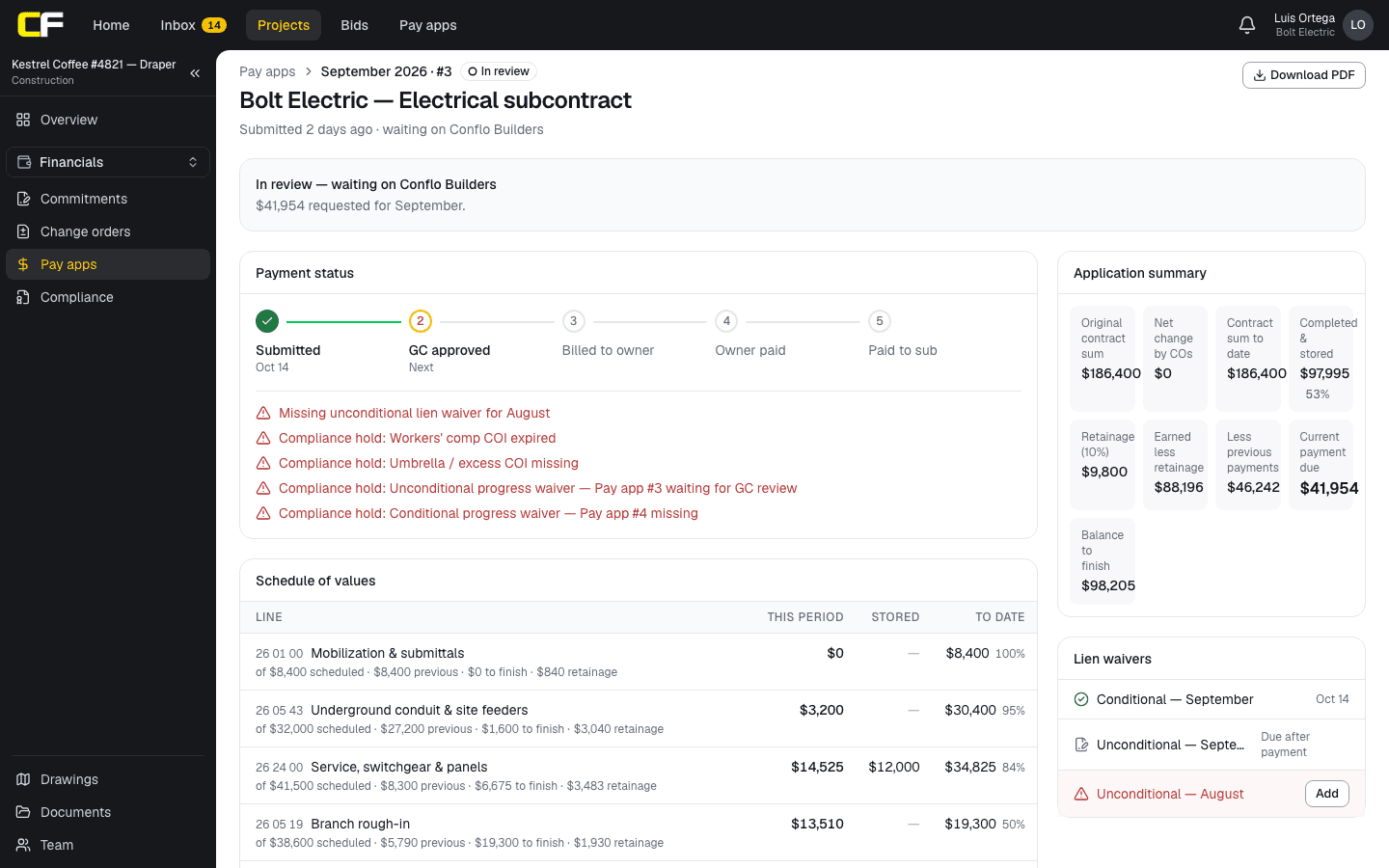
Stored material billed on one pay app carries into previous billing on the next, so it is never billed twice. Not built today: a separate step to record when stored material is installed, and a separate retainage rate for stored materials.
The bottom line
Electrical bids are won on price and kept on clarifications. Say exactly what is in and out at the trade's edges, and split the schedule of values so each phase and each big material delivery can be billed when it happens.
Before your next bid, add the six clarifications in the table above to your proposal template.
Sources
- NFPA 70, National Electrical Code (NEC) — National Fire Protection Association. Read October 16, 2026.
- FAR 52.232-5, Payments under Fixed-Price Construction Contracts — Acquisition.gov, U.S. General Services Administration. Read October 16, 2026.
Questions
How do you bid commercial electrical work?
Take off devices, fixtures, conduit, wire and gear from the drawings and specs, price labor by phase, get gear and fixture quotes with their lead times, and write clarifications for temporary power, fire alarm, low voltage and equipment connections.
What lines go on an electrical schedule of values?
Phases in the order work happens, such as underground, rough-in by floor, feeders, gear, fixtures, trim, fire alarm, testing and closeout, with gear and fixtures split into material and labor so deliveries can be billed.
Can an electrical sub bill for switchgear before it is installed?
Usually as stored material, if the contract allows it. Off-site storage often needs proof of title and insurance; federal contracts allow it only where the contract specifically authorizes it.
Is retainage held on stored materials?
Usually, yes. Stored material is part of work completed and stored to date, so the contract's retainage percentage applies unless the contract says otherwise.
Related
Money
How Does a Subcontractor Fill Out a Pay Application?
A subcontractor's pay app bills percent complete and stored materials per schedule-of-values line, less retainage and prior payments, with a lien waiver.
· 9 min read
Money
How Do You Calculate Retainage on a Pay App?
Retainage is a percentage of work completed and stored to date, held back each pay period. How to calculate it, reduce it, release it, with an example.
· 9 min read
Preconstruction
How Do You Track Long-Lead Items on a Job?
How a GC tracks long-lead items: work back from the need-on-site date through lead time and submittal review to an order-by date, and review it weekly.
· 6 min read
Bidding
How Low-Voltage Subs Bid and Bill Commercial Work
How low-voltage subs bid data, security and AV work: the split with the electrical sub, a takeoff by drops, testing and labeling, and an SOV to bill.
· 9 min read
Bidding
How Elevator Contractors Bid and Bill Commercial Work
How elevator contractors bid commercial work and bill it: work by others, the order-by date from approved drawings, a milestone SOV and acceptance.
· 9 min read
Role hub
The Subcontractor's Guide: Bidding to Getting Paid
Every step of a commercial job from the subcontractor's seat: bidding, the subcontract, submittals, RFIs, change orders, pay apps, retainage and closeout.
· 9 min read