
How to Write a Scope of Work for a Subcontractor
By Wyatt Cooper · Published · 7 min read
Key takeaways
- A subcontractor scope of work says which work belongs to this trade; the drawings and specifications say how it is built, so the scope points to them rather than repeating them.
- Write it from the documents, not from a sub's proposal, and list inclusions as numbered items every bidder prices the same way.
- The expensive gaps sit at trade boundaries: firestopping, blocking, cutting and patching, temporary protection, equipment hookups and cleanup each need one named owner.
- Name the exclusions you expect, the alternates you want priced and the addenda the scope covers, so the bids come back comparable and the subcontract matches the bid.
To write a scope of work for a subcontractor, start from the drawings and specifications for that trade. Write a one-paragraph summary, then number every inclusion in plain words, name the boundary items that are this trade's and the ones that are not, list the alternates to price and the documents and addenda the scope is based on. Use the same scope in the invitation to bid, the leveling sheet and the subcontract, so the sub prices and signs the same work.
A scope of work assigns work; the documents describe it
The drawings and specifications describe the building. They do not say which subcontractor installs each piece of it: that is the general contractor's job, and the scope of work is where it is written down. A good scope answers one question for every item on the job: is this yours or not?
Specifications are already organized in a way that helps. CSI describes MasterFormat as organizing specifications "into work results that contractors can price, procure, and build" (CSI), so a trade's scope usually starts from its sections. But a spec section is not a scope: firestopping has its own section and still has to be assigned to someone, and one trade often installs work from several sections.
The scope also sits inside a contract. In the AIA's conventional family, the A201 general conditions are adopted by reference in the contractor/subcontractor agreement as well as the owner/contractor one (AIA Contract Documents), so the sub is bound by the prime contract's terms; the scope is what narrows the work to this trade. Check how your own subcontract form incorporates the prime contract.
What a subcontractor scope of work contains
- A summary: one paragraph naming the trade, the building or area, and the specification sections and drawing series it covers.
- Inclusions: numbered items in plain words ("Level 4 finish at lobby walls", not "finishes per plans"). These become the rows bids are leveled against.
- Boundary items: each item at the edge of the trade, assigned in or out by name (see the table below).
- Exclusions: the work you know this trade will not do, with who does it instead, so bidders do not price it and you do not forget it.
- Alternates: the priced options you want back, each described well enough to price, kept apart from the base bid.
- Allowances and unit prices, if any: the fixed amount every bidder carries, or the unit price you want for added quantities.
- The documents: the drawing set and date, the specification sections and every addendum the scope covers.
- Schedule and site conditions: the expected start, duration, phasing, working hours and access limits that change the price.
Assign every boundary item to one trade
Most scope gaps are not in the middle of a trade; they are where two trades meet. Before you write individual scopes, make one matrix of the boundary items on the job and give each a single owner. Then copy each trade's lines into its scope as inclusions or exclusions.
| Boundary item | Assigned to | Written in the other trades' scopes as |
|---|---|---|
| Firestopping at rated wall penetrations | Each penetrating trade (electrical, plumbing, HVAC) | Drywall: excluded, by others |
| Blocking in walls for casework and grab bars | Drywall and framing | Casework and specialties: excluded, by drywall |
| Access panels (supply and install) | Drywall and framing installs; owner furnishes | Mechanical and plumbing: locate only |
| Equipment final connections | Electrical (power) and plumbing (water and waste) | Equipment supplier: set in place only |
| Cutting and patching for own work | The trade that needs the opening | Every scope: patch to match, by the trade cutting |
| Daily cleanup and debris to GC dumpster | Each trade | General contractor: dumpsters and final clean |
A worked example: a drywall scope for a fictional clinic
The job is fictional: "Alder Court Clinic", a two-story medical clinic. The general contractor writes the metal framing and drywall scope from the drawings, the Division 09 sections and the matrix above, before any bidder sends a proposal.
Scope of work: metal framing and drywall, Alder Court Clinic
- Summary
- Furnish and install all non-structural metal framing, gypsum board assemblies and finishing for Levels 1 and 2, per the A-series drawings and specification Sections 09 22 16 and 09 29 00.
- Inclusions
- 1. Interior partitions, rated and non-rated, to the heights shown. 2. Ceiling and soffit framing, including the soffits added by Addendum 2. 3. Level 4 finish at the lobby, Level 3 elsewhere unless noted. 4. Blocking for casework, grab bars and wall-mounted equipment. 5. Installing owner-furnished access panels. 6. Daily cleanup to the GC's dumpster.
- Exclusions (by others)
- Firestopping at penetrations (penetrating trades). Painting (Section 09 91 23). Access panels themselves (owner-furnished).
- Alternate 1
- Impact-resistant gypsum board at corridor walls, Level 1, in place of standard board: price as an add.
- Documents
- Drawings dated for bid, specification Sections 09 22 16 and 09 29 00, Addenda 1 and 2.
- Schedule
- Start 3 weeks after the structure tops out; 10 weeks on site; two mobilizations (Level 1, then Level 2).
Each numbered inclusion is a row on the leveling sheet later, so a bidder who excludes item 3 is visibly different from one who includes it. The exclusions name who does the work instead, so the firestopping is already in the electrical, plumbing and HVAC scopes rather than in nobody's.
Common mistakes in subcontractor scopes
- Writing "per plans and specs" as the whole scope. It covers everything and assigns nothing.
- Copying the first sub's proposal into the scope. Its exclusions become yours.
- Leaving a boundary item out of every scope. Nobody prices it, and you pay for it later.
- Changing the scope after bids without an addendum. Bidders then priced different work.
- Letting the subcontract say something different from the scope that was bid. Attach the bid scope and the sub's clarified proposal to the subcontract.
- Asking a design question in a scope. If the documents conflict, send an RFI before bids close.
Clear scopes also make conditions on a bid easier to judge. On federal sealed bids, a bid whose conditions modify the invitation's requirements is rejected (FAR 14.404-2); a private GC is not bound by that rule, but a vague scope invites exactly those conditions.
How it works in Conflo
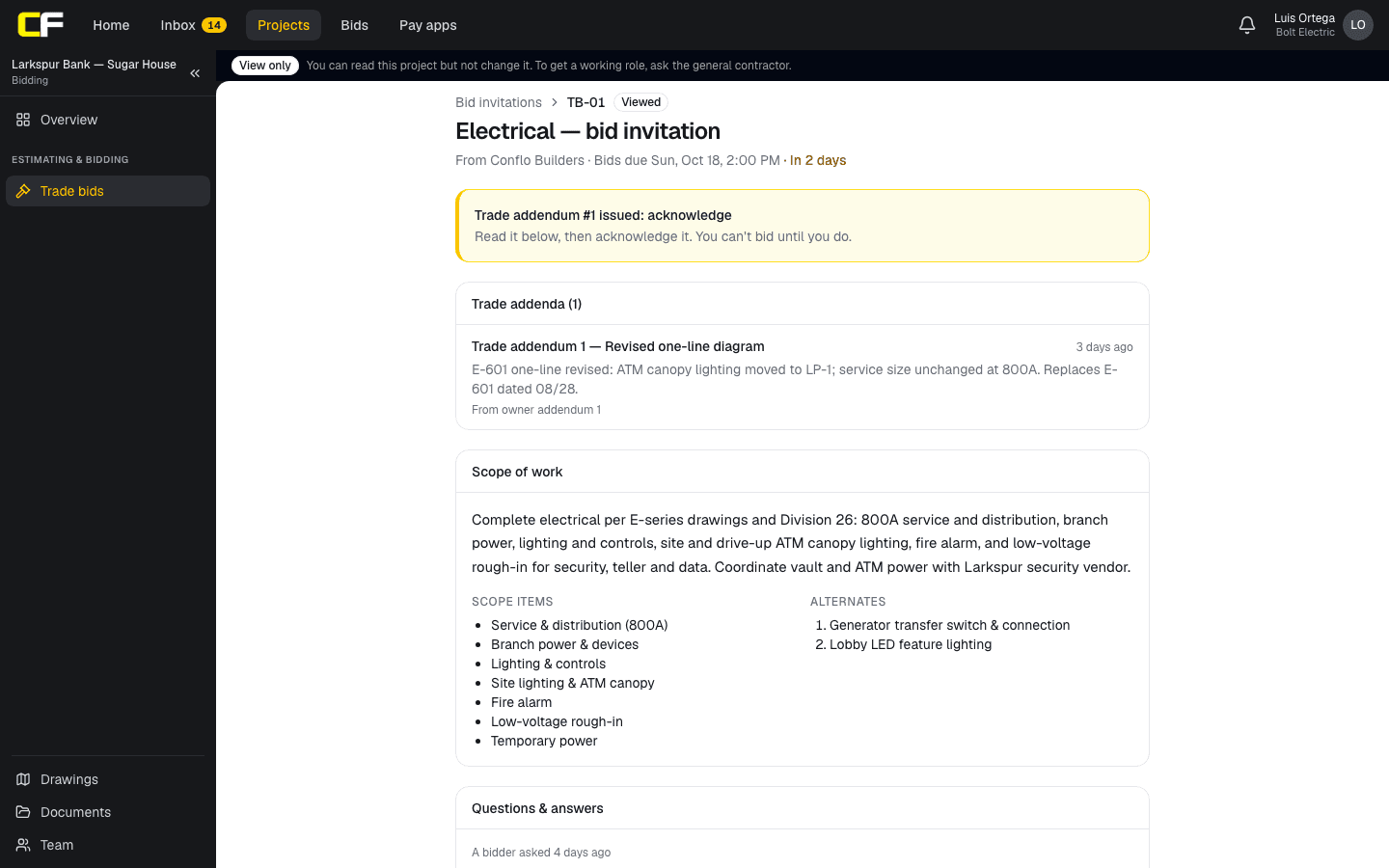
In Conflo, each trade bid carries the scope: a written description of the work, a list of scope items and the alternates you want priced, with the owner's bid documents attached. The scope items are the rows bidders mark included or excluded, with an optional breakout price, and the rows the bid leveling grid compares. The invitation email lists the scope items, and when the scope changes, a numbered trade addendum goes to every bidder, who must acknowledge it before submitting.
What it does not do yet: there is no job-wide boundary-item matrix across trades, so assign those items yourself and write them into each trade's scope items.
The bottom line
A scope of work is a list of decisions: for every item on the job, whose it is. Write those decisions from the documents, number them, and resolve the boundaries before the first proposal arrives.
Then use the same scope everywhere: in the invitation to bid, on the leveling sheet and in the subcontract. When all three match, the number you award is the number you build.
Sources
- CSI Standards: MasterFormat — Construction Specifications Institute. Read October 16, 2026.
- Summary: A201–2017, General Conditions of the Contract for Construction — AIA Contract Documents. Read October 16, 2026.
- FAR 14.404-2, Rejection of individual bids — Acquisition.gov, U.S. General Services Administration. Read October 16, 2026.
Questions
What should a subcontractor scope of work include?
A one-paragraph summary, numbered inclusions in plain words, the boundary items assigned in or out by name, exclusions with who does the work instead, alternates to price, any allowances or unit prices, the drawings, specification sections and addenda it covers, and the schedule and site conditions that affect price.
Is a scope of work the same as the specifications?
No. The specifications describe how the work is built and what it is made of. The scope of work says which of that work belongs to this subcontractor. It points to the specification sections rather than repeating them.
Who writes the subcontractor's scope of work?
The general contractor, usually the estimator or project manager who builds the bid package. The subcontractor's proposal then responds to it, and the clarified proposal is attached to the subcontract.
How do you avoid scope gaps between trades?
List the boundary items on the job (firestopping, blocking, access panels, equipment connections, cutting and patching, cleanup) in one matrix, give each a single owner, and write each line into every affected scope as an inclusion or an exclusion.
Should the scope of work go in the subcontract?
Yes. Attach the scope that was bid, with any addenda and the sub's clarified proposal, so the subcontract describes the same work the price covers. Check how your subcontract form ranks attached documents against its own terms.
Related
Bidding
How Do You Level Subcontractor Bids?
Level subcontractor bids by pricing every scope gap, exclusion and missing addendum so each bid covers the same work, then compare the leveled totals.
· 9 min read
Bidding
How Do You Break a Job Into Bid Packages?
Split a job into bid packages by trade: start from the CSI divisions, group what one kind of sub performs, and give every boundary item one home.
· 7 min read
Bidding
How Do You Send an Invitation to Bid to Subs?
What an invitation to bid to subs includes, how to send it, and how to run questions and addenda so every bid prices the same scope, with an example.
· 7 min read
Bidding
How to Write a Sub Proposal a GC Can Level
Write a subcontractor bid proposal the GC can level: match its scope items, break out prices, price exclusions, and see what the GC does with each line.
· 7 min read
Preconstruction
What Should a Subcontract Agreement Include?
The clauses a construction subcontract agreement needs, what to check in each, how terms flow down from the prime contract, and a worked example.
· 8 min read
Role hub
The General Contractor's Guide: Bid to Closeout
What a general contractor is responsible for at every phase of a commercial job, from bidding and buyout to RFIs, change orders, pay apps and closeout.
· 8 min read