
What Is a Subcontract?
By Wyatt Cooper · Published · 3 min read
Key takeaways
- A subcontract hands part of the prime contract's work to another company, on terms that usually flow down from the prime contract.
- It carries the scope, price and schedule of values, schedule, insurance, retainage and payment terms.
- The owner has no contract with the subcontractor; the GC stays responsible to the owner for the sub's work.
A subcontract is the contract between a general contractor and a subcontractor for part of the prime contract's work. It sets the scope, the price and schedule of values, the schedule, insurance, retainage and payment terms, and usually binds the sub to the prime contract's terms for its work, so the owner's requirements flow down.
What a subcontract holds
| Part | What it says |
|---|---|
| Agreement | Parties, price, payment terms, retainage, flow-down of the prime contract |
| Scope exhibit | The trade's inclusions, exclusions and the documents they rest on |
| Schedule of values | The price split into lines the sub will bill against |
| Schedule | Start, durations and milestones for the trade |
| Insurance and bonds | Coverages, limits, additional insureds, any bond required |
AIA's standard form is A401, the Standard Form of Agreement Between Contractor and Subcontractor, whose terms AIA describes as paralleling its A201 general conditions (AIA). The scope exhibit is the scope of work, and the billing lines are the schedule of values.
Subcontract vs. purchase order
In federal usage the word is broad: a subcontract is "any contract" a subcontractor enters to furnish supplies or services for a prime contract, and "it includes but is not limited to purchase orders" (FAR 44.101). On a job site, people split them: a subcontract buys work installed on site, with labor, insurance and retainage; a purchase order buys material delivered. When the subcontract is signed is part of buyout; a letter of intent sometimes comes first.
How it works in Conflo
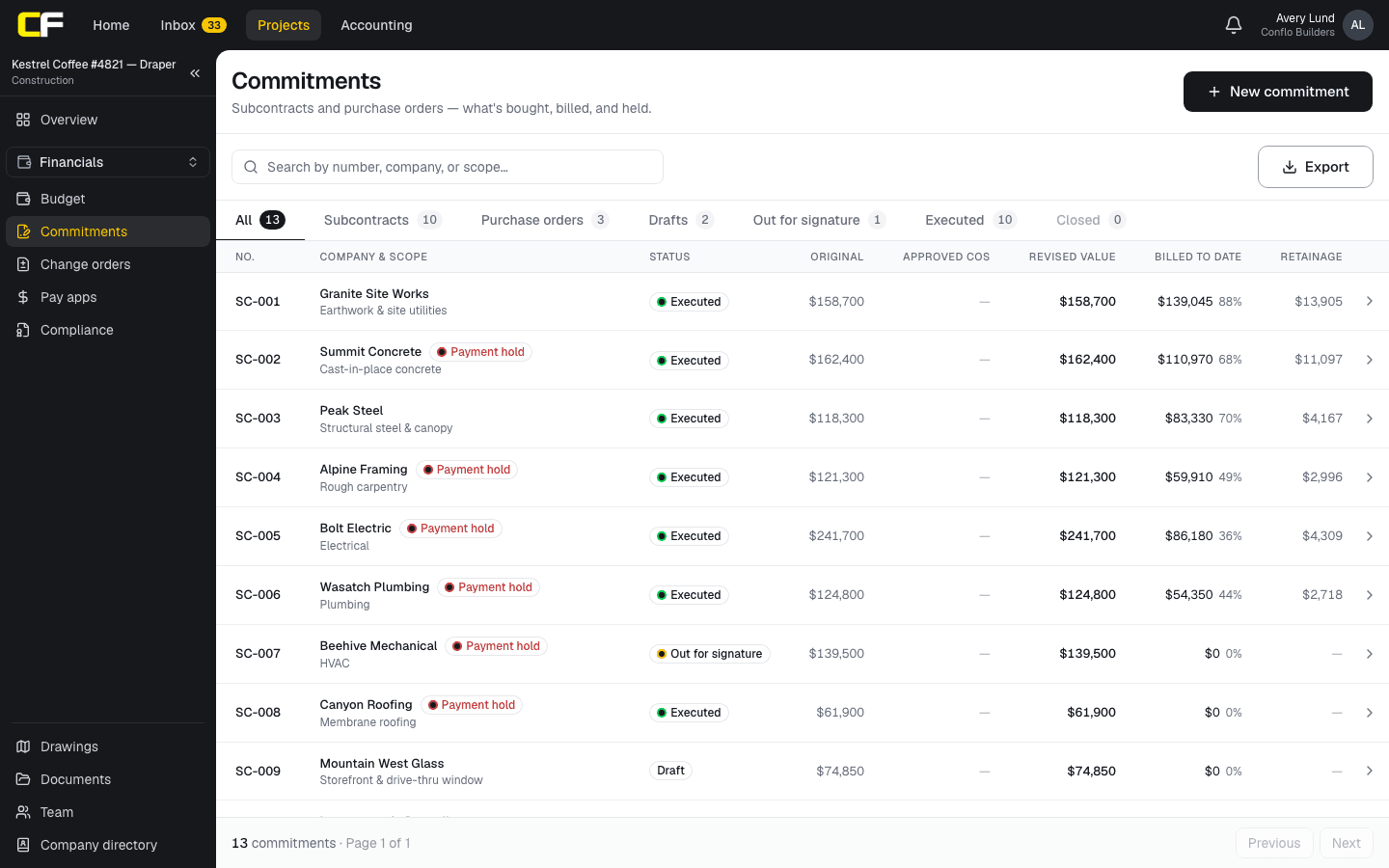
In Conflo's commitments, a subcontract carries its scope, a schedule of values by cost code and a retainage percentage. You send it for signature, the sub's signer signs by typing their full name, and the contract shows original value, change orders, revised value, billed to date and retainage held.
The bottom line
A subcontract is the GC's contract with a trade: its scope, price, billing lines and the terms that flow down from the owner.
Sign it before the sub mobilizes, with the same scope the sub bid.
Sources
- FAR 44.101, Definitions (subcontract, subcontractor) — Acquisition.gov, U.S. General Services Administration. Read October 22, 2026.
- List of document synopses by family (A401, A201) — AIA Contract Documents. Read October 22, 2026.
Questions
What is a flow-down clause?
A subcontract clause that binds the sub to the prime contract's terms for its part of the work, so the GC can meet what it owes the owner.
Can a subcontractor subcontract its work?
Usually yes, to a lower-tier sub, unless the subcontract forbids it or requires the GC's approval. The first-tier sub stays responsible for that work.
Related
Preconstruction
How Do You Buy Out a Construction Job?
Construction buyout step by step: scope review, leveling, award, the subcontract and its exhibits, compliance documents, and savings against budget.
· 7 min read
Definition
What Is a Purchase Order in Construction?
A construction purchase order buys materials or equipment at stated prices, quantities and delivery terms. Definition, an example, PO vs. subcontract.
· 3 min read
Bidding
How to Write a Scope of Work for a Subcontractor
Write a subcontractor scope of work from the drawings and specs: a summary, numbered inclusions, named exclusions, alternates and the documents behind it.
· 7 min read
Preconstruction
What Should a Subcontract Agreement Include?
The clauses a construction subcontract agreement needs, what to check in each, how terms flow down from the prime contract, and a worked example.
· 8 min read
Role hub
The General Contractor's Guide: Bid to Closeout
What a general contractor is responsible for at every phase of a commercial job, from bidding and buyout to RFIs, change orders, pay apps and closeout.
· 8 min read