
How to Write a Sub Proposal a GC Can Level
By Wyatt Cooper · Published · 7 min read
Key takeaways
- A general contractor reads your proposal against its own list of scope items, so write your proposal in the same order, one line per item, with a price where you can give one.
- An exclusion with no price gets the GC's plug, the GC's own estimate of that work; in the example below, pricing one exclusion turns a $2,300 loss into a $1,400 win.
- Unclear wording is treated as excluded, and an addendum you did not acknowledge is treated as unpriced; both cost you in the comparison.
- Qualifications that change the GC's terms can sink a bid: on federal sealed bids, a bid whose conditions modify the invitation's requirements is rejected.
To write a subcontractor proposal a GC can level, follow the GC's scope items in order and say for each one whether it is included, with a breakout price where you can. Price your exclusions as adds instead of only listing them, price alternates separately, list the addenda you priced by number, give the bond as its own add, and keep qualifications short and specific. The GC fills every gap with its own number, so leave as few gaps as you can.
What the GC's leveler does with your proposal
On bid day the GC's estimator puts every bid for your trade on one sheet: scope items down the side, bidders across the top. For each item it marks your bid included, excluded or unclear, then adds a plug for every gap so that all bids cover the same work. The leveled totals decide who gets the scope review call. The process is described in how to level subcontractor bids; this is what it means for each line you write.
| What you write | What the leveler does | What to do instead |
|---|---|---|
| Item included, with a breakout price | Uses your breakout if it needs one; no plug | Give breakouts for the GC's items whenever you can |
| Item excluded, no price | Adds the GC's plug, from its own takeoff or another bidder's breakout | Price it as an add, or say who does it |
| Item excluded, priced as an add | Usually uses your price as the plug | This is the strongest way to exclude |
| Vague wording ("per plans", "standard") | Treated as excluded until you confirm | Name the item and say included or excluded |
| Work the GC did not ask for | Deducted at your breakout, if you gave one | Leave it out, or price it separately |
| Addenda not listed | Treated as not priced; a plug for what changed | List every addendum you priced, by number |
| Bond excluded, no price | A plug at the GC's estimate of the bond | Give your surety's quoted bond cost as an add |
| Qualifications that change terms | Questioned, discounted or rejected | Keep them few, specific and priced |
Write the proposal in the GC's order
- Header: your company, the GC, the project, the package and the date. Say which drawings, specification sections and addenda you priced.
- Base bid: one number for the whole package as the GC defined it.
- Scope by item: the GC's scope items in its order, each included or excluded, with a breakout price where you can give one.
- Exclusions: each one named, with an add price or with who you assume does it.
- Alternates: each priced as an add or deduct, as the invitation asks, outside the base bid.
- Bond and insurance: whether the bond is included, or its cost as an add; confirmation you meet the insurance requirements.
- Qualifications: the conditions your price depends on (number of mobilizations, working hours, price validity), short and specific.
- Schedule: crew size, duration and any long-lead material, and when you can start.
A worked example: one exclusion, two outcomes
The job is fictional: a medical clinic. A fictional drywall contractor, Larch Wall Systems, bids the GC's metal framing and drywall package at $402,000 and excludes firestopping at rated partitions, which the GC's scope lists as an item. The next-best competitor's leveled total is $410,900. The GC's own plug for firestopping is $11,200; Larch's own price for the same firestopping would be $7,500.
| Exclusion listed, no price | Exclusion priced as an add | |
|---|---|---|
| Base bid | $402,000 | $402,000 |
| Firestopping | + $11,200 (the GC's plug) | + $7,500 (Larch's own add) |
| Leveled total | $413,200 | $409,500 |
| Against the competitor's $410,900 | $2,300 higher | $1,400 lower |
Same base bid, same work, different result: $402,000 + $11,200 = $413,200, which is $2,300 above $410,900; $402,000 + $7,500 = $409,500, which is $1,400 below it. Pricing the exclusion cost Larch nothing and made it the low leveled bidder.
Proposal: metal framing and drywall, base bid $402,000
- Priced documents
- Drawings dated for bid; Sections 09 22 16 and 09 29 00; Addenda 1 and 2
- 1. Interior partitions
- Included: $226,400
- 2. Ceiling and soffit framing, including Addendum 2 soffits
- Included: $61,800
- 3. Level 4 finish at lobby; Level 3 elsewhere
- Included: $98,300
- 4. Blocking
- Included: $15,500
- 5. Firestopping at rated partitions
- Excluded from the base bid; add $7,500 to include
- Alternate 1: impact-resistant board at corridors
- Add $15,100
- Performance and payment bond
- Excluded from the base bid; add $4,000 as quoted by our surety
- Qualifications
- Two mobilizations; normal working hours; price valid 45 days
The four included breakouts add up to the base bid: $226,400 + $61,800 + $98,300 + $15,500 = $402,000.
Qualifications, addenda and public bids
On public work, conditions on a bid can disqualify it. On federal sealed bids, a bid is rejected when the bidder imposes conditions that would modify the invitation's requirements or limit its liability to the government; a low bidder may be asked to delete conditions that go only to form, not substance (FAR 14.404-2). A missed amendment can be waived only when the bid shows it was received or the amendment's effect on price, quantity, quality or delivery is negligible (FAR 14.405).
Some public construction manager-at-risk contracts carry the same idea to trade bids: one has the apparent low trade bid reviewed to verify it accounted for all the costs of its scope, and lets the construction manager disqualify one that did not (NC State University, CM-at-Risk General Provisions). On private work the GC decides, but a short, specific, priced list of qualifications is easier to accept everywhere. Check the bid instructions for each job.
How it works in Conflo
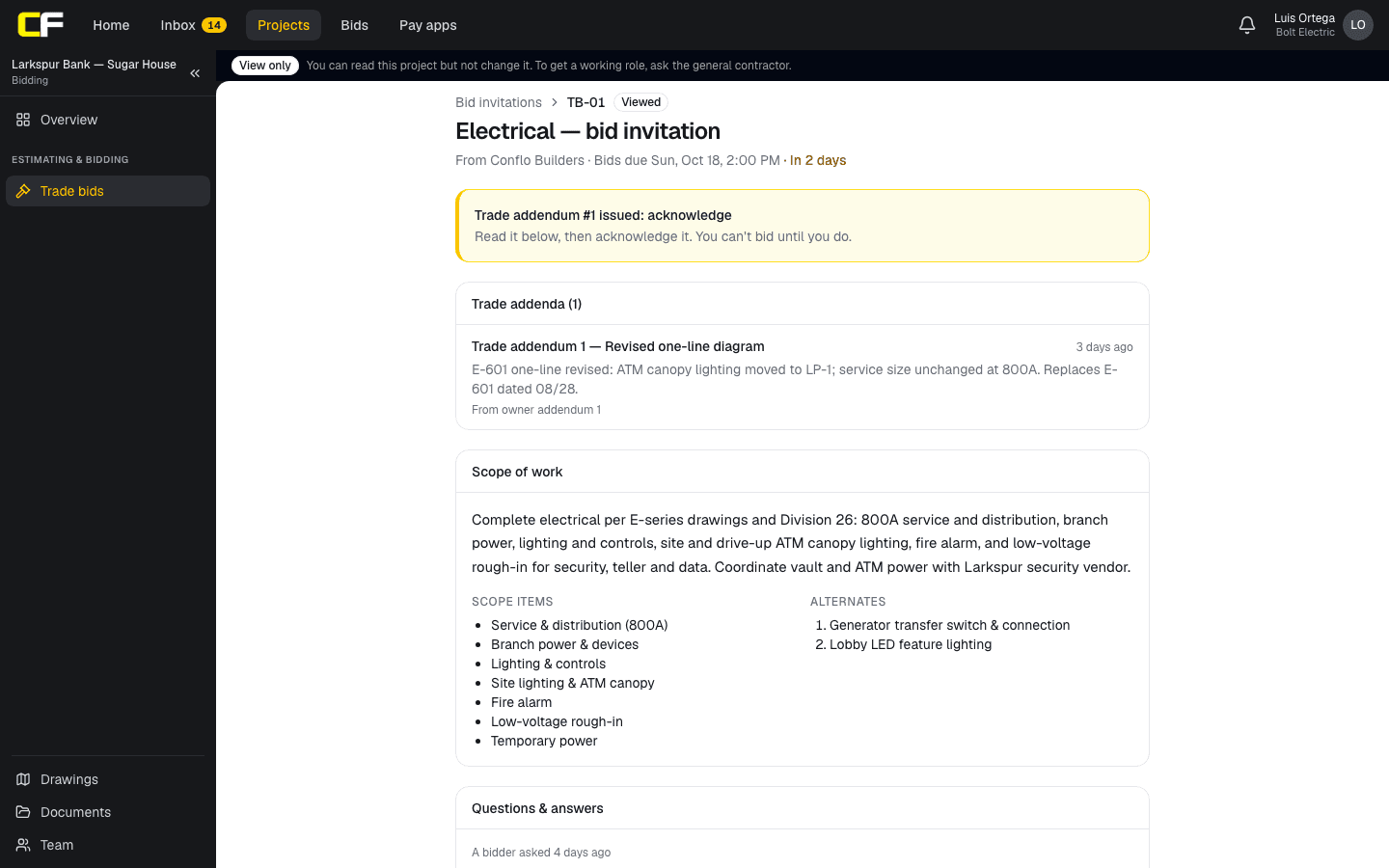
When a GC sends you a trade bid in Conflo, the bid form is already in the GC's order: a base bid, then each of the GC's scope items marked included or excluded with an optional breakout, then a price for each alternate, then your exclusions and qualifications. You acknowledge each trade addendum before you can submit, so the GC sees which addenda you priced. Invited subs use Conflo free.
One limit: the bid form has no separate field for an exclusion's add price or for a bond add, so write those in your exclusions or qualifications with the amount ("Firestopping excluded; add $7,500 to include").
The bottom line
Every line of your proposal either gives the GC your number or leaves it to use its own. Follow its scope items, break out your prices, price your exclusions and list your addenda.
Then bid the right jobs: see how to bid a GC's job as a subcontractor for choosing them and for what happens after bid day.
Sources
- FAR 14.404-2, Rejection of individual bids — Acquisition.gov, U.S. General Services Administration. Read October 16, 2026.
- FAR 14.405, Minor informalities or irregularities in bids — Acquisition.gov, U.S. General Services Administration. Read October 16, 2026.
- Section II, General Provisions (Construction Manager-at-Risk), part 3, Principal Trade & Specialty Contracts — NC State University Facilities. Read October 16, 2026.
Questions
What should a subcontractor bid proposal include?
The documents and addenda you priced, a base bid, each of the GC's scope items marked included or excluded with breakout prices, priced exclusions, alternates, bond and insurance, short qualifications, your schedule and how long the price is valid.
Should I list exclusions or price them?
Price them where you can. A listed exclusion with no price gets the GC's own estimate when it levels bids, and that plug is often higher than your price. A priced exclusion is usually leveled at your number.
Why do GCs ask for breakouts by scope item?
To compare bids line by line. A breakout lets the GC deduct work it does not need at your price and see where bids differ. Without one, it has to estimate those amounts itself.
Can qualifications get my bid rejected?
On public bids, yes: conditions that change the invitation's requirements can make a bid nonresponsive. On private work the GC decides, but long or open-ended qualifications make a bid harder to compare and easier to pass over.
Related
Bidding
How Do You Bid a GC's Job as a Subcontractor?
How a subcontractor bids commercial work for a GC: choosing jobs, reading the invitation, pricing, writing a bid the GC can level, and what comes after.
· 7 min read
Bidding
How Do You Level Subcontractor Bids?
Level subcontractor bids by pricing every scope gap, exclusion and missing addendum so each bid covers the same work, then compare the leveled totals.
· 9 min read
Definition
What Is a Plug Number in a Bid?
A plug number is an estimator's own figure for work with no firm price yet: a placeholder in the estimate, or an add to a bid that excluded scope.
· 4 min read
Bidding
How to Write a Scope of Work for a Subcontractor
Write a subcontractor scope of work from the drawings and specs: a summary, numbered inclusions, named exclusions, alternates and the documents behind it.
· 7 min read
Role hub
The Subcontractor's Guide: Bidding to Getting Paid
Every step of a commercial job from the subcontractor's seat: bidding, the subcontract, submittals, RFIs, change orders, pay apps, retainage and closeout.
· 9 min read