
How Does a Subcontractor Get Retainage Released?
By Wyatt Cooper · Published · 6 min read
Key takeaways
- Retainage is released when your subcontract's conditions are met, usually completion of your scope, a closed punch list, closeout documents and lien waivers, not when the whole project ends unless the subcontract says so.
- Ask in writing: a release request that lists the amount held, the conditions met and the documents attached is harder to leave in a drawer.
- Some rules set deadlines: on federal-aid transportation work, retainage owed to a sub must be paid within 30 days after the sub's work is satisfactorily completed.
- Protect your lien rights while you wait; Texas, for example, requires a notice of claim for unpaid retainage within 30 days after your subcontract is completed in many cases.
To get retainage released, a subcontractor finishes its scope, closes its punch-list items and delivers the closeout documents its subcontract lists, such as warranties, O&M manuals and as-builts. Then it sends a written release request with the amount held, the conditions met and the lien waiver asked for, and follows up when the owner releases retainage to the GC. Contracts and statutes set when it must be paid, so check your subcontract and your state's law, and keep your lien-notice deadlines.
Find the release conditions in your subcontract
Retainage is earned money held back until conditions are met (see what retainage is). Release usually depends on three clauses: the retainage clause itself, the payment clause (often "pay when paid" or "pay if paid" language tying your payment to the owner's), and the closeout clause listing what you must deliver. Read all three before you finish, not after.
- When: at completion of your scope, at substantial completion of the project, or at final completion and acceptance.
- What: punch list closed, closeout documents delivered, final lien waivers, sometimes consent of surety.
- How much: all of it, or all but an amount kept for incomplete or defective work.
- Who first: whether the GC must release your retainage before the owner releases its own, or only after.
What the law says on some jobs
| Job | Rule | Source |
|---|---|---|
| Federal construction | At substantial completion the contracting officer releases all withheld funds except an amount considered adequate to protect the government; subs are paid within 7 days of the prime being paid, with retainage only as the subcontract specifies | FAR 52.232-5; 31 U.S.C. § 3905 |
| Federal-aid transportation (DOT DBE program) | Retainage owed to a sub is paid within 30 days after the sub's work is satisfactorily completed, and the rule reaches every lower tier | 49 CFR § 26.29 |
| Texas public works | No retainage after the prime's work is complete, including the warranty period; a prime can't hold a higher percentage from a sub than the entity holds from the prime | Texas Government Code § 2252.032 |
| Texas private work | A claimant other than the original contractor whose contract provides for retainage gives notice of claim for unpaid retainage within 30 days after its contract is completed, terminated or abandoned, or after the original contract is terminated or abandoned, whichever is earlier, to keep its lien | Texas Property Code § 53.057 |
These are examples, not a survey: many states have their own retainage-release and prompt-payment statutes for public and private work. Look up the state the project is in.
Request the release, step by step
- Close your punch list and get the GC's sign-off in writing, with the date your scope was complete.
- Assemble the closeout documents your subcontract lists: warranties, O&M manuals, as-builts, attic stock receipts, test reports.
- Total your retainage held from your pay apps and check it against the GC's figure.
- Send a written release request: the amount, the conditions met (with dates), the documents attached, and the waiver the GC asks for (often a conditional waiver on final payment).
- Ask when the owner will release the GC's retainage, and whether yours depends on it.
- Follow up in writing on the date the contract or statute says payment is due, and diary your lien-notice deadline in case it isn't paid.
Need to check the amount? The retainage calculator works out retainage held to date from your totals, and how to calculate retainage shows the arithmetic behind it.
A worked example: releasing 5% at completion
A fictional electrical subcontractor, "Eastfield Electric", finishes a $486,250.00 subcontract on a fictional library. Retainage was reduced to 5% partway through the job, so $24,312.50 is held at completion (5% of $486,250.00). The subcontract releases retainage when Eastfield's scope is complete and accepted, its closeout documents are delivered, and the GC receives the owner's retainage payment for that scope.
- 1Eastfield ElectricCloses its last punch items; the GC signs off its scope as complete
- 2Eastfield ElectricSends the release request for $24,312.50 with warranties, O&M manuals, as-builts and a conditional final waiver
- 3GCIncludes Eastfield's retainage in its retainage billing to the owner
- 4OwnerPays the GC the retainage for that scope
- 5GCPays Eastfield $24,312.50 within the subcontract's period; Eastfield sends an unconditional waiver
Request for release of retainage
- Project
- Larkin Avenue Library
- Subcontract
- Electrical, $486,250.00
- Retainage held
- $24,312.50 (5%)
- Scope complete
- Punch list closed and signed off by the GC on the date of the sign-off
- Attached
- Warranties, O&M manuals, as-builts, conditional waiver on final payment
- Requested
- Release of $24,312.50 per the subcontract's retainage clause
How it works in Conflo
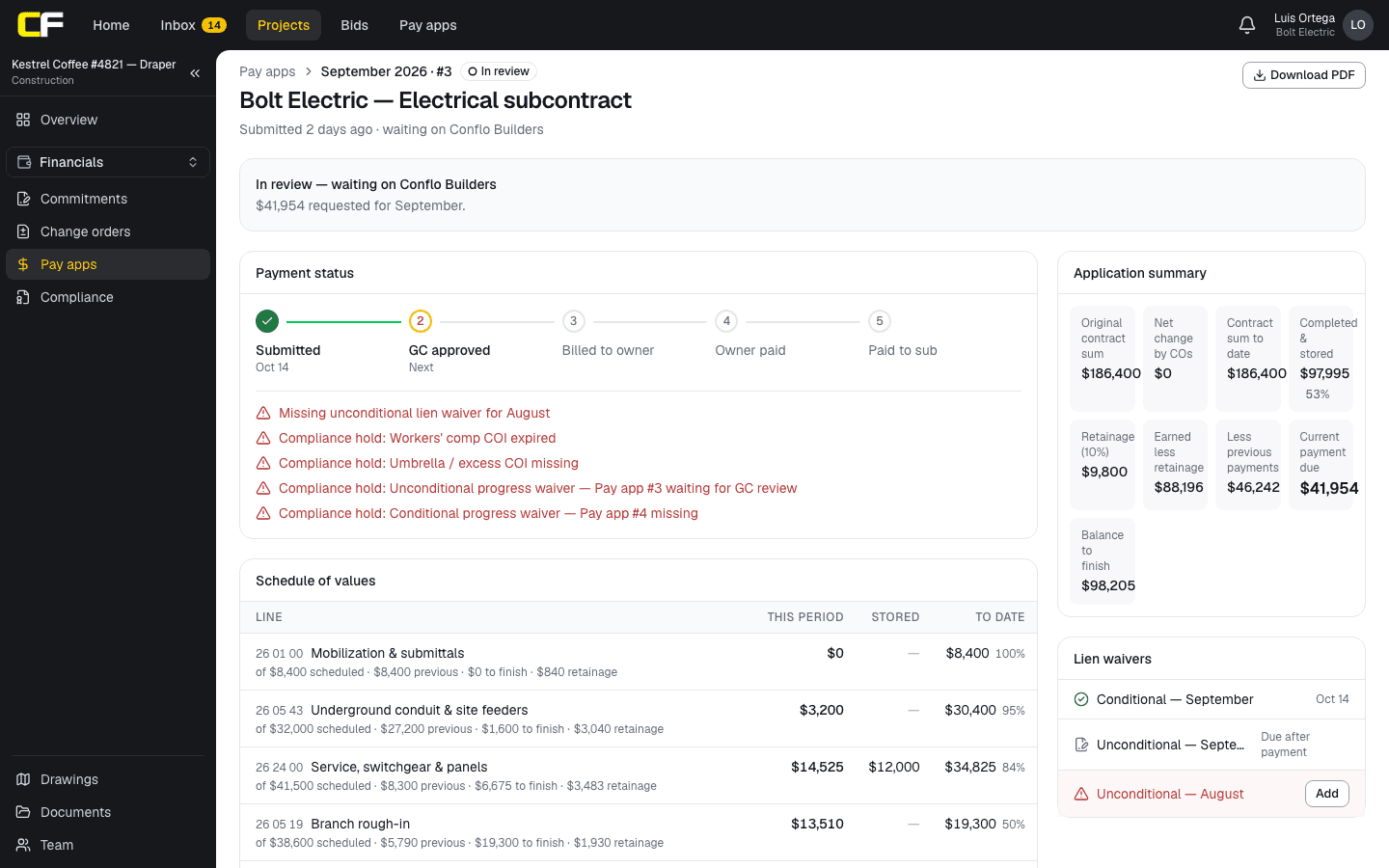
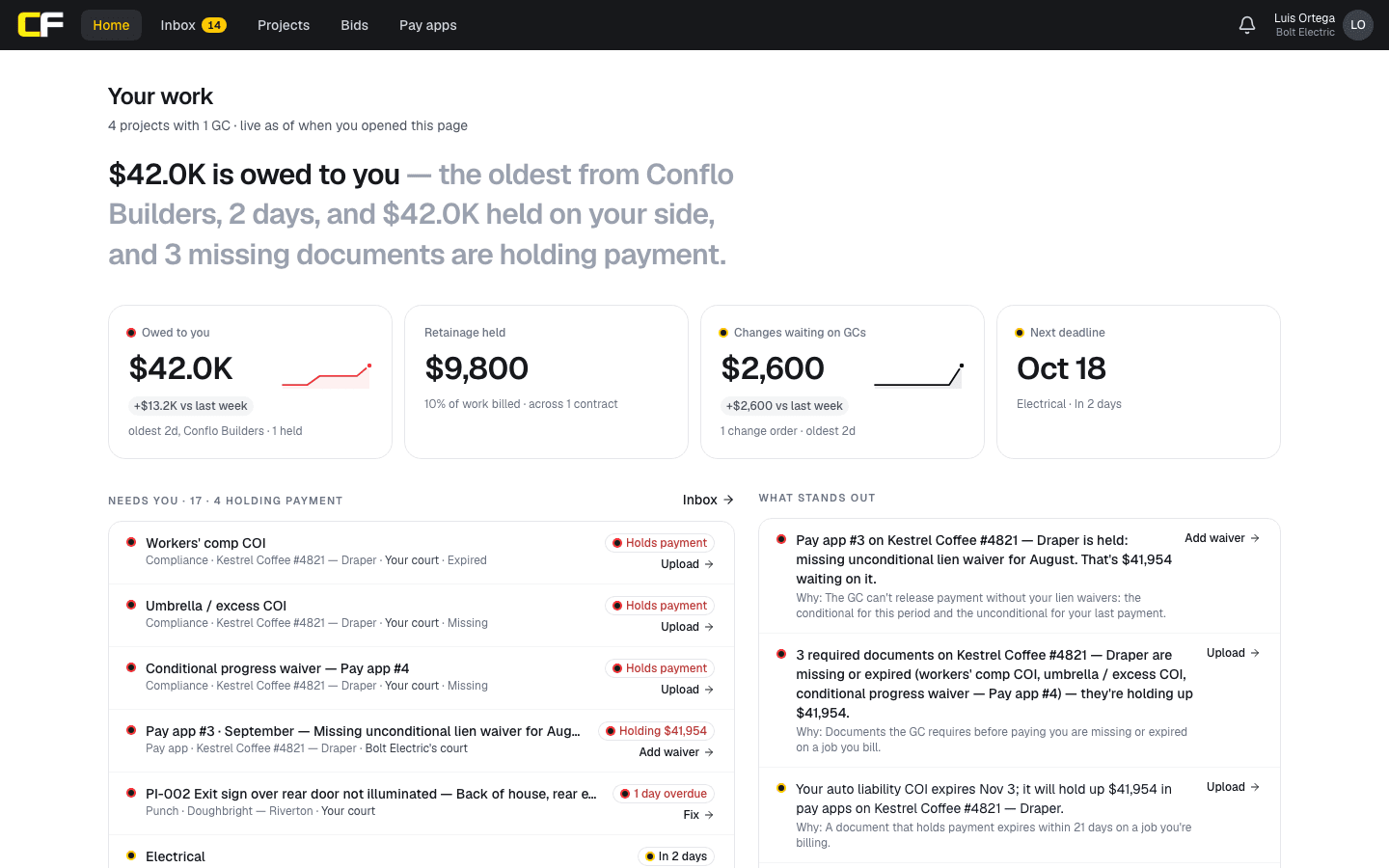
On Conflo's pay apps, every pay app shows the retainage held on its summary and on each schedule-of-values line, and a subcontractor's Home shows retainage held across its contracts. When a project is in closeout and retainage is still held, the sub's Home calls it out and links to that project's pay apps.
Not built yet: a retainage release step. Conflo doesn't record a release request, a release payment or a retainage reduction today, so the request itself goes to the GC outside Conflo.
The bottom line
Retainage comes back fastest to the sub who treats release as a deliverable: finish clean, hand over the documents, ask in writing for an exact amount, and follow up on the date it is due.
Start the file on day one: note your retainage clause, your state's rules and your lien-notice deadlines, so the end of the job is a checklist, not a chase.
Sources
- FAR 52.232-5, Payments under Fixed-Price Construction Contracts — Acquisition.gov, U.S. General Services Administration. Read October 16, 2026.
- 31 U.S.C. § 3905, Payment provisions relating to construction contracts — U.S. Government Publishing Office (govinfo), United States Code, 2023 edition. Read October 17, 2026.
- 49 CFR § 26.29, Prompt payment mechanisms — Electronic Code of Federal Regulations (eCFR). Read October 17, 2026.
- Texas Government Code § 2252.032, Retainage — Texas Legislature. Read October 16, 2026.
- Texas Property Code § 53.057, Derivative claimant: notice of claim for unpaid retainage — Texas Legislature. Read October 16, 2026.
Questions
When should a subcontractor get its retainage back?
When its subcontract's release conditions are met: often completion and acceptance of its scope, closeout documents and final waivers, and sometimes the owner's release of retainage to the GC. Some statutes set a deadline, such as 30 days after satisfactory completion on federal-aid transportation work.
Can a GC hold my retainage until the whole project is finished?
Only if your subcontract and the law allow it. Many subcontracts tie release to the project's completion, and some statutes require earlier release once a sub's work is done. Check your subcontract and your state's law.
What documents do I need to get retainage released?
Usually the punch-list sign-off, warranties, O&M manuals, as-builts and a final lien waiver, plus anything else your subcontract's closeout section lists.
What if my retainage isn't paid?
Follow up in writing, then check your lien and bond rights and their deadlines, which can be short. In Texas, for example, a notice of claim for unpaid retainage is due within 30 days in many cases. Talk to a construction lawyer.
Related
Money
How Do You Calculate Retainage on a Pay App?
Retainage is a percentage of work completed and stored to date, held back each pay period. How to calculate it, reduce it, release it, with an example.
· 9 min read
Definition
What Is Retainage in Construction?
Retainage is a percentage of each construction progress payment held back until the work is complete. Definition, an example, and how it differs.
· 3 min read
Template
Retainage Calculator for Pay Applications
Free retainage calculator: enter work to date and the rate to get retainage held, previous payments and the amount due, including a rate reduction.
· 3 min read
Closeout
How Do You Build a Punch List?
Build a punch list by walking the job room by room before substantial completion, logging each item with location, trade, photo and due date. With example.
· 9 min read
Role hub
The Subcontractor's Guide: Bidding to Getting Paid
Every step of a commercial job from the subcontractor's seat: bidding, the subcontract, submittals, RFIs, change orders, pay apps, retainage and closeout.
· 9 min read