
What Are General Conditions in a Construction Bid?
By Wyatt Cooper · Published · Updated · 4 min read
Key takeaways
- In a bid, general conditions are the general contractor's job-site cost of running the project, such as the superintendent, site office, temporary utilities, dumpsters and cleanup, that no trade's scope covers.
- The same words also name a contract document, such as AIA A201, the General Conditions of the Contract for Construction; that is terms, not costs.
- Most general conditions costs scale with time, so a longer schedule raises them.
- Owner contracts decide where each cost goes: in general conditions, in the fee or in the cost of the work. Check your contract.
General conditions, in a construction bid, are the general contractor's costs of running the job site that no trade's work covers: supervision, the site office, temporary utilities, dumpsters, cleanup and permits. They are usually priced by time, as their own line between direct cost and fee. The term also names a contract document, such as AIA A201.
Two meanings of the same words
The general conditions document is part of the contract. AIA's A201 general conditions are incorporated by reference into the owner/contractor agreement and "set forth the rights, responsibilities, and relationships of the owner, contractor, and architect" (AIA Contract Documents). That is terms: payment, changes, claims, insurance, termination.
General conditions costs are a line in the estimate: what it costs the GC to staff and run the site for the duration of the job. When an estimator says "our general conditions are $90,000", this is what is meant.
What general conditions costs include
Owners draw the line differently, so read the contract. One public owner's construction manager-at-risk exhibit sorts the costs into columns: home-office expenses and principals not assigned to the project go in the fee, while project managers, superintendents, the site office and a list of "general conditions expenses" (among them temporary fencing, temporary utilities, jobsite restrooms, dumpsters and trash removal, general cleanup and final cleaning) are paid as construction-phase services or as cost of the work (University of Northern Iowa). Another public contract has the construction manager provide its general conditions services and fee as lump sums (NC State University).
- Staff: superintendent, project manager, project engineer, safety.
- Temporary facilities: site office, toilets, temporary power and water, fencing.
- Site services: dumpsters, cleanup, final cleaning, security.
- Equipment shared by trades: hoists, lifts, scaffolding.
- Insurance and permits: builder's risk when the contract puts it on the contractor (some owners buy it themselves), and the building permit.
An example
A fictional 20-week fit-out: superintendent 20 weeks × $4,000 = $80,000; site trailer 5 months × $1,200 = $6,000; portable toilets 5 months × $350 = $1,750. General conditions total $87,750. Most of it is time, so a longer job costs more; how to build it up from the schedule, and what one extra week really costs, is in how to price general conditions. See how to build an estimate from sub bids for where the line sits in the total, and what a plug number is for the trade numbers beside it.
How it works in Conflo
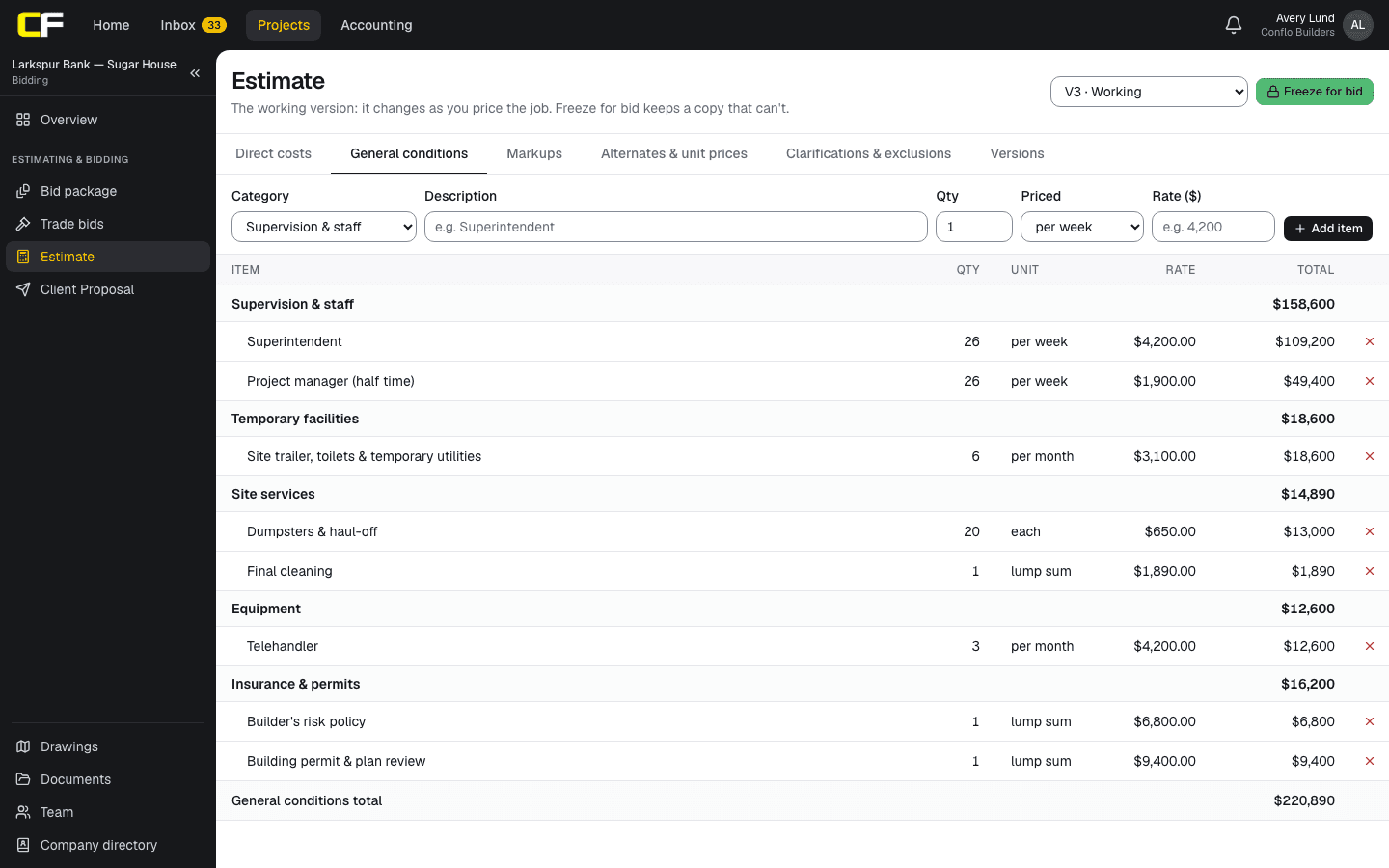
Conflo's Estimate has a General conditions tab: each row is a category (staff, temporary facilities, site services, equipment, insurance and permits), a quantity, a unit such as per week, per month or lump sum, and a rate. The total sits between direct cost and the markups.
The bottom line
General conditions are the cost of the job's time and of running the site. Price them against your schedule, keep them out of the trades' scopes, and follow the owner contract on what counts.
When someone says "general conditions", ask whether they mean the costs or the contract document.
Sources
- Summary: A201–2017, General Conditions of the Contract for Construction — AIA Contract Documents. Read October 16, 2026.
- Exhibit A, Construction Manager's Designated Services and Method of Payment (January 2021 edition), Gallagher Bluedorn Performing Arts Center Expansion — University of Northern Iowa Facilities Management. Read October 16, 2026.
- Section II, General Provisions (Construction Manager-at-Risk) — NC State University Facilities. Read October 16, 2026.
Questions
What is the difference between general conditions and general requirements?
General requirements are Division 01 of the specifications: the administrative and temporary-facility requirements written for the project. General conditions costs are what the contractor spends to meet many of them, plus supervision. The general conditions document is the contract's terms.
Are general conditions part of the fee?
Usually not: fee covers the contractor's home-office overhead and profit, and general conditions cover job-site costs. But owner contracts draw the line differently, so check yours.
How are general conditions priced?
Mostly by time, such as weeks of supervision and months of trailer, plus lump sums for items like permits. Some contracts pay them as a fixed lump sum.
Related
Bidding
How Do You Build an Estimate From Sub Bids?
Build a GC estimate from sub bids: plug each division, carry the leveled bid in place of the plug, add your own work and general conditions, then markups.
· 7 min read
Definition
What Is a Plug Number in a Bid?
A plug number is an estimator's own figure for work with no firm price yet: a placeholder in the estimate, or an add to a bid that excluded scope.
· 4 min read
Money
How Do You Price a Change Order?
Price a change order from direct cost (burdened labor, materials, equipment, sub quotes), then the markups and time your contract allows. Worked example.
· 9 min read
Bidding
How Do You Price General Conditions?
Price general conditions from the schedule: staff by the weeks on site, facilities by the month, fixed items as lump sums, and a weekly delay rate.
· 7 min read
Role hub
The General Contractor's Guide: Bid to Closeout
What a general contractor is responsible for at every phase of a commercial job, from bidding and buyout to RFIs, change orders, pay apps and closeout.
· 8 min read