
How Do You Collect O&M Manuals From Subcontractors?
By Wyatt Cooper · Published · 6 min read
Key takeaways
- Request O&M manuals by spec section and company as soon as each trade's equipment submittals are approved, not at the end of the job.
- Set a draft date well before substantial completion so the owner's staff can train from a real manual.
- Check each manual against the installed equipment: model numbers, parts lists, maintenance tasks and warranty terms, not just that a binder arrived.
- Send back what is generic or incomplete with a note saying exactly what is missing, and track each trade until it is approved.
Collect O&M manuals by requesting them from each subcontractor by spec section as soon as its equipment submittals are approved, with a due date well before substantial completion. When each arrives, check it against what was installed: model and serial numbers, operating and maintenance procedures, parts lists and warranties. Send back anything generic with a specific note, and keep one list of every trade's status until all of them are approved.
Why O&M manuals are the item that runs late
Of everything in a closeout package, the operation and maintenance manual is the one a subcontractor is most likely to leave until after its crew has left the site. It has to come from the manufacturer, it has to match the exact models installed, and the people who know which models those were are moving to the next job. The fix is to treat the manual as a submittal with a due date, not as paperwork at the end. (Where closeout sits in the whole job: the construction project lifecycle and the general contractor's guide.)
The federal guide specification for O&M data is a useful public model. UFGS 01 78 23 calls for a progress submittal "when construction is approximately 50 percent complete", a complete prefinal submittal a set number of days before the beneficial occupancy date (it offers 90 or 60 days as options), and the final submittal "due at BOD" (UFGS 01 78 23, §3.2). Your own spec may be lighter, but the idea holds: a draft early, a complete copy before handover, and corrections before the last one.
Request them by spec section and company
Read Division 01 and each technical section for what it calls for, then build the list one line per spec section and company. A mechanical sub may owe one manual for the rooftop units, one for the pumps and one for the controls; list each so nothing is buried in a single line called "HVAC O&Ms".
- List every section that requires O&M data, with the company that installed the work.
- Send each company its request with the spec section, what the manual must contain and the due date.
- Set the due date from the handover date: a draft before training, the final before substantial completion.
- Remind the trades whose equipment submittals are approved; the product data they sent is the start of the manual.
- Log each manual as it arrives, review it, and approve it or send it back with a note.
What to check in each manual
UFGS 01 78 23 asks for documents "specific to the product(s) installed", parts identified "by make, model, serial number, and source of supply to allow reordering without further identification", and, where possible, no files "containing multiple product catalogs from the same manufacturer" (UFGS 01 78 23, §1.6.3.3). Those three lines are a good test for any manual.
| Check | What good looks like | Common reason to send it back |
|---|---|---|
| Equipment matches | Model and serial numbers match the nameplates and the approved submittal | A catalog for the whole product line |
| Operation | Start-up, shutdown, normal and emergency operation for the installed system | Only a spec sheet, no procedures |
| Maintenance | Preventive tasks with their intervals, and what keeps the warranty valid | No schedule of tasks |
| Parts | Parts list with numbers and where to buy them | Parts list for a different model |
| Contacts | Installer, manufacturer rep and service contacts | Contacts for the sub's estimator who has left |
| Warranty | Warranty terms and start date for the equipment | Warranty letter missing or naming the wrong owner |
| Organization | Tabbed or bookmarked by system and spec section | One unsearchable scan |
Ask for the manual's warranty pages to match what you will hand the owner; UFGS 01 78 00 has the contractor cross-reference each warranty to its O&M manual (UFGS 01 78 00, §1.9.1). If you will run owner training, the manual should exist before the class, so the owner's staff learn from the book they will keep.
A worked example: a fictional clinic
The project is fictional: a two-story clinic with substantial completion planned for June 30. The GC asks for drafts by May 15 and finals by June 13, which leaves 17 days before handover for the last corrections.
- 1GCOn March 3, requests O&M manuals for 6 spec sections from 4 companies, drafts due May 15
- 2Mechanical subTurns in the rooftop unit manual on May 12: the manufacturer's catalog for every size it makes
- 3GCSends it back: "Manual for the two units installed, by serial number, with the filter and belt schedule"
- 4Electrical subTurns in the switchboard and lighting control manuals on May 15; both approved
- 5Plumbing subMisses May 15; the GC holds its next pay application review until the draft arrives on May 22
- 6Mechanical subResubmits the corrected manual on May 28; approved
- 7GCAll 6 approved by June 11, two days before the June 13 final date; the owner's training uses them
Holding a pay application is only a lever if the subcontract makes closeout documents a condition of payment; read yours. Many subcontracts tie at least the final payment and the release of retainage to them, which is why retainage release is the last lever on the job, though your state's prompt payment law may limit how long retainage can be held.
How it works in Conflo
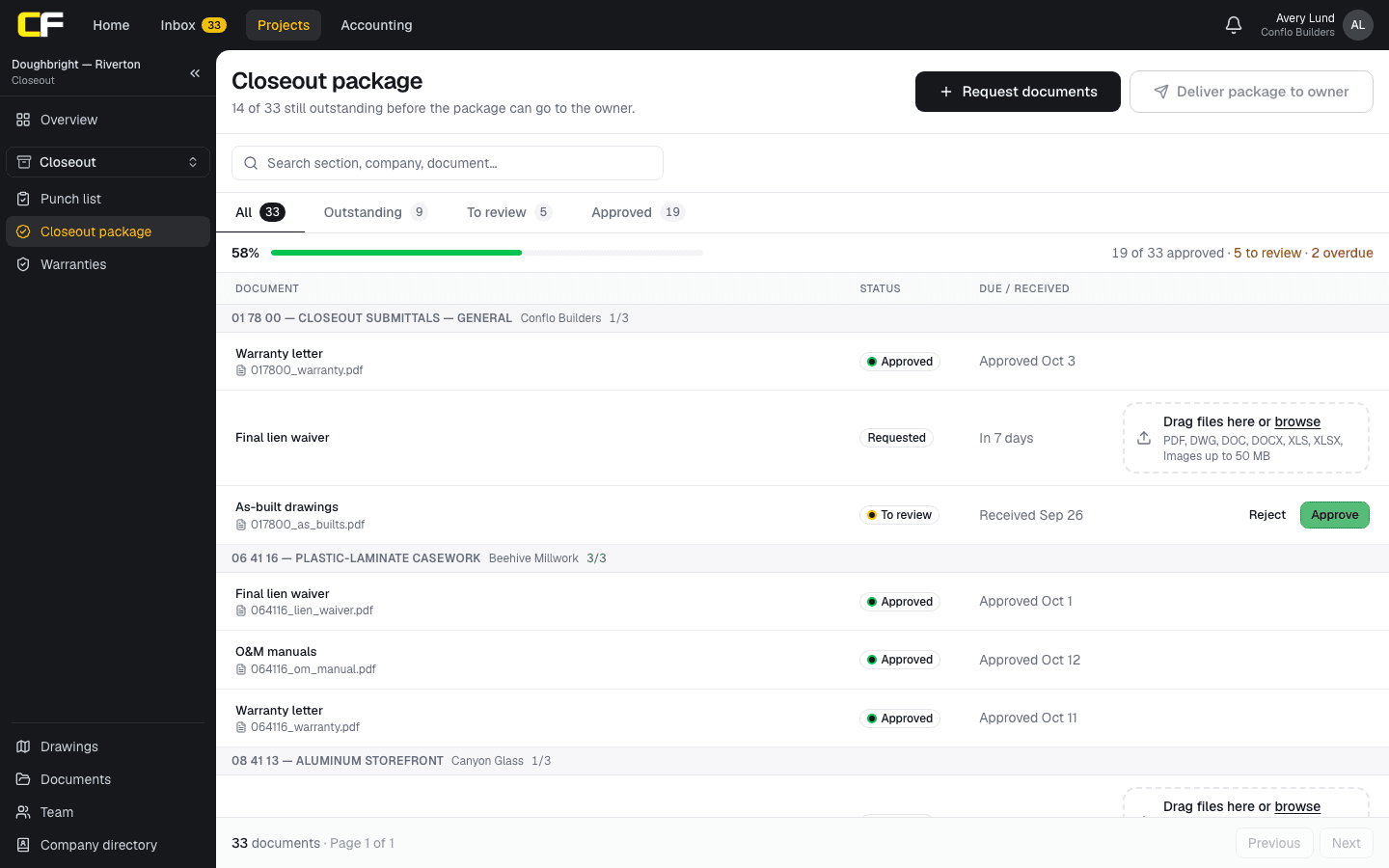
In Conflo's closeout package the GC requests documents for a spec section and company in one pass, O&M manuals among them, with a due date. Each becomes a line that is requested, received or approved; a request past its due date shows as overdue. The subcontractor sees only what its own company owes and turns the file in from its side.
The GC approves each document or sends it back with a note, which the sub sees until it resubmits. The package shows the percent approved, grouped by spec section, and the GC can deliver it to the owner only once every line is approved.
The bottom line
O&M manuals arrive on time when they are asked for early, by spec section and company, with a date before handover. Review each one against the installed equipment and send back what is generic.
Keep every trade's manual on one list until the last one is approved, then hand the owner a book their staff can use.
Sources
- UFGS 01 78 23 Operation and Maintenance Data (May 2023), §1.6.3.3 and §3.2 — Whole Building Design Guide, USACE / NAVFAC / AFCEC. Read October 22, 2026.
- UFGS 01 78 00 Closeout Submittals (August 2026), §1.9.1 — Whole Building Design Guide, USACE / NAVFAC / AFCEC. Read October 22, 2026.
Questions
When should a subcontractor submit O&M manuals?
When your spec says; many call for a draft well before substantial completion and the final before handover. The federal model asks for a progress copy at about 50 percent complete and the final at beneficial occupancy.
What should an O&M manual include?
Operating procedures, preventive maintenance tasks and intervals, parts lists with numbers, service contacts and warranty terms, all for the equipment actually installed, organized by system and spec section.
Is a manufacturer's catalog an acceptable O&M manual?
Usually not. A catalog covering every model does not tell the owner's staff how to run and maintain the units installed. Send it back and ask for the installed models by serial number.
Who reviews O&M manuals?
The GC reviews each trade's manual first, and the architect, engineer or commissioning agent often reviews them again before the owner accepts the package. Your contract names who approves them.
Related
Closeout
How Do You Assemble a Construction Closeout Package?
A closeout checklist by spec section and company: O&M manuals, as-builts, warranties, attic stock, training, lien waivers. Build it at buyout. Example.
· 9 min read
Closeout
What Should an Owner Get at Project Closeout?
The owner's closeout checklist: what you should get at substantial completion and before final payment, and how to check each document.
· 7 min read
Closeout
How Do You Close Out a Subcontract?
A GC's checklist to close out a subcontract: settle the last change orders, take the final pay app, release retainage against waivers, record the warranty.
· 6 min read
Role hub
The General Contractor's Guide: Bid to Closeout
What a general contractor is responsible for at every phase of a commercial job, from bidding and buyout to RFIs, change orders, pay apps and closeout.
· 8 min read