
What Are Stored Materials on a Pay App?
By Wyatt Cooper · Published · 4 min read
Key takeaways
- Stored materials are materials delivered for the job but not yet installed, billed on the pay app so the contractor is not financing expensive equipment until it is in place.
- On-site storage is the usual case; off-site storage generally needs the contract's permission, proof of title and often insurance.
- Once the material is installed, its value stops being stored and counts as work completed; where the contract holds retainage, it applies to stored and installed value alike.
Stored materials are materials delivered for the job but not yet installed, billed on a pay application in their own column so the contractor is paid for them before installation. Materials stored on site can usually be billed; off-site storage usually needs the contract's permission and proof of title, and often insurance. Once installed, their value moves into work completed.
The rules for billing stored materials
On federal fixed-price construction, "The Contracting Officer may authorize material delivered on the site and preparatory work done to be taken into consideration" in a progress payment. Material delivered elsewhere may be counted only if the contract specifically authorizes it and "The Contractor furnishes satisfactory evidence that it has acquired title to such material and that the material will be used to perform this contract" (FAR 52.232-5(b)(2)).
The federal payment specification narrows which materials qualify: "major high cost, long lead, special order, or specialty items" such as structural steel, equipment and large pipe, and not consumables such as "nails, fasteners, conduits, gypsum board, glass, insulation, and wall coverings". (UFGS 01 20 00, 1.7.2). The backup owners ask for (invoices, insurance, title, surety consent) is in how to bill for stored materials. Private contracts set their own rules; read the payment article before the first request.
Example: two pay apps
| Pay app 4 (delivered) | Pay app 5 (installed) | |
|---|---|---|
| Work completed to date | $0 | $180,000 |
| Materials presently stored | $150,000 | $0 |
| Completed and stored to date | $150,000 | $180,000 |
| Retainage (10%) | $15,000 | $18,000 |
| Earned less retainage | $135,000 | $162,000 |
| Less previous payments | $0 | $135,000 |
| Payment due | $135,000 | $27,000 |
The arithmetic: on pay app 4, 10% of $150,000 is $15,000, leaving $135,000. On pay app 5 the gear is installed, so the $150,000 leaves the stored column and the line is $180,000 of completed work; 10% retainage is $18,000, $180,000 − $18,000 = $162,000, and less the $135,000 already paid, $27,000 is due. Gear like this is usually a long-lead item, which is why it is delivered early. For the whole form, see what a pay application is and the free pay application workbook.
How it works in Conflo
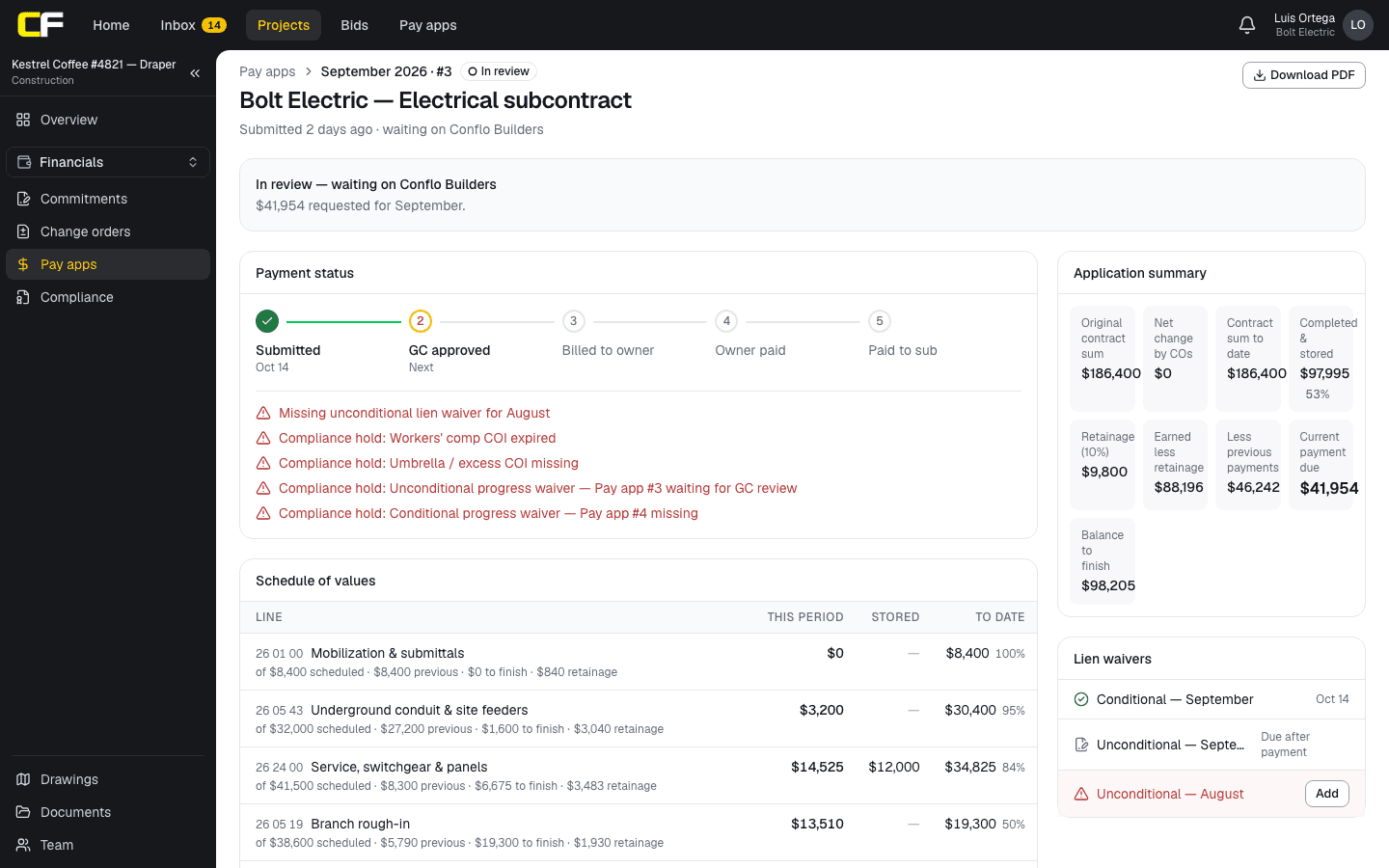
In Conflo's pay apps, each schedule-of-values line takes the percent completed this period and the materials stored, in dollars. Previous billing carries forward, no line can bill past 100%, and retainage is calculated on work completed and stored to date. The steps for a sub are in how to fill out a pay application as a subcontractor.
The bottom line
Stored materials let you bill for what is on site, or in an approved warehouse, before it is installed.
Know your contract's rules, attach the invoices and proof of title, and move the value to completed work once it is in.
Sources
- FAR 52.232-5, Payments under Fixed-Price Construction Contracts — Acquisition.gov, U.S. General Services Administration. Read October 22, 2026.
- UFGS 01 20 00, Price and Payment Procedures (November 2020) — Whole Building Design Guide (USACE / NAVFAC / AFCEC). Read October 22, 2026.
Questions
Is retainage held on stored materials?
Usually yes. Retainage is commonly calculated on work completed and materials stored to date, unless the contract or a statute says otherwise.
Can I bill for materials stored off site?
Only if the contract allows it. Expect to show title, insurance and where the materials are, and sometimes to arrange an inspection.
What happens to stored materials when they are installed?
Their value leaves the stored column and is counted as work completed, so the line's total to date does not change from the move itself.
Related
Definition
What Is a Pay Application in Construction?
A pay application is a contractor's monthly request for payment against the schedule of values, less retainage and earlier payments. With an example.
· 3 min read
Money
How Does a Subcontractor Fill Out a Pay Application?
A subcontractor's pay app bills percent complete and stored materials per schedule-of-values line, less retainage and prior payments, with a lien waiver.
· 9 min read
Template
Free Pay Application Template With Schedule of Values
A free Excel pay application: a summary sheet and a schedule of values with change orders, stored materials and retainage, calculated. No email needed.
· 4 min read
Definition
What Is Retainage in Construction?
Retainage is a percentage of each construction progress payment held back until the work is complete. Definition, an example, and how it differs.
· 3 min read
Money
How Do You Bill for Stored Materials on a Pay App?
Bill delivered but uninstalled materials: the backup owners ask for, on site vs off site, and how stored amounts move to installed work. Worked example.
· 7 min read
Role hub
The Subcontractor's Guide: Bidding to Getting Paid
Every step of a commercial job from the subcontractor's seat: bidding, the subcontract, submittals, RFIs, change orders, pay apps, retainage and closeout.
· 9 min read