
What Is Substantial Completion?
By Wyatt Cooper · Published · 3 min read
Key takeaways
- Substantial completion is the stage when the work is complete enough, under the contract documents, for the owner to occupy or use it for its intended purpose.
- It is not final completion: punch list items remain, and final payment usually waits for them.
- On many contracts the date starts the warranties, stops the delay clock and releases most of the retainage; your contract says which.
Substantial completion is the stage when the work, or a designated part of it, is complete enough under the contract documents that the owner can occupy or use it for its intended purpose. Punch list items can remain. The date is recorded on a certificate and often starts warranties, stops delay damages and releases most retainage.
The definition most contracts use
AIA's general conditions, A201-2017 Section 9.8.1, define it as "the stage in the progress of the Work when the Work or designated portion thereof is sufficiently complete in accordance with the Contract Documents so that the Owner can occupy or utilize the Work for its intended use" (AIA Contract Documents). Other contract families and public owners word it differently, so read the definition in your own contract.
The date is set on a certificate. The AIA's summary of G704 describes it as a form "for recording the date of substantial completion of the work or a designated portion thereof", with the list of items still to complete or correct, the time to finish them, and who takes on maintenance, heat, utilities and insurance. For how the architect decides, see how an architect decides substantial completion.
What the date usually triggers
- Warranties: the G704 summary says warranties start on the date of substantial completion unless the parties indicate otherwise.
- Retainage: on federal fixed-price construction, once the work is substantially complete the contracting officer keeps only what is adequate to protect the government and releases the rest of the withheld funds (FAR 52.232-5). See how to calculate retainage.
- Delay damages: federal liquidated damages run "until the work is completed or accepted" (FAR 52.211-12); many private contracts stop them at substantial completion instead. Check yours.
- Possession: the owner takes over the space, and with it, by agreement, utilities, security and insurance.
Substantial completion vs. final completion
Substantial completion means usable. Final completion means everything is done: every punch list item closed, the closeout documents delivered, and the final payment application ready. Example: a fictional clinic is certified substantially complete on June 2 with 50 punch items open; the last item closes and the closeout package is delivered on July 2, which is final completion.
How it works in Conflo
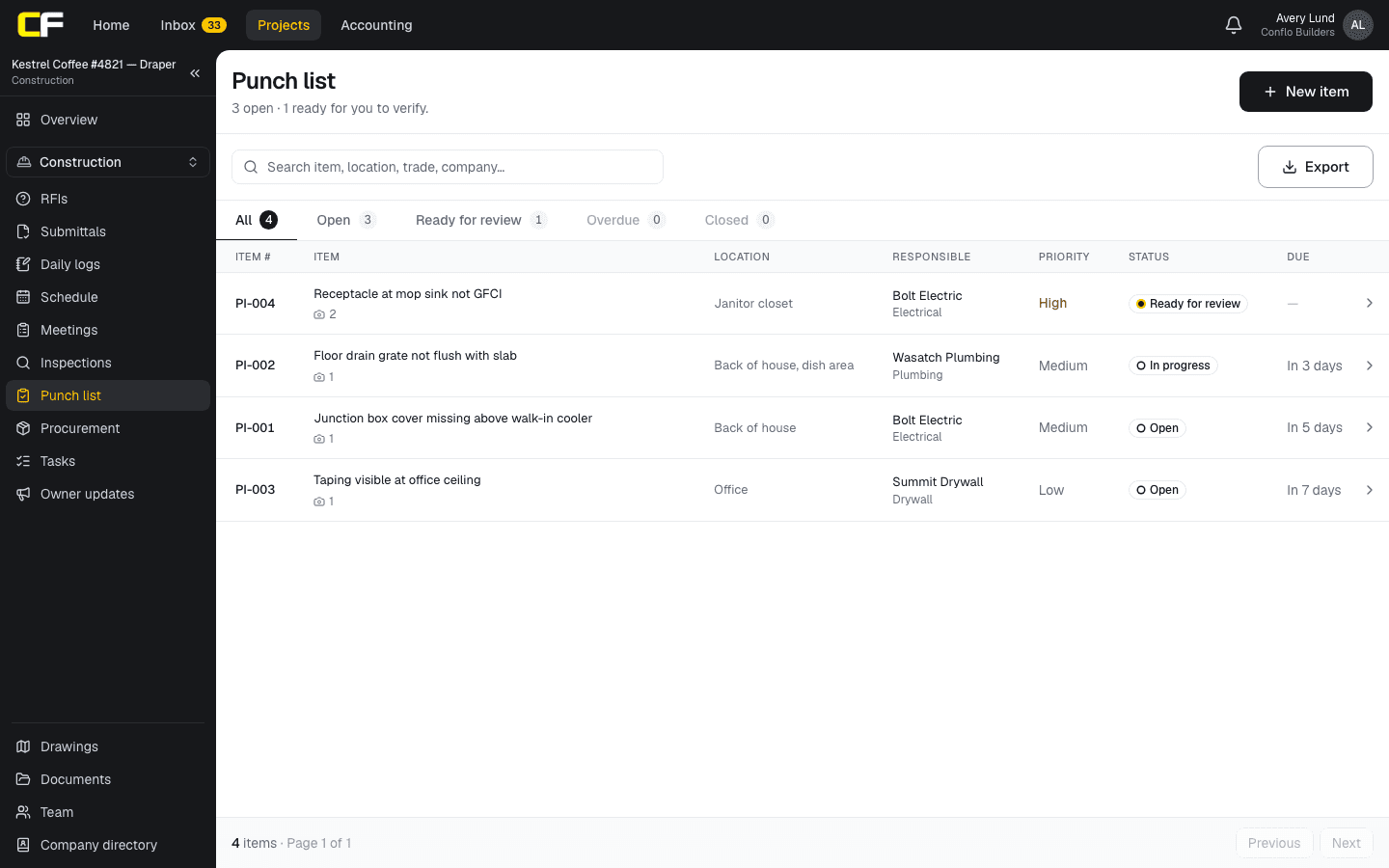
Conflo's punch list carries the items between the two dates: the GC logs and verifies each one, subs fix their own, and the owner and architect follow the same list. Conflo does not issue the certificate of substantial completion itself; that stays your contract's form.
The bottom line
Substantial completion is a date with money and risk attached: warranties, retainage, delay damages and who insures the building can all turn on it.
Know what your contract ties to it before you ask for the inspection.
Sources
- The Construction Schedule – Substantial Completion Considerations — AIA Contract Documents (The American Institute of Architects). Read October 16, 2026.
- Summary: G704–2017, Certificate of Substantial Completion — AIA Contract Documents (The American Institute of Architects). Read October 16, 2026.
- FAR 52.232-5, Payments under Fixed-Price Construction Contracts — Acquisition.gov, U.S. General Services Administration. Read October 16, 2026.
- FAR 52.211-12, Liquidated Damages—Construction — Acquisition.gov, U.S. General Services Administration. Read October 16, 2026.
Questions
Who decides substantial completion?
Under AIA documents, the architect inspects and certifies it after the contractor submits its list of items to complete or correct. On public work the owner's engineer or project staff usually decide. Your contract names who.
Does a certificate of occupancy mean substantial completion?
Not by itself. A certificate of occupancy is the building official's permission to occupy; substantial completion is a contract status. Many contracts list the certificate of occupancy as one requirement for it.
Can part of a building be substantially complete?
Yes, if the contract allows it and the owner agrees to accept a designated portion separately. That portion's date can then start its own warranties and occupancy.
Related
Definition
What Is a Punch List in Construction?
A punch list is the list of work still to be completed or corrected once a building is substantially complete. What goes on it, who writes it, an example.
· 3 min read
Closeout
How Does an Architect Decide Substantial Completion?
How the architect inspects for substantial completion: the contractor's list, who walks, what blocks use and what is a punch item, and the certificate.
· 8 min read
Money
How Do You Calculate Retainage on a Pay App?
Retainage is a percentage of work completed and stored to date, held back each pay period. How to calculate it, reduce it, release it, with an example.
· 9 min read
Definition
What Is a Certificate of Occupancy?
A certificate of occupancy is the building department's approval to occupy a building. Definition, temporary COs, and how it differs from completion.
· 3 min read
Role hub
The General Contractor's Guide: Bid to Closeout
What a general contractor is responsible for at every phase of a commercial job, from bidding and buyout to RFIs, change orders, pay apps and closeout.
· 8 min read