
What Is a Cost Code in Construction?
By Wyatt Cooper · Published · 3 min read
Key takeaways
- A cost code is the label that puts every dollar on a job into a category of work, so budget, commitments, costs and changes can be compared line by line.
- Commercial contractors commonly build their codes on CSI MasterFormat divisions and sections, sometimes adding a cost type such as labor, material or subcontract.
- Codes only work if they are set before buyout and used the same way on every contract, invoice and change order.
A cost code is the number a contractor assigns to each category of work in the budget, so every estimate line, subcontract, purchase order, invoice and change order can be tracked against the same bucket. Commercial contractors commonly base cost codes on CSI MasterFormat divisions, such as 23 for HVAC, sometimes with a cost-type suffix for labor or material.
What cost codes do
A cost code is the job's filing system for money. Federal cost guidance makes the same point about its work breakdown structure: "A WBS is an essential part of developing a program's cost estimate", and it "facilitates establishing the schedule, cost, and earned value management (EVM) baseline" (GAO-20-195G, Cost Estimating and Assessment Guide). On a building job the cost-code list plays that role.
Most commercial contractors start from CSI MasterFormat, which CSI describes as organizing specifications "into work results that contractors can price, procure, and build" (CSI). Using the spec's numbers means the bid package, the subcontract's schedule of values and the budget all line up. The setup is in how to build a schedule of values and how to buy out a job.
Example
| Record | Cost code | Amount |
|---|---|---|
| Budget line: HVAC controls | 23 09 00 | $84,000 |
| Controls subcontract | 23 09 00 | $79,500 |
| Change order: added zone sensors | 23 09 00 | $3,200 |
| Committed to date | 23 09 00 | $82,700 |
| Left in the budget | 23 09 00 | $1,300 |
The arithmetic: $79,500 + $3,200 = $82,700 committed; $84,000 − $82,700 = $1,300 still uncommitted. Had the change order been coded to general HVAC instead, the controls line would look $3,200 healthier than it is. The committed column is explained in what a committed cost is.
How it works in Conflo
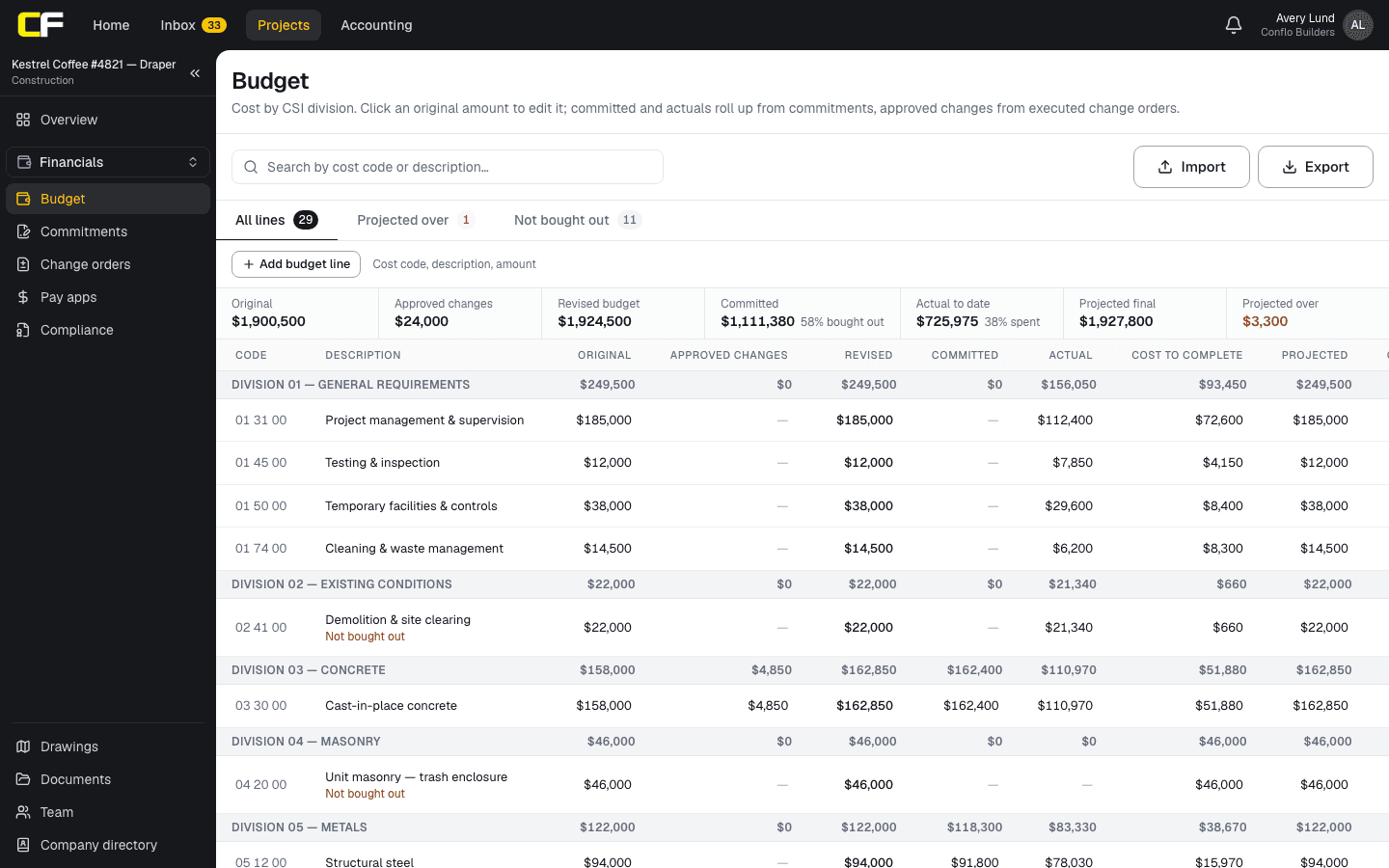
In Conflo's budget, lines are keyed by MasterFormat cost code and grouped by division, with subtotals on each division row. Every commitment line carries a cost code, so an executed subcontract's schedule of values rolls into the matching budget codes, and its approved change orders count against the contract's first code.
The bottom line
A cost code is the tag that lets you compare what you planned, bought and spent on each piece of work.
Set the list from the specs before buyout, and code every contract, invoice and change order the same way.
Sources
- GAO-20-195G, Cost Estimating and Assessment Guide (March 2020) — U.S. Government Accountability Office. Read October 22, 2026.
- Standards overview: MasterFormat — Construction Specifications Institute (CSI). Read October 22, 2026.
Questions
What is the difference between a cost code and a cost type?
The cost code says what work the money is for (HVAC controls); the cost type says what kind of cost it is (labor, material, equipment, subcontract).
Do cost codes have to follow MasterFormat?
No. Any consistent list works, but codes based on the specification's section numbers make it easier to match bids, contracts and submittals.
How many cost codes should a job have?
Enough to see where the money is going, no more. Many commercial jobs use one code per bid package plus the GC's own general conditions codes.
Related
Definition
What Is CSI MasterFormat?
CSI MasterFormat is the standard numbering for construction specifications, reused for bid packages, cost codes and closeout. Definition and an example.
· 3 min read
Preconstruction
How Do You Build a Schedule of Values?
Split the contract sum into billable lines that follow the work, price each with its share of overhead and profit, and keep closeout real. With an example.
· 7 min read
Preconstruction
How Do You Buy Out a Construction Job?
Construction buyout step by step: scope review, leveling, award, the subcontract and its exhibits, compliance documents, and savings against budget.
· 7 min read
Preconstruction
How Do You Set Up Cost Codes for a Construction Job?
Set up construction cost codes from CSI MasterFormat: pick the detail, match codes to bid packages, and use them from estimate to pay app.
· 7 min read
Role hub
The General Contractor's Guide: Bid to Closeout
What a general contractor is responsible for at every phase of a commercial job, from bidding and buyout to RFIs, change orders, pay apps and closeout.
· 8 min read