
Texas Retainage Law: What Property Code Ch. 53 Says
By Wyatt Cooper · Published · 9 min read
Key takeaways
- Texas Property Code Chapter 53 does not cap private contract retainage; instead § 53.101 makes the owner reserve 10% of the contract price, or of the value of work done, for 30 days after completion for lien claimants.
- A sub owed retainage must send a notice of claim for unpaid retainage within 30 days after its own contract is completed, terminated or abandoned, or sooner if the original contract is terminated or abandoned first, unless an earlier notice already covered it.
- A lien affidavit for retainage is due by the 15th day of the third month after the month the original contract was completed, terminated or abandoned (§ 53.052(d)).
- On public works, Government Code § 2252.032 caps retainage at 10% under $5 million and 5% at $5 million or more, and a prime may not hold a greater percentage from a sub.
Texas Property Code Chapter 53 treats retainage mainly as a lien question. It defines retainage, requires a private owner to reserve 10% of the contract price for 30 days after completion (§ 53.101), and sets the notice and filing deadlines a subcontractor must meet to keep a lien for unpaid retainage (§§ 53.057 and 53.052). It does not cap the percentage on private contracts; on public works, Government Code § 2252.032 caps it at 10% or 5%. Verify the current statute.
What Texas means by retainage
Chapter 53 defines retainage as "an amount representing part of a contract payment that is not required to be paid to the claimant within the month following the month in which labor is performed, material is furnished, or specially fabricated material is delivered" (Tex. Prop. Code § 53.001(11)). Chapter 53 was largely rewritten by H.B. 2237 (Acts 2021, 87th Leg., ch. 690), effective January 1, 2022, so guides written before 2022 often quote repealed notice rules.
The owner's 10% reserve is not the same as retainage
Subchapter E, "Funds Reserved for Benefit of Lien Claimants," requires that during the work "and for 30 days after the work under the contract is completed, the owner shall reserve" 10% of the contract price, or 10% of the value of the work done measured against the contract price (§ 53.101). Those funds secure payment of the people who did the work and furnished material for any contractor or sub (§ 53.102).
- A claimant has a lien on the reserved funds if it sends the required notices and, except as § 53.057(f) allows, files a lien affidavit no later than the 30th day after the earliest of completion, termination or abandonment (§ 53.103).
- Individual artisans and mechanics share first, for wages and fringe benefits; other claimants share the rest proportionately (§ 53.104).
- If the owner fails to reserve, complying claimants have a lien at least to the extent of the amount that should have been reserved (§ 53.105).
- An owner may file an affidavit of completion; it is prima facie evidence of the completion date and must say that a claimant may not have a lien on retained funds unless it files on time (§ 53.106).
Contract retainage is whatever the contract says, held by whoever pays. The statutory reserve is a separate duty of the owner. They often overlap on the same dollars, but meeting one does not mean you met the other.
Keeping a lien for unpaid retainage
A subcontractor or supplier (a claimant other than an original contractor) whose contract provides for retainage has two steps. Both are counted from facts you must track: the dates your contract and the original contract end.
| Step | Deadline in the statute | Section |
|---|---|---|
| Notice of claim for unpaid retainage, to the owner and the original contractor | Not later than the earlier of the 30th day after the claimant's contract is completed, terminated or abandoned, or the 30th day after the original contract is terminated or abandoned | § 53.057(a-1) |
| Lien affidavit for retainage, filed with the county clerk | Not later than the 15th day of the third month after the month the original contract was completed, terminated or abandoned | § 53.052(d) |
| Copy of the filed affidavit to the owner and the original contractor | Not later than the fifth day after filing | § 53.055 |
The retainage notice is needed only "to the extent that a claim for unpaid retainage is not included wholly or partly" in a monthly notice of claim for unpaid labor or materials under § 53.056. The statute gives the notice's form, headed "NOTICE OF CLAIM FOR UNPAID RETAINAGE" with a warning that it is provided to preserve lien rights; use the form as the statute states it.
For unpaid progress billings, not retainage, a non-residential claimant's notice of claim is due by the 15th day of the third month after the month the work was done, and its lien affidavit by the 15th day of the fourth month after the month it last provided labor or materials (§§ 53.056 and 53.052(b)); residential projects are a month shorter. More on lien timing: mechanic's lien deadlines.
Texas public works: the caps in Government Code § 2252.032
Public jobs have a percentage cap. Except for listed water-project entities, a governmental entity may not withhold more than 10% of the contract price, or 10% on any schedule-of-values item, on a contract under $5 million, and no more than 5% at $5 million or more; dam contracts stay at 10% whatever their size (Tex. Gov't Code § 2252.032). The prime "may not withhold from a subcontractor a greater percentage of retainage than the percentage that may be withheld from the prime contractor," the entity may not hold retainage after completion, "including during the warranty period," and on contracts of $10 million or more the parties may agree to put retainage in an interest-bearing account.
Worked example: a retainage lien calendar
A fictional mechanical subcontractor, "Brazos Air Systems", holds 10% retainage on a private warehouse in Texas, the fictional "Pecan Creek Distribution Center". Its own scope is finished on March 20, 2026, and the original contract between the owner and the GC is completed in May 2026. Brazos has been paid for every progress billing, but not its retainage.
- 1March 20, 2026Brazos's subcontract is completed: the 30-day clock for the retainage notice starts
- 2By April 19, 2026Notice of claim for unpaid retainage to the owner and the GC (30th day after the subcontract was completed, § 53.057(a-1))
- 3May 2026The original contract is completed
- 4By August 15, 2026Lien affidavit for retainage filed with the county clerk (15th day of the third month after May, § 53.052(d))
- 5Within 5 days of filingCopy of the affidavit to the owner and the GC (§ 53.055)
Counting from the statute: March 20 plus 30 days is April 19; the first, second and third months after May are June, July and August, so the 15th day of the third month is August 15. Under § 53.003(e) a deadline that falls on a Saturday, Sunday or legal holiday moves to the next business day (here April 20 and August 17); plan on the earlier date. If the owner files an affidavit of completion, or the original contract is terminated earlier, the dates can move; the safest course is to send the notice and file early, not on the last day. For how the retainage itself is figured on each pay app, see how to calculate retainage.
Prompt pay is a separate Texas chapter
Texas Property Code Chapter 28 sets payment deadlines on private work: the owner pays a contractor's proper payment request "less any amount withheld as authorized by statute" within 35 days, and each contractor pays its subs within seven days of being paid; overdue amounts bear interest at 1.5% per month (Tex. Prop. Code ch. 28). Chapter 28 says it does not change rights under Chapter 53. See prompt payment acts for the federal and state timelines.
How it works in Conflo
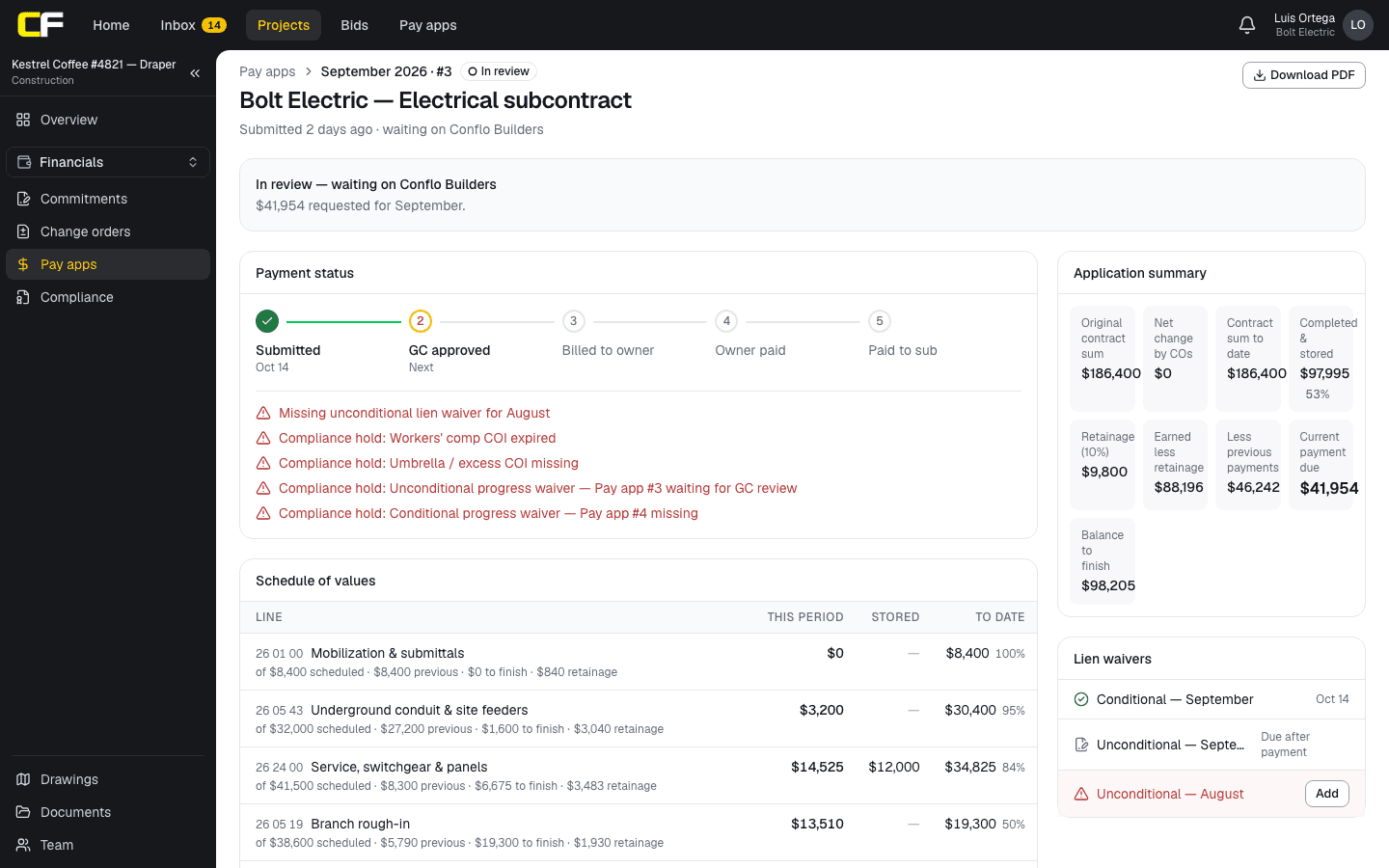
On Conflo's pay applications, each contract carries one retainage percentage (0 to 20%) and retainage is calculated on work completed and stored to date, so a sub can see retainage held to the cent on every pay app. The payment tracker records the date of each step, from submitted to paid to the sub.
Not built: lien notices, Texas notice-of-claim forms, lien deadline calendars or the owner's 10% reserve. Keep those dates yourself, or with your attorney.
The bottom line
In Texas, retainage on a private job is mostly a contract number plus a lien deadline: the owner must reserve 10% for 30 days after completion, and a sub owed retainage has 30 days from the end of its contract (or less) to send its notice and until the 15th day of the third month to file.
Write two dates into every Texas job file the day they happen: when your subcontract was completed, and when the original contract was completed. Every retainage deadline counts from one of them.
Sources
- Texas Property Code Chapter 53, Mechanic's, Contractor's, or Materialman's Lien — Texas Legislature. Read October 16, 2026.
- Texas Property Code Chapter 28, Prompt Payment to Contractors and Subcontractors — Texas Legislature. Read October 16, 2026.
- Texas Government Code § 2252.032, Retainage — Texas Legislature. Read October 16, 2026.
Questions
Is there a retainage limit in Texas?
On public works, yes: Government Code § 2252.032 caps it at 10% on contracts under $5 million and 5% at $5 million or more, with exceptions. On private work, Property Code Chapter 53 does not cap the contract percentage; it requires the owner to reserve 10% for 30 days after completion.
What is the deadline to claim a lien for retainage in Texas?
Send the notice of claim for unpaid retainage by the earlier of the 30th day after your contract is completed, terminated or abandoned, or the 30th day after the original contract is terminated or abandoned, and file the lien affidavit by the 15th day of the third month after the month the original contract ended (§§ 53.057 and 53.052(d)). Verify the current statute.
What is the Texas 10% reserve?
Property Code § 53.101 requires a private owner to reserve 10% of the contract price, or of the value of the work done, during the work and for 30 days after completion. The reserved funds secure payment of subcontractors, suppliers and workers who perfect their claims.
Can a Texas GC hold more retainage from a sub than the owner holds?
On public works, no: § 2252.032(d) forbids a prime from withholding a greater percentage than the entity may withhold from it. On private work, the subcontract controls, so read it before you sign.
When did Texas lien law change?
H.B. 2237 (Acts 2021, 87th Legislature) rewrote much of Chapter 53 effective January 1, 2022, including the notice forms and deadlines. Use the current text, not older summaries.
Related
Money
Retainage Laws in the Five Largest Construction States
Retainage caps and release deadlines in California, Texas, Florida, New York and North Carolina, from each state's statutes, private and public.
· 10 min read
Money
California Retainage Law: Private and Public Jobs
California retention rules from the statutes: the new 5% private cap from 2026, the 5% public cap, release deadlines and the 2% monthly penalty.
· 8 min read
Money
Mechanic's Lien Deadlines: How They Work
How mechanic's lien deadlines are counted: the notices before, the filing deadline, the deadline to sue, and five states' filing deadlines from statute.
· 8 min read
Money
How Do You Calculate Retainage on a Pay App?
Retainage is a percentage of work completed and stored to date, held back each pay period. How to calculate it, reduce it, release it, with an example.
· 9 min read
Role hub
The Subcontractor's Guide: Bidding to Getting Paid
Every step of a commercial job from the subcontractor's seat: bidding, the subcontract, submittals, RFIs, change orders, pay apps, retainage and closeout.
· 9 min read