
How Do You Build a Schedule of Values?
By Wyatt Cooper · Published · 7 min read
Key takeaways
- A schedule of values splits the contract sum into lines you can measure in the field, and every pay application for the rest of the job bills against those lines.
- Each line should carry its true cost plus its share of overhead and profit, so no line is worth more early in the job than the work it describes.
- Front-loading moves value into early lines; in the example below, shifting $18,000 from closeout to mobilization raises the first bill from $13,600 to $31,600.
- Separate lines for stored materials, allowances and closeout, and one new line per approved change order, keep later billing easy to check.
To build a schedule of values, start from your estimate and split the contract sum into lines that match how the work will be built and checked: by specification section, area or phase, with material and labor separated where materials will be stored before they are installed. Give each line its direct cost plus a proportional share of overhead and profit, add a real closeout line, make the lines total the contract sum exactly, and submit it for approval before the first pay application.
What a schedule of values is for
A schedule of values (SOV) is the contract sum broken into lines. Each month, the pay application bills a percentage of each line, so the SOV decides how money moves for the whole job. The AIA describes its continuation sheet as breaking the contract sum into portions of the work "in accordance with a schedule of values prepared by the contractor" (AIA G703 summary), and notes that it publishes no standard schedule-of-values form of its own (AIA G702 summary). So the contractor builds it, and the owner, architect or GC approves it.
Federal jobs ask for the same thing in other words: a progress payment request must include "an itemization of the amounts requested, related to the various elements of work required by the contract" (FAR 52.232-5). Whatever the form, the reviewer needs lines they can walk the site and check.
Read the spec section that governs it first
Most commercial projects put the rules for the SOV in Division 01, often a section called Payment Procedures. One public university's master specification is a fair picture of what owners ask for (University of Houston, Section 01 29 00):
- Submit the schedule of values to the architect no later than 14 days before the first application for payment.
- Use the project manual's table of contents as a guide, with at least one line per specification section.
- Give principal subcontracts over five percent of the contract sum multiple lines.
- Include separate closeout lines totaling five percent of the contract sum and of each principal subcontract.
- Round to whole dollars, with the total equal to the contract sum.
- Give stored materials, and each allowance, their own lines.
- Include each item's total cost and "proportionate share of general overhead and profit".
- Update the schedule when change orders change the contract sum, with each change order as a new line.
Your contract may differ on every point. Find the section, and build to it.
Build it in six steps
- Start from the estimate you priced the job with: labor, material, equipment and subcontract costs by scope.
- Choose the line breakdown: by spec section, then split large scopes by building area, floor or phase so each line is a piece of work someone can see finished.
- Split material from installation where material will be bought and stored before it is installed (fixtures, switchgear, equipment), so stored material can be billed and checked on its own line.
- Spread overhead and profit across the lines in proportion to their cost. Don't park it in mobilization or general conditions.
- Add a closeout line (testing, O&M manuals, as-builts, training) sized to the real effort, or to what the spec requires.
- Total the lines, check they equal the contract sum to the dollar, and submit for approval with your first billing paperwork.
A worked example: a plumbing subcontract
A fictional plumbing subcontractor, "Copperline Plumbing", has a $240,000.00 subcontract on a fictional "Maple Street Clinic". Its estimate, with overhead and profit spread in proportion to cost, gives seven lines:
| Line | Description | Scheduled value | Share of the sum |
|---|---|---|---|
| 1 | Mobilization and bonds | $6,000.00 | 2.50% |
| 2 | Underground rough-in | $38,000.00 | 15.83% |
| 3 | Above-ground rough-in | $72,000.00 | 30.00% |
| 4 | Fixtures, material | $46,000.00 | 19.17% |
| 5 | Fixture installation and trim | $40,000.00 | 16.67% |
| 6 | Water heaters and equipment | $18,000.00 | 7.50% |
| 7 | Testing, closeout and as-builts | $20,000.00 | 8.33% |
| Total | $240,000.00 | 100.00% |
The lines add to $240,000.00: 6,000 + 38,000 + 72,000 + 46,000 + 40,000 + 18,000 + 20,000. Fixtures are split into material (line 4) and installation (line 5) because the fixtures will sit in a locked room on site for weeks before they are set. Shares are rounded to two decimals.
Front-loaded version of lines 1 and 7
- Line 1, mobilization and bonds
- $24,000.00 instead of $6,000.00
- Line 7, testing, closeout and as-builts
- $2,000.00 instead of $20,000.00
- Contract sum
- Still $240,000.00
- Pay app 1: mobilization + 20% of underground ($7,600.00)
- $31,600.00 billed instead of $13,600.00
- Paid ahead of the work
- $18,000.00
The front-loaded schedule bills the same work for $18,000.00 more in month one: $24,000.00 + $7,600.00 = $31,600.00 against $6,000.00 + $7,600.00 = $13,600.00. And it leaves $2,000.00 to motivate a closeout that costs far more. Reviewers look for exactly this; an honest schedule gets approved faster.
Want the layout ready-made? The free pay application workbook has this schedule of values filled in as an example, with change-order lines and the summary page.
Mistakes that get a schedule of values sent back
- Front-loading: early lines (mobilization, general conditions, deposits) worth more than their cost.
- Lines too big to measure: one $400,000 "rough-in" line that nobody can call 35% or 40% with a straight face.
- No stored-material lines, so material on site has nowhere to be billed.
- A token closeout line, which many owners treat as front-loading in reverse.
- Lines that don't add to the contract sum, or change orders folded into existing lines instead of added as new ones.
Subcontractors: your GC's SOV to the owner usually needs your lines to roll up into theirs. Ask for the GC's line structure or cost codes before you build yours, and see how a subcontractor fills out a pay application for the monthly billing that follows.
How it works in Conflo
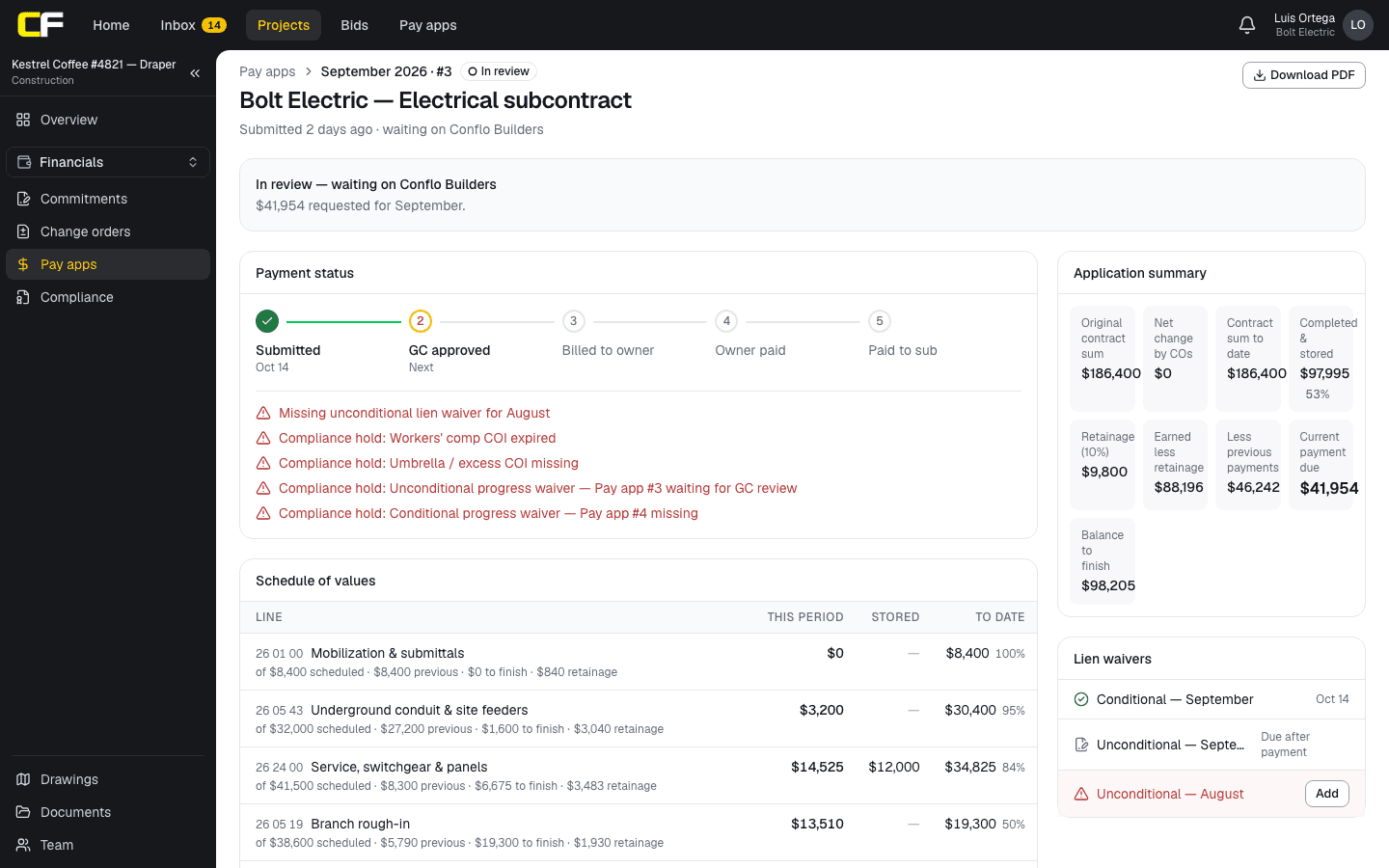
In Conflo, a subcontract's schedule of values is written in Commitments, each line on a budget cost code, and once the sub signs it becomes the schedule the sub bills against on pay apps. The GC's schedule to the owner is set up with the owner's prime contract, or built from the awarded estimate. Each month the sub enters a percent complete and stored materials per line, and no line can bill past 100%. Approved change orders show as the net change on the summary; billing a change order as its own new line is not built yet.
The bottom line
A schedule of values is a promise about how money will follow the work. Build it from your estimate, split it where the work can be checked, spread overhead and profit honestly, and the next twelve months of billing get easier for everyone.
Before you build one, read the payment section of your contract and Division 01, and ask the reviewer how they want it laid out. Then use the free workbook as your starting layout.
Sources
- Section 01 29 00, Payment Procedures (master construction specification) — University of Houston, Facilities Planning and Construction. Read October 16, 2026.
- Summary: G703–1992, Continuation Sheet — AIA Contract Documents (The American Institute of Architects). Read October 16, 2026.
- Summary: G702–1992, Application and Certificate for Payment — AIA Contract Documents (The American Institute of Architects). Read October 16, 2026.
- FAR 52.232-5, Payments under Fixed-Price Construction Contracts — Acquisition.gov, U.S. General Services Administration. Read October 16, 2026.
Questions
Who prepares the schedule of values?
The contractor billing on the contract: the GC for its contract with the owner, each subcontractor for its subcontract. The party who pays, or the architect acting for the owner, reviews and approves it before the first pay application.
How detailed should a schedule of values be?
Detailed enough that each line can be measured in the field. Many specifications ask for at least one line per specification section and several lines for large subcontracts, with stored materials and allowances on their own lines.
What is front-loading a schedule of values?
Putting more value in early lines than their work is worth, so the contractor is paid ahead of the work. Owners and GCs look for it in mobilization, general conditions and deposit lines, and send it back.
How do change orders go on a schedule of values?
Usually as new lines, added once the change order is approved, so the original lines stay as they were. Check your contract: some specifications require it in those words.
Can you change a schedule of values after it is approved?
Only with the approver's agreement. Most contracts expect the original lines to stay fixed and changes to come through change orders, so get the breakdown right before the first billing.
Related
Definition
What Is a Schedule of Values?
A schedule of values splits a construction contract sum into line items that every pay application bills against. Definition, example and how it differs.
· 3 min read
Template
Free Pay Application Template With Schedule of Values
A free Excel pay application: a summary sheet and a schedule of values with change orders, stored materials and retainage, calculated. No email needed.
· 4 min read
Money
How Does a Subcontractor Fill Out a Pay Application?
A subcontractor's pay app bills percent complete and stored materials per schedule-of-values line, less retainage and prior payments, with a lien waiver.
· 9 min read
Money
How Does a GC Review a Subcontractor's Pay App?
Check each line against the field, stored materials against backup, change orders against approvals, then the math and the lien waivers. With an example.
· 7 min read
Role hub
The General Contractor's Guide: Bid to Closeout
What a general contractor is responsible for at every phase of a commercial job, from bidding and buyout to RFIs, change orders, pay apps and closeout.
· 8 min read