
What Is a Change Order Request?
By Wyatt Cooper · Published · 4 min read
Key takeaways
- A change order request (COR, also called a proposed or potential change order) is a priced proposal; it changes nothing until a change order is signed.
- It says what changed and why, with labor, material, equipment, markup and days, and the document that caused it.
- Contracts put a clock on it: the federal changes clause, except for defective specifications, bars costs incurred more than 20 days before written notice of a constructive change.
A change order request is a contractor's or subcontractor's written proposal for a change to the contract: what changed, why, the priced cost and any added days. It asks for a change order; it does not change the contract by itself. The owner or GC reviews it, negotiates, and then issues a change order or rejects it.
Where a change order request fits
Most changes start with a request. On the City of Los Angeles's jobs, "Change orders may be requested by the Designer, Owner, Contractor", and the city may ask the contractor for "a lump sum cost quotation and Time Impact Analysis" before work starts (LA Bureau of Engineering, 20.1). A dispute that goes unresolved becomes a request for equitable adjustment, "the first step, prior to filing a formal claim" (LA 21.1).
The timing matters. Under the federal changes clause, when the contractor treats an order or direction as a change, it must give written notice stating "The date, circumstances, and source of the order", and, "except for an adjustment based on defective specifications, no adjustment for any change under paragraph (b) of this clause shall be made for any costs incurred more than 20 days before the Contractor gives written notice as required". It must also assert its right to an adjustment within 30 days after receiving a written change order, or after giving that notice, "unless this period is extended by the Government" (FAR 52.243-4). Private contracts set their own notice periods; find yours before the first one.
Example
COR-07: Reframe soffit at corridor 2 (concealed duct)
- Cause
- Field condition: existing duct found 6 in. lower than shown; see RFI-031
- Labor
- 32 hrs × $85 = $2,720
- Material
- $1,150
- Equipment (lift)
- $400
- Subtotal
- $4,270
- Markup (10%)
- $427
- Requested amount
- $4,697
- Schedule impact
- 1 day
The arithmetic: 32 × $85 = $2,720; $2,720 + $1,150 + $400 = $4,270; 10% of $4,270 is $427; $4,270 + $427 = $4,697. The GC reviews it, adds its own markup if it passes the change to the owner, and once signed it becomes a change order. The method is in how a subcontractor writes a change order request, and the change order pricing calculator does this math. If the scope cannot be priced yet, the work may go time and materials instead.
How it works in Conflo
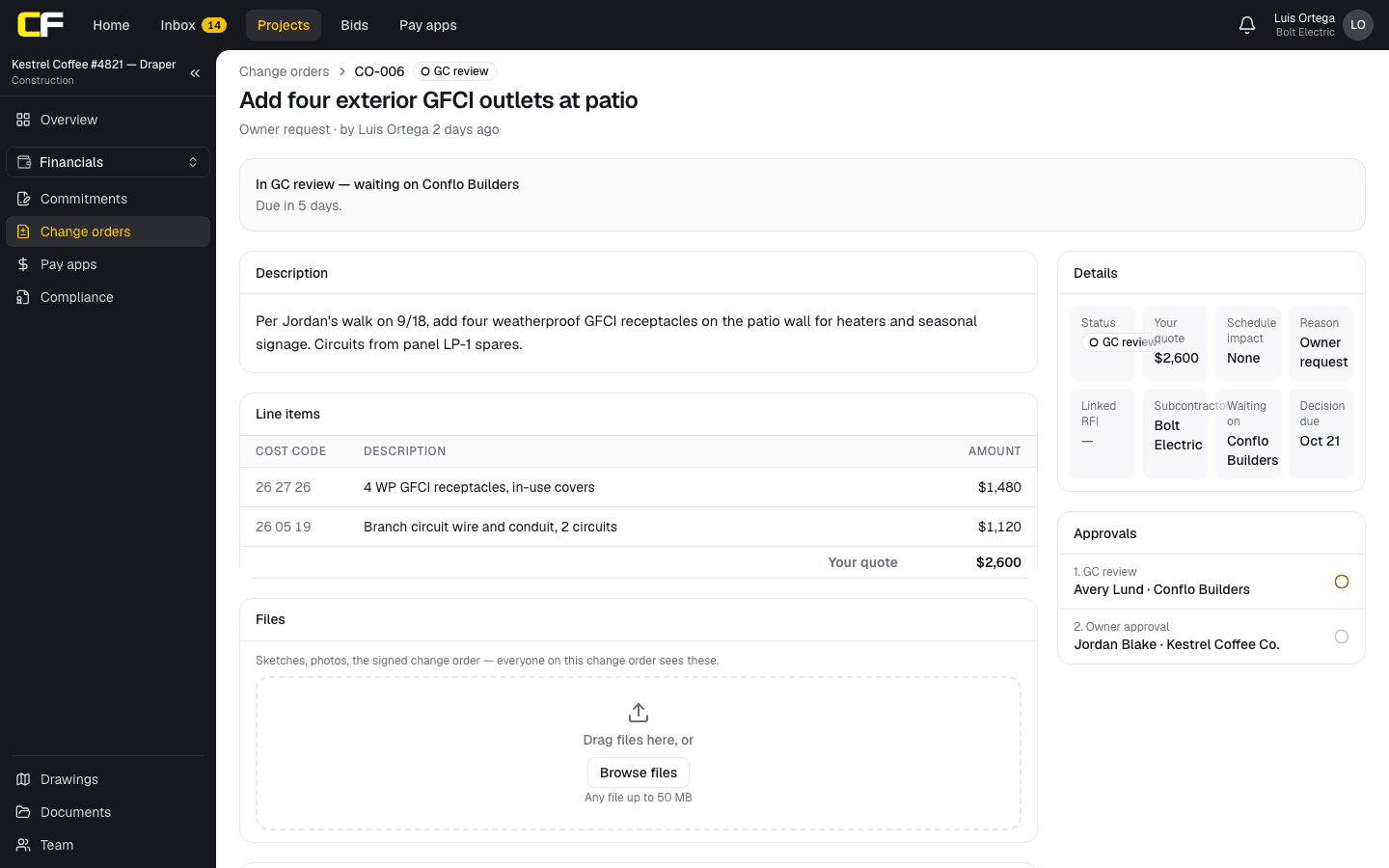
In Conflo's change orders, a sub writes up the title, reason, linked RFI, priced lines, schedule days and a due date; the sub's quote is their cost for the work. The GC's reviewer adjusts the lines and sets the markup, which the sub never sees, and sends it to the owner. When the owner approves, the work is added to the sub's commitment at their cost.
The bottom line
A change order request is your priced case for a change, sent fast and with backup.
Give notice inside your contract's window, tie it to the RFI or direction that caused it, and do not treat it as approved until it is signed.
Sources
- FAR 52.243-4, Changes — Acquisition.gov, U.S. General Services Administration. Read October 22, 2026.
- 20.1 Introduction (Construction Change Orders) — City of Los Angeles, Bureau of Engineering, Project Delivery Manual. Read October 22, 2026.
- 21.1 Request for Equitable Adjustment - Prevention — City of Los Angeles, Bureau of Engineering, Project Delivery Manual. Read October 22, 2026.
Questions
Is a change order request the same as a change order?
No. The request proposes the change and its price; the change order is the signed agreement that changes the contract.
What is a PCO?
Usually a potential or proposed change order: the same idea as a COR. On some public jobs a preliminary change order is the owner's request for the contractor's quote.
How fast should a change order request go out?
As soon as you know the work is a change, inside the contract's notice period. Late notice can cost you the costs incurred before it.
Related
Money
How Does a Subcontractor Write a Change Order Request?
A sub's change order request: notice first, then scope, priced direct cost, your markup, days and backup the GC can pass to the owner. Worked example.
· 9 min read
Template
Change Order Pricing Calculator
A free change order pricing calculator (Excel): direct cost, markup on your own and subcontracted work, insurance and bond, to the cent. No email needed.
· 4 min read
Money
How Do You Price a Change Order?
Price a change order from direct cost (burdened labor, materials, equipment, sub quotes), then the markups and time your contract allows. Worked example.
· 9 min read
Money
How Does a GC Review a Sub's Change Order Request?
Review a sub's change order request like the owner will: is it a change, was notice on time, do hours, prices and markup hold up. Worked example.
· 8 min read
Role hub
The Subcontractor's Guide: Bidding to Getting Paid
Every step of a commercial job from the subcontractor's seat: bidding, the subcontract, submittals, RFIs, change orders, pay apps, retainage and closeout.
· 9 min read