
How Do You Break a Job Into Bid Packages?
By Wyatt Cooper · Published · 7 min read
Key takeaways
- A bid package is the work one kind of subcontractor will price and perform; build packages around how subs in your market actually bid, using the CSI divisions as the checklist.
- Every specification section and every boundary item must land in exactly one package or in the general contractor's own work; a section in no package is a gap and one in two is a double count.
- Split a trade when the work needs different crews, licenses or timing; combine small scopes when a single sub would bid them together anyway.
- Some public owners set the packages for you: one North Carolina construction manager-at-risk contract requires separate packages for general, electrical, mechanical, fire protection and plumbing work.
To break a job into bid packages, list every specification section in CSI order, then group the sections one kind of subcontractor performs into a package: concrete, steel, roofing, drywall, plumbing, HVAC, electrical and so on. Assign each boundary item, such as firestopping or blocking, to one package, and keep the work you will do yourself apart. Check that every section lands in exactly one place, then write a scope and due date for each package.
A bid package is the work one subcontractor will price
A bid package (or trade package) is the slice of the job you send to one group of subcontractors to price: its scope, its drawings and specification sections, its alternates and its due date. Each package becomes one subcontract when you award it, so the way you split the job now is the way you will buy it out, manage it and pay it.
The specifications give you the checklist. CSI describes MasterFormat as organizing specifications "into work results that contractors can price, procure, and build" (CSI). Divisions are a starting point, not the answer: one division can hold work for three different trades, and one trade can work from several divisions.
Steps to split the job
- 1EstimatorLists every specification section and drawing series in CSI order
- 2EstimatorMarks the work the general contractor will self-perform or buy directly
- 3EstimatorGroups the rest into packages the way local subs bid
- 4EstimatorAssigns each boundary item to one package
- 5Project teamChecks every section is in exactly one package
- 6EstimatorWrites each package's scope, alternates and due date, then invites bidders
- Group by who performs it. Doors, frames and hardware may be one package or three, depending on whether the subs near you supply and install together.
- Split when crews, licenses or timing differ: sitework and landscaping, or early foundations and later slabs on a phased job.
- Combine small scopes a single sub would bid anyway, such as toilet accessories, signage and corner guards into one specialties package.
- Keep allowances and owner-furnished items out of the packages, or name them in the scope so every bidder treats them the same.
- Decide the alternates before you send. Federal construction invitations are expected to carry any special instructions concerning bids, alternate bids and award (FAR 36.213-3); a private GC needs the same clarity so alternates come back priced the same way.
A worked example: packages for a fictional office building
The job is fictional: "Coyle Avenue Office", a three-story office building with a steel frame. The general contractor self-performs concrete formwork and finish carpentry and buys everything else. The specification has sections in sixteen divisions; here is how they map to packages.
| Package | Specification divisions | Boundary items written in |
|---|---|---|
| BP-01 Sitework and utilities | 31, 32, 33 | Excavation for foundations; utility tie-ins to 5 feet outside the building |
| BP-02 Concrete (rebar and placing; GC forms) | 03 | Embeds and anchor bolts set from the steel erector's layout |
| BP-03 Structural and miscellaneous steel | 05 | Embed plates supplied to concrete; stairs and railings |
| BP-04 Roofing and sheet metal | 07 (roofing and flashing sections) | Roof curbs set by HVAC, flashed by roofing |
| BP-05 Glazing and storefront | 08 (glazing sections) | Sealant at storefront perimeter |
| BP-06 Doors, frames and hardware | 08 (door and hardware sections) | Frames installed by drywall; hardware installed by this package |
| BP-07 Drywall, framing and ceilings | 07 (insulation, air barrier and joint sealant sections), 09 (framing, board and ceiling sections) | Blocking; installs door frames and access panels; joint sealants except at storefront |
| BP-08 Painting and wall coverings | 09 (painting and coating sections) | Painting of exposed steel and doors |
| BP-09 Fire protection | 21 | Firestopping at its own penetrations |
| BP-10 Plumbing | 22 | Firestopping at its own penetrations; equipment water and waste connections |
| BP-11 HVAC | 23 | Firestopping at its own penetrations; roof curbs; controls wiring |
| BP-12 Electrical | 26, 27, 28 | Firestopping at its own penetrations; power to HVAC equipment |
| General contractor's own work | 01, 03 formwork, 06 finish carpentry | General conditions, final cleaning, dumpsters |
That is twelve bid packages plus the GC's own work. The check that matters is placement: each of the sixteen divisions appears in the table, each section of a split division is assigned by name, and divisions 03, 07, 08 and 09 are split by section rather than sent whole, because different crews do the formwork and the rebar, the storefront and the doors, the drywall and the paint. The controls wiring is written into HVAC on purpose, and so excluded from electrical, so it is priced once.
When the owner decides the packages
On public work the owner or the statute may set the split. One North Carolina construction manager-at-risk contract requires one or more trade packages for each of the general construction, electrical, mechanical, fire protection and plumbing divisions, lets the construction manager define other specialty packages before prequalifying bidders, and allows combined bids covering two or more advertised packages when the advertised conditions are met (NC State University, CM-at-Risk General Provisions).
Read the procurement rules for the owner and state before you split a public job. Check your contract and your state's law.
Common mistakes when splitting a job
- Sending a whole division as one package when local subs split it, so you get few bids and a high number.
- Leaving a section in no package: often sealants, firestopping, signage or final cleaning.
- Putting one item in two packages, such as controls wiring in both HVAC and electrical, and paying for it twice.
- Splitting so finely that every package draws one bidder and you manage twenty subcontracts for a small job.
- Changing a package's boundaries after bids are out without an addendum to every bidder.
Once the packages are set, write each one's scope of work and send the invitation to bid.
How it works in Conflo
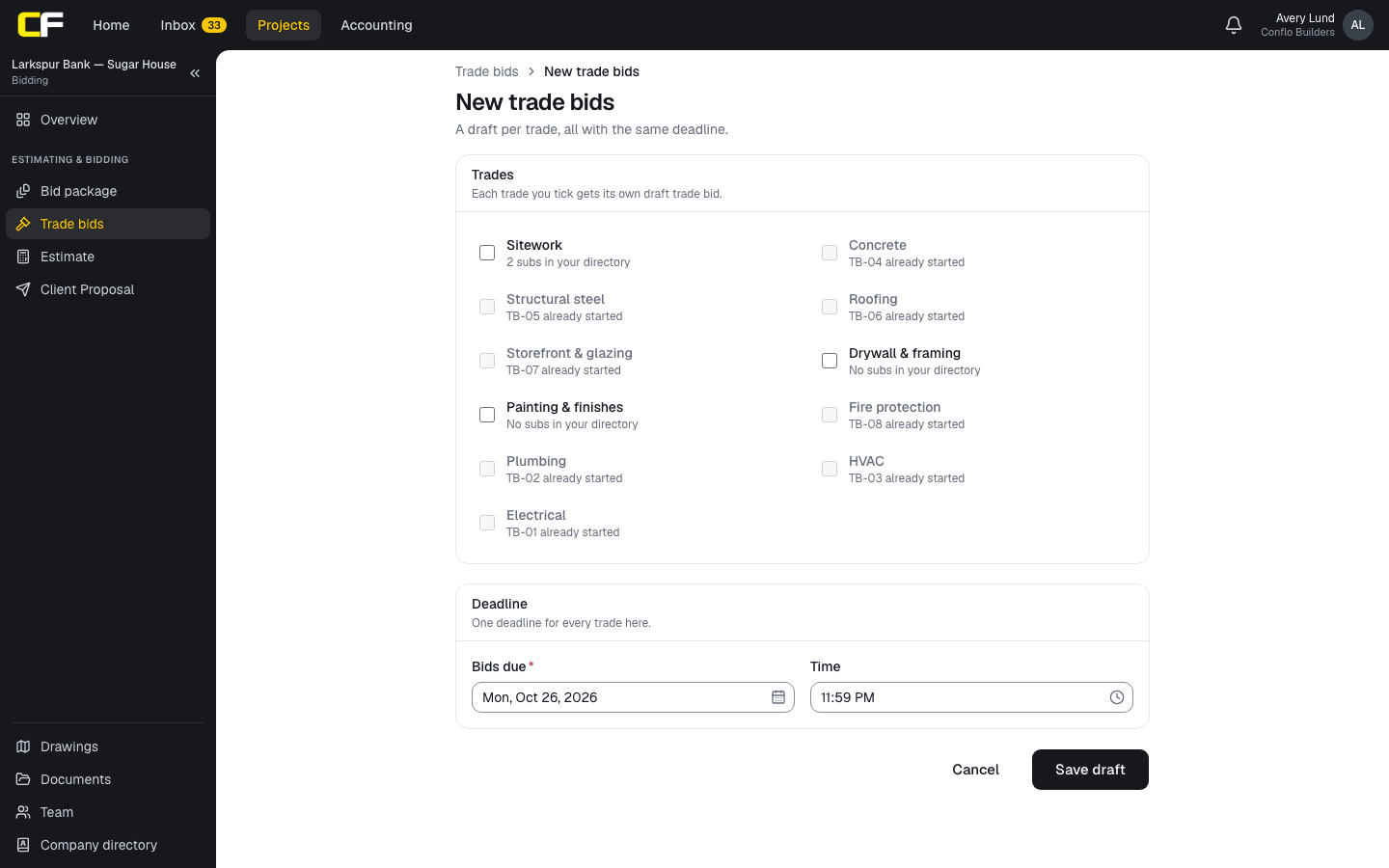
In Conflo, each package is a trade bid tied to a trade and its CSI division. New trade bids starts several at once: tick the job's trades, give them one deadline, and each becomes a draft that starts from suggested scope items for that trade, with how many subs in your directory work it shown beside it. A trade that already has a trade bid is not started twice. Each draft is then finished and sent from its own page.
One limit: the trade on a package comes from a fixed list of eleven trades (sitework through electrical). You can name a package anything, but a package for a trade outside the list, such as doors and hardware, has to sit under the nearest trade for now.
The bottom line
Split the job the way subcontractors bid it, with the specification as the checklist and every boundary item given one home. The packages you choose now are the subcontracts you will manage for the rest of the job.
Then make each package easy to price the same way: one scope, numbered items, named alternates and a due date every bidder sees.
Sources
- CSI Standards: MasterFormat — Construction Specifications Institute. Read October 16, 2026.
- Section II, General Provisions (Construction Manager-at-Risk), part 3, Principal Trade & Specialty Contracts — NC State University Facilities. Read October 16, 2026.
- FAR 36.213-3, Invitations for bids — Acquisition.gov, U.S. General Services Administration. Read October 16, 2026.
Questions
What is a bid package in construction?
The part of the job sent to one group of subcontractors to price: its scope, drawings and specification sections, alternates and due date. Each package usually becomes one subcontract when it is awarded.
Should bid packages follow CSI divisions?
Use the divisions as the checklist, not as the split. Group the sections one kind of subcontractor performs. Divisions such as 07, 08 and 09 usually hold work for several trades and are split by section.
How many bid packages should a job have?
As many as there are distinct kinds of subcontractor in the work, and no more. A small job may have eight; a large one, thirty or more. Too many packages draw thin bidding and add subcontracts to manage.
How do you avoid gaps between bid packages?
List every specification section and boundary item, put each one in exactly one package or in your own work, and write the boundary items into each affected scope as an inclusion or an exclusion. Then check the list once more before you send.
Related
Bidding
How to Write a Scope of Work for a Subcontractor
Write a subcontractor scope of work from the drawings and specs: a summary, numbered inclusions, named exclusions, alternates and the documents behind it.
· 7 min read
Bidding
How Do You Send an Invitation to Bid to Subs?
What an invitation to bid to subs includes, how to send it, and how to run questions and addenda so every bid prices the same scope, with an example.
· 7 min read
Bidding
How Do You Level Subcontractor Bids?
Level subcontractor bids by pricing every scope gap, exclusion and missing addendum so each bid covers the same work, then compare the leveled totals.
· 9 min read
Bidding
How Do You Build an Estimate From Sub Bids?
Build a GC estimate from sub bids: plug each division, carry the leveled bid in place of the plug, add your own work and general conditions, then markups.
· 7 min read
Role hub
The General Contractor's Guide: Bid to Closeout
What a general contractor is responsible for at every phase of a commercial job, from bidding and buyout to RFIs, change orders, pay apps and closeout.
· 8 min read