
What Is a Change Order in Construction?
By Wyatt Cooper · Published · 3 min read
Key takeaways
- A change order is the signed document that adds, deletes or revises work and states the new contract price and time.
- It usually starts as a change order request with a price; it becomes a change order once both sides sign.
- Executed change orders raise or lower the contract sum, and every later pay application bills against the revised total.
A change order is a written amendment to a construction contract, on most private jobs signed by the owner and contractor, that changes the scope of work and adjusts the contract price, the contract time, or both. It is how added, deleted or revised work becomes part of the contract, and later pay applications bill against the revised contract sum.
How a change order works
The City of Los Angeles's manual puts it simply: a change order identifies "required changes to the original plans, specifications, or other contract documents", and once scope, cost and schedule are negotiated, "the final change order with the proper signatures becomes a legal amendment to the construction contract". It sorts changes into three causes: changed or unforeseen conditions, errors and omissions, and changes in scope (LA Bureau of Engineering, 20.1).
Federal contracts use the word differently. Under the changes clause, the contracting officer may issue written change orders on its own, including changes "In the specifications (including drawings and designs)" and "In the method or manner of performance of the work", and the price and time are adjusted afterward (FAR 52.243-4). That is closer to what private contracts call a directive; the difference is set out in change order vs. change directive.
Example
Change order #3: add two doors at the break room
- Reason
- Owner request
- Cost of the work
- $8,400
- GC markup (10%)
- $840
- Change order amount
- $9,240
- Contract time
- +2 days
- Original contract sum
- $1,250,000
- Previous change orders
- +$14,500
- Contract sum after this change order
- $1,273,740
The arithmetic: 10% of $8,400 is $840, so the change order is $9,240; $1,250,000 + $14,500 + $9,240 = $1,273,740. How to build the price is in how to price a change order; an owner's checks are in how to review a change order as an owner.
Change order vs. change order request
| Document | Who sends it | Does it change the contract? |
|---|---|---|
| Change order request | Contractor or sub | No; it proposes a change and a price |
| Change directive | Owner, through the architect | Directs the work now; price settled later |
| Change order | Signed by owner and contractor | Yes |
The first step is the change order request, often started by an RFI answer or a field condition.
How it works in Conflo
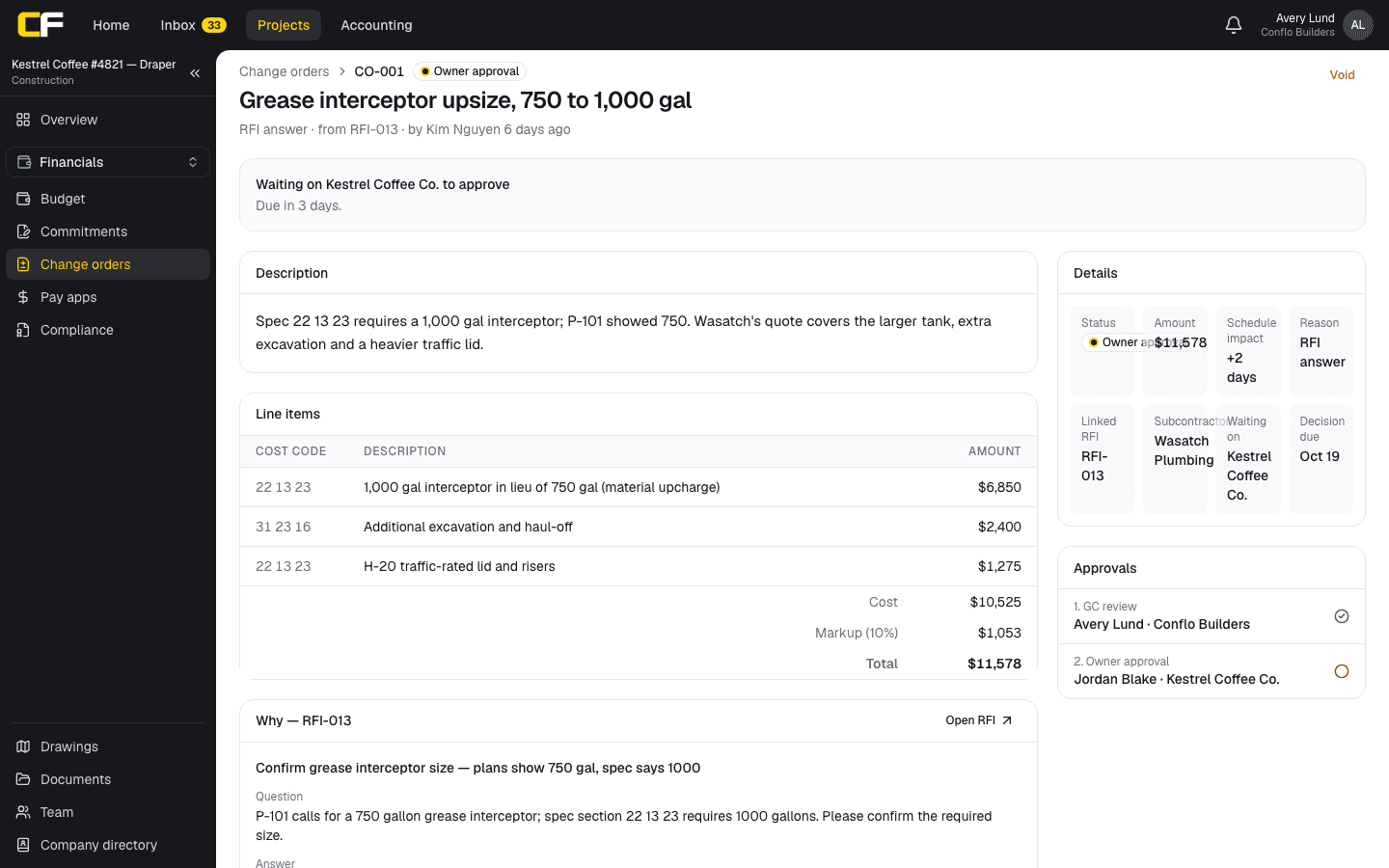
In Conflo's change orders, each one carries its reason (RFI, owner request, field condition or design error) and can link the RFI that started it. Lines are priced by cost code, the GC sets the markup, days added or saved are recorded, and it goes through GC review and owner approval. Approval executes it, adds a sub's quoted work to their commitment at their cost, and the change flows into pay applications.
The bottom line
A change order is the only document that changes what the contract says you will build and be paid.
Price it with backup, state the days, get it signed before you bill it, and keep the log current.
Sources
- 20.1 Introduction (Construction Change Orders) — City of Los Angeles, Bureau of Engineering, Project Delivery Manual. Read October 22, 2026.
- FAR 52.243-4, Changes — Acquisition.gov, U.S. General Services Administration. Read October 22, 2026.
Questions
Who signs a change order?
The owner and the contractor, and on many contracts the architect too. A subcontract change order is signed by the GC and the sub.
Can a change order reduce the contract price?
Yes. Deleted work, a cheaper substitute or an unused allowance can produce a deductive change order that lowers the contract sum.
Should work start before the change order is signed?
Only with written direction. Starting on a verbal request risks not being paid; a change directive or a signed not-to-exceed amount protects both sides.
Related
Money
How Do You Price a Change Order?
Price a change order from direct cost (burdened labor, materials, equipment, sub quotes), then the markups and time your contract allows. Worked example.
· 9 min read
Definition
Change Order vs Construction Change Directive
A change order is an agreed change in scope, price and time; a construction change directive orders the work before price or time is agreed.
· 4 min read
Money
How Should an Owner Review a Change Order?
How an owner reviews a contractor's change order: is it a change, is the price right, are the markups the contract's, are the days real. Worked example.
· 8 min read
Template
Change Order Pricing Calculator
A free change order pricing calculator (Excel): direct cost, markup on your own and subcontracted work, insurance and bond, to the cent. No email needed.
· 4 min read
Role hub
The General Contractor's Guide: Bid to Closeout
What a general contractor is responsible for at every phase of a commercial job, from bidding and buyout to RFIs, change orders, pay apps and closeout.
· 8 min read