
How to Write an RFI in Construction (With an Example)
By Wyatt Cooper · Published · 9 min read
Key takeaways
- An RFI asks the design team one question about the contract documents. It doesn't approve a product (a submittal) or change the contract (a change order).
- A good RFI names the sheet, detail and spec section, proposes a solution, states the cost and schedule impact, and gives the date the answer is needed.
- Under AIA A201–2017, the contractor reports errors, inconsistencies and omissions it finds as a request for information, and the architect answers in writing.
- Keep every RFI on one numbered log showing who has it, when it is due and whether it may cost money or time.
To write an RFI, ask one specific question about the contract documents, point to the exact sheet, detail and spec section it concerns, propose an answer if you have one, state the possible cost and schedule impact, and give the date you need the answer and why. Number it in sequence, send it to whoever your contract says answers it (usually the architect), copy the people it affects, and track it on the RFI log until it is closed.
What an RFI is and when to send one
A request for information (RFI) is a written question from the contractor to the design team about the contract documents: the drawings, the specifications and the contract. Send one when the documents conflict, leave something out or can't be built as drawn, before the work reaches that point.
It is also a contract duty. Under the AIA's general conditions, A201–2017, the contractor reports errors, inconsistencies or omissions it finds "as a request for information" (§3.2.2), and the architect answers in writing (§4.2.14). Your contract may change those words, so read yours.
Three other documents look like an RFI and do a different job: a submittal, an architect's supplemental instruction and a change order.
| Document | Use it when | Example |
|---|---|---|
| RFI | The documents conflict, leave something out or can't be built as shown | The plumbing and foundation plans put a floor drain on top of a footing |
| Submittal | You show how you will meet the documents: shop drawings, product data, samples | The plumber's floor drain product data, sent for review |
| Architect's supplemental instruction (ASI; AIA G710) | The architect orders a minor change with no cost or time (A201–2017 §7.4) | The drain moves 6 inches within the room |
| Change order | Scope, price or time changes; the owner, contractor and architect sign it (A201–2017 §7.2.1) | The owner adds two floor drains to the mechanical room |
The City of Los Angeles Bureau of Engineering's project delivery manual puts it plainly: RFIs "should not be used to change the design", and when an answer does, a change order must be issued.
The parts of a good RFI
Agencies publish their own RFI forms, and they ask for the same things. The New Jersey DOT's form DC-162 asks for the reference documents, the date a response is needed, and cost and time impact ("Yes", "No" or "Unknown at this time"). Louisiana DOTD's instruction sheet asks for numbers in sequence from 001, the plan sheets in question and a proposed solution.
| Field | What to write | Example | Common mistake |
|---|---|---|---|
| Number | The next number in the project's one sequence, never reused | RFI 007 | Numbering per sub, so the job has three RFI 7s |
| Subject | The element and the problem, in about ten words | Floor drain FD-3 conflicts with footing at grid B/2 | "Plumbing question" |
| Question | One question that can be answered in a sentence | Can FD-3 move 18 inches east, clear of the footing? | Three questions in one RFI |
| References | Every sheet, detail, grid line and spec section involved | P-101; S-101; detail 3/S-501; section 22 13 19 | "See drawings" |
| Proposed solution | What you would do, so the designer can say yes | Move FD-3 18 inches east; keep the floor slope to the drain | Blank, when the field knows the fix |
| Cost and schedule impact | None, possible or yes, and why | Cost: none if moved. Schedule: possible, the slab pour waits on the answer | "None", then a change request later |
| Answer needed by | A date, and the activity it holds up | March 10, for the underground inspection on March 12 | "ASAP" on every RFI |
| Distribution | Who answers, and who is copied | To the architect; copies to the engineers, the plumber and the owner's rep | Sending it straight to an engineer, outside the contract |
Two rules sit under the table. Ask one question per RFI, because an RFI closes when its question is answered. And send it from the contractor that holds the contract: a sub's question goes to the GC. Louisiana makes the prime contractor "the only source" of RFIs.
A worked example: RFI 007
Here is a filled-in RFI on a made-up job, the Alder Street Medical Office. Laying out the underground piping, the plumbing foreman finds that the floor drain in mechanical room 108 lands on the footing along grid B. The GC's project manager writes the RFI the same day.
RFI 007 — Floor drain FD-3 conflicts with footing at grid B/2
- Project
- Alder Street Medical Office (fictional)
- Date sent
- March 3
- From
- GC project manager, for the plumbing subcontractor
- To
- Architect of record
- Copies
- Structural engineer, MEP engineer, plumbing subcontractor, owner's representative
- References
- P-101 (plumbing plan, level 1); S-101 (foundation plan); detail 3/S-501 (footing section); spec section 22 13 19
- Question
- P-101 locates floor drain FD-3 in mechanical room 108, 1'-0" east of grid B. Detail 3/S-501 shows the footing on grid B extending 1'-6" east of the grid, so the drain would sit in the footing. Can FD-3 move 18 inches east, to 2'-6" east of grid B?
- Proposed solution
- Move FD-3 18 inches east. Keep the floor sloped to the drain as shown on the architectural plan. No change to pipe sizes.
- Cost impact
- None expected if FD-3 moves as proposed
- Schedule impact
- Possible: the underground inspection is March 12 and the slab pour March 17
- Answer needed by
- March 10
- Attachments
- Marked-up P-101 with the proposed location; photo of the layout at grid B/2
Notice what makes it easy to answer. The RFI hands over the sheets and the dimensions, so nobody has to find the conflict. It can be answered "yes" or "no, put it here". The date is tied to a real inspection. And the engineer is checking a proposed answer, not designing one.
How responses and the RFI log work
- 1Field or subFinds the problem and tells the GC
- 2GC project managerWrites, numbers, logs and sends the RFI
- 3ArchitectAnswers, or routes it to the engineer whose sheets it concerns
- 4EngineerAnswers the technical question to the architect
- 5ArchitectReturns the answer in writing
- 6GC project managerCloses it, sends the answer to the field, gives notice of any cost or time
The GC sends the answer to everyone who builds from it: the sub who asked, the trades it touches, the superintendent. An answer is not a change by itself. The New Jersey DOT form says a response "does not entitle the Contractor to any additional Time or increase in Price", and under A201–2017 a contractor who believes an answer adds cost or time makes a claim under Article 15 (§3.2.4). Give your contract's notice on time.
The RFI log lists every RFI on the job: number, subject, who sent it, who has it now (the ball in court), date sent, date needed, date answered, cost and schedule impact, and status. Go through the open ones at every owner-architect-contractor meeting, oldest first. If a delay is disputed later, its dates show who was waiting on whom.
Common mistakes
- Asking what the documents already answer. Read the specs and general notes first.
- "ASAP" on everything. Tie the date to the activity it holds up.
- Using an RFI to get a substitution or a design change approved. Those have their own procedures.
- Letting the answer stop at the PM's desk. Send it to the trades and mark the current drawings.
- Staying quiet about cost. If the answer might cost money or time, mark it possible and give your contract's notice.
How it works in Conflo
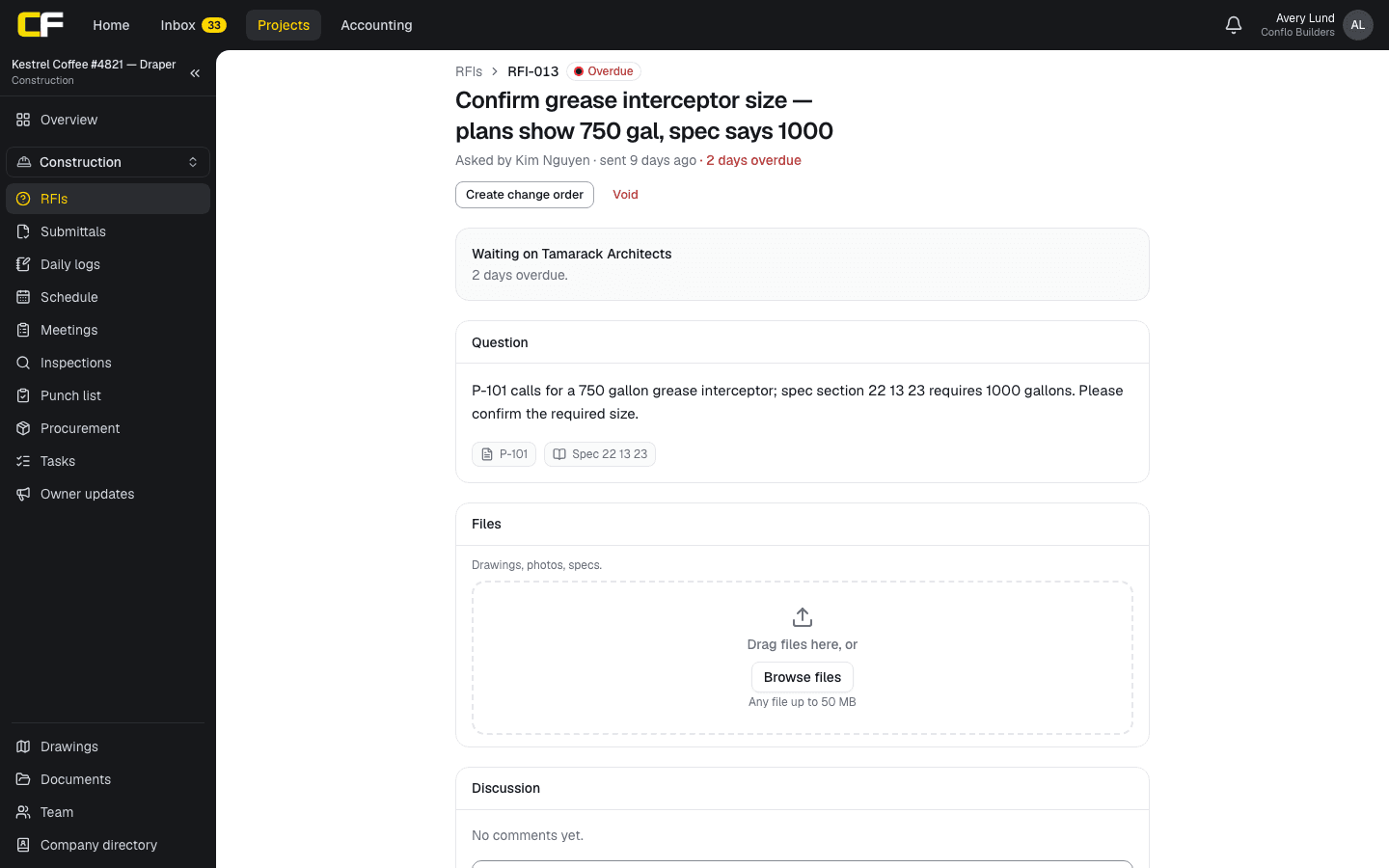
In Conflo's RFI tool, each RFI is a numbered record that the GC, subs, owner and design team share. You write the subject and question, add the location, drawing and spec section, mark the cost and schedule impact, choose who answers, copy who should follow it, set the due date, and send it or save a draft. Files attach to the RFI.
Answers and comments stay on the RFI. The log shows who each one is waiting on, how long it has been open and which are overdue, and the RFI's manager closes it, marking an official answer if there is one. Conflo doesn't decide whether an answer changes the contract: added cost or time goes through a change order.
The bottom line
A good RFI is one question, tied to the exact sheet and spec section, with a proposed answer, its cost and schedule impact, and a date that matters. Send it through the contract's chain and keep it on the log until the answer is in the field.
If your RFIs live in email threads and a spreadsheet, put them on one log the whole team can read.
Sources
- Summary: A201–2017, General Conditions of the Contract for Construction — AIA Contract Documents. Read October 17, 2026.
- Project Delivery Manual, 16.2 Request for Information — City of Los Angeles, Bureau of Engineering. Read October 16, 2026.
- Request for Information, form DC-162 — New Jersey Department of Transportation. Read October 16, 2026.
- RFI-Proposals Instruction Sheet — Louisiana Department of Transportation and Development. Read October 16, 2026.
Questions
How do you write an RFI in construction?
Ask one specific question about the contract documents, name the exact sheet, detail and spec section, propose a solution, state the possible cost and schedule impact, and give the date you need the answer. Number it in sequence, send it to whoever your contract names, and track it on the RFI log until it is closed.
What is the difference between an RFI and a change order?
An RFI asks a question about the contract documents; a change order changes the contract's scope, price or time, and the owner, contractor and architect sign it. An RFI answer can lead to a change order when it adds work, but the answer alone doesn't change the contract.
Who answers an RFI?
Under AIA A201–2017, the architect responds to requests for information about the contract documents, often after passing the question to the engineer whose drawings it concerns. Other contracts name an owner's representative or a construction manager. Subcontractors send their questions through the general contractor.
How long should an RFI response take?
As long as your contract allows. A201–2017 says the architect answers within any agreed time limits, or otherwise with reasonable promptness, so check your contract and the Division 01 specifications for a set number of days. Either way, put a needed-by date on every RFI and say what it holds up.
What should an RFI log include?
The RFI number, subject, who sent it, who has it now, the dates it was sent, is needed and was answered, any cost or schedule impact, and its status. Review the open RFIs at each owner-architect-contractor meeting, oldest first, and keep the log after the job.
Related
Construction
How Should an Architect Respond to an RFI?
How the design team answers an RFI: check it against the documents, answer the question asked, cite the sheet and spec, and say if it changes the work.
· 8 min read
Template
Free RFI Template With a Filled-In Example
A free RFI template in Word, no email needed: every field a good request for information needs, a response section, and a filled-in example on page two.
· 4 min read
Definition
ASI vs RFI: What Is the Difference?
ASI vs RFI: an RFI is the contractor's question about the documents; an ASI is the architect's written instruction or minor change, with no cost or time.
· 4 min read
Definition
RFI vs Submittal: What Is the Difference?
An RFI asks the design team what the documents mean; a submittal shows how the contractor will meet them. The difference, side by side, with an example.
· 3 min read
Role hub
The General Contractor's Guide: Bid to Closeout
What a general contractor is responsible for at every phase of a commercial job, from bidding and buyout to RFIs, change orders, pay apps and closeout.
· 8 min read