
How Low-Voltage Subs Bid and Bill Commercial Work
By Wyatt Cooper · Published · 9 min read
Key takeaways
- Most low-voltage scope fights are at the line with the electrical sub: who installs boxes, conduit, sleeves and cable tray, and who pulls, terminates and tests the cable.
- Take off by the drop: each drop is one cable with a length, two terminations, a label at each end and a test result, and that count drives the whole price.
- Cabling is not done until it is tested and labeled: specs ask for a test result for every cable and record drawings that match the labels.
- In the takeoff example below, 412 drops come to 61,200 feet of cable, 824 terminations and nine 48-port patch panels.
Low-voltage subcontractors bid commercial work from the telecommunications, security and AV drawings with a takeoff by the drop: cables, average run lengths, terminations, patch panels, racks and devices. They state exactly where their scope meets the electrical sub's (pathway, cabling, terminations, power) and the owner's IT vendor's (switches and active equipment). They bill monthly against a schedule of values split by system and by material and labor, with testing, labeling and record documents held as their own lines.
What a low-voltage scope usually covers
"Low voltage" on a commercial job is a bundle of systems: structured cabling for voice and data (CSI Division 27), electronic security such as access control, intrusion detection and video surveillance (Division 28), audiovisual, and sometimes nurse call, paging or distributed antenna systems. The federal guide spec for cabling, UFGS 27 10 00, covers the cable, outlets, patch panels, racks, labeling and testing, and points to Section 26 20 00 for the electrical distribution it relies on (UFGS 27 10 00). The security guide spec covers intrusion detection, access control and video surveillance (UFGS 28 10 05). Fire alarm usually sits with the electrical sub or its own fire alarm contractor, not the low-voltage package.
Draw the line with the electrical sub
The low-voltage scope often reaches you as a sub to the electrician, or as a separate package where the GC has to split the work cleanly. Either way, the same items cause gaps. How electrical subs bid commercial work covers the other side of this line.
| Item | Common question | Write in your clarifications |
|---|---|---|
| Boxes and conduit stubs | Who sets back boxes and stubs conduit to the ceiling? | By the electrical sub unless listed; your scope starts at the box |
| Cable tray, J-hooks and sleeves | Who provides the main pathway above ceilings and through walls? | Included or excluded, by area, with the tray length you priced |
| Firestopping | Who seals your penetrations through rated walls? | Included for your sleeves, or by the firestopping trade |
| Power to racks and devices | Who brings circuits to telecom rooms, cameras, door controllers and displays? | Line-voltage power by the electrical sub; low-voltage power supplies included |
| Door hardware | Who furnishes electrified locks, strikes and door position switches? | Furnished by the hardware supplier; wiring and termination to the access panel included |
| Active equipment | Who furnishes network switches, wireless access points and servers? | By the owner's IT vendor; you mount and patch what the drawings show |
| Grounding and bonding | Who provides the telecom bonding busbars and the conductor to building ground? | Included in telecom rooms, or by the electrical sub, named by item |
Ask the GC to answer gaps through the bid's questions so every bidder prices the same split. If the drawings show pathway but no one owns it, say in your qualifications that you priced cable only.
Take off by the drop
A drop is one cable from a work-area outlet back to a patch panel in a telecom room. Count drops by floor and room from the telecom plans, take an average run length from each room's telecom closet, add slack, and check the longest runs against the length limit. The guide spec's notes keep the "90 meter 295 feet maximum permanent link" for horizontal cabling (UFGS 27 10 00); a run past it means another telecom room or a change, which is an RFI before bid day, not a field fix.
Brightline Systems, takeoff: horizontal cabling, Category 6A
- Level 1
- 226 drops × (120 ft average run + 15 ft slack) = 226 × 135 ft = 30,510 ft
- Level 2
- 186 drops × (150 ft average run + 15 ft slack) = 186 × 165 ft = 30,690 ft
- Total cable
- 30,510 + 30,690 = 61,200 ft, bought as 62 boxes of 1,000 ft
- Terminations
- 412 drops × 2 ends = 824 (a jack at the outlet, a port at the patch panel)
- Patch panels
- 412 ÷ 48 ports = 8.58, so nine 48-port panels
- Tests and labels
- 412 test results, 824 cable labels (one at each end)
- Longest run
- 262 ft on level 2, under the 295 ft limit
Checks: 226 + 186 = 412 drops; 226 × 135 = 30,510; 186 × 165 = 30,690; 9 panels × 48 = 432 ports, enough for 412. Labor is then priced per drop for pulling and per termination for terminating, plus devices (cameras, card readers, door contacts) counted from the security plans.
Submittals, qualifications and testing
Cabling specs often ask for qualifications before you start, not just product data. UFGS 27 10 00 asks for the contractor's and key personnel's experience and certifications "a minimum of 30 days prior to installation", and for supervisors, installers and testers to be BICSI Registered Cabling Installers, Technician Level, or to show equivalent experience and training the government accepts (UFGS 27 10 00). BICSI is the association that, in its own words, "defines the standards, credentials, and training" for telecommunications infrastructure (BICSI). Plan those submittals with the shop drawings and product data; how to prepare a submittal covers the package.
Testing is part of the scope, not an extra. The guide spec asks for a test plan 60 days before the test date (unless the project edits that), test reports "in native and PDF format" for each cable, with cable IDs that "must match those provided in T4 approved submittals", and labels at both ends of every cable; "Handwritten labeling is unacceptable" (UFGS 27 10 00). Price the tester, the technician time and the label printer, and keep the reports organized by telecom room so they can go straight into the closeout package.
Build a schedule of values you can bill
Split the schedule of values by system, and split cabling into material, pulling and terminating, because cable goes in long before it is terminated and tested. Give testing and record documents their own lines so the last dollars match the last paperwork.
| Line | Description | Scheduled value |
|---|---|---|
| 1 | Mobilization, shop drawings and submittals | $9,200 |
| 2 | Pathway: cable tray, J-hooks and sleeves | $22,400 |
| 3 | Horizontal cable, material | $38,600 |
| 4 | Horizontal cable, pulling labor | $41,800 |
| 5 | Terminations, jacks, faceplates and patch panels | $24,500 |
| 6 | Backbone fiber and copper | $18,900 |
| 7 | Telecom rooms: racks, ladder rack and bonding | $16,300 |
| 8 | Access control | $29,700 |
| 9 | Video surveillance | $27,400 |
| 10 | Testing, certification and labeling | $11,200 |
| 11 | Record drawings and closeout documents | $8,600 |
| Total | $248,600 |
Check: $9,200 + $22,400 + $38,600 + $41,800 + $24,500 + $18,900 + $16,300 + $29,700 + $27,400 + $11,200 + $8,600 = $248,600. Cable and devices delivered before they are installed can be billed as stored material where the subcontract allows; how a sub fills out a pay application and how to calculate retainage cover how that works.
Worked example: one pay period
Brightline holds the $248,600 subcontract above with 10% retainage. In period 3, the cable on line 3 goes from 30% to 70% installed, pulling labor on line 4 from 30% to 70%, and terminations on line 5 from 0% to 40%.
| Line | Previous | This period | To date |
|---|---|---|---|
| 3. Horizontal cable, material ($38,600) | $11,580 (30%) | $15,440 (40%) | $27,020 (70%) |
| 4. Pulling labor ($41,800) | $12,540 (30%) | $16,720 (40%) | $29,260 (70%) |
| 5. Terminations ($24,500) | $0 | $9,800 (40%) | $9,800 (40%) |
| Total of these lines | $24,120 | $41,960 | $66,080 |
This period bills $41,960. Retainage at 10% is $4,196, so these lines add $37,764 to the payment due. Checks: $15,440 + $16,720 + $9,800 = $41,960; $24,120 + $41,960 = $66,080; $11,580 + $15,440 = $27,020 = 70% of $38,600. Line 10 stays at zero until the test reports are delivered, which keeps that line honest when the GC reviews it.
Closeout documents for low voltage
- Test reports for every cable, in the tester's native format and PDF, with cable IDs matching the labels.
- Record drawings showing outlets, cable IDs, patch panel layouts and telecom rooms as built.
- O&M manuals and programming records for access control and video systems, and the owner training the spec calls for.
- Manufacturer warranty registration where the spec requires a cabling system warranty.
- Final lien waiver and the request to release retainage.
Low-voltage work tends to finish last, after ceilings close and the owner's equipment arrives, so changes often land late; write them up as they happen with a change order request. The whole sub side of a job, bid to final payment, is in the subcontractor's guide, and where your work falls in the job is in the construction project lifecycle.
How it works in Conflo
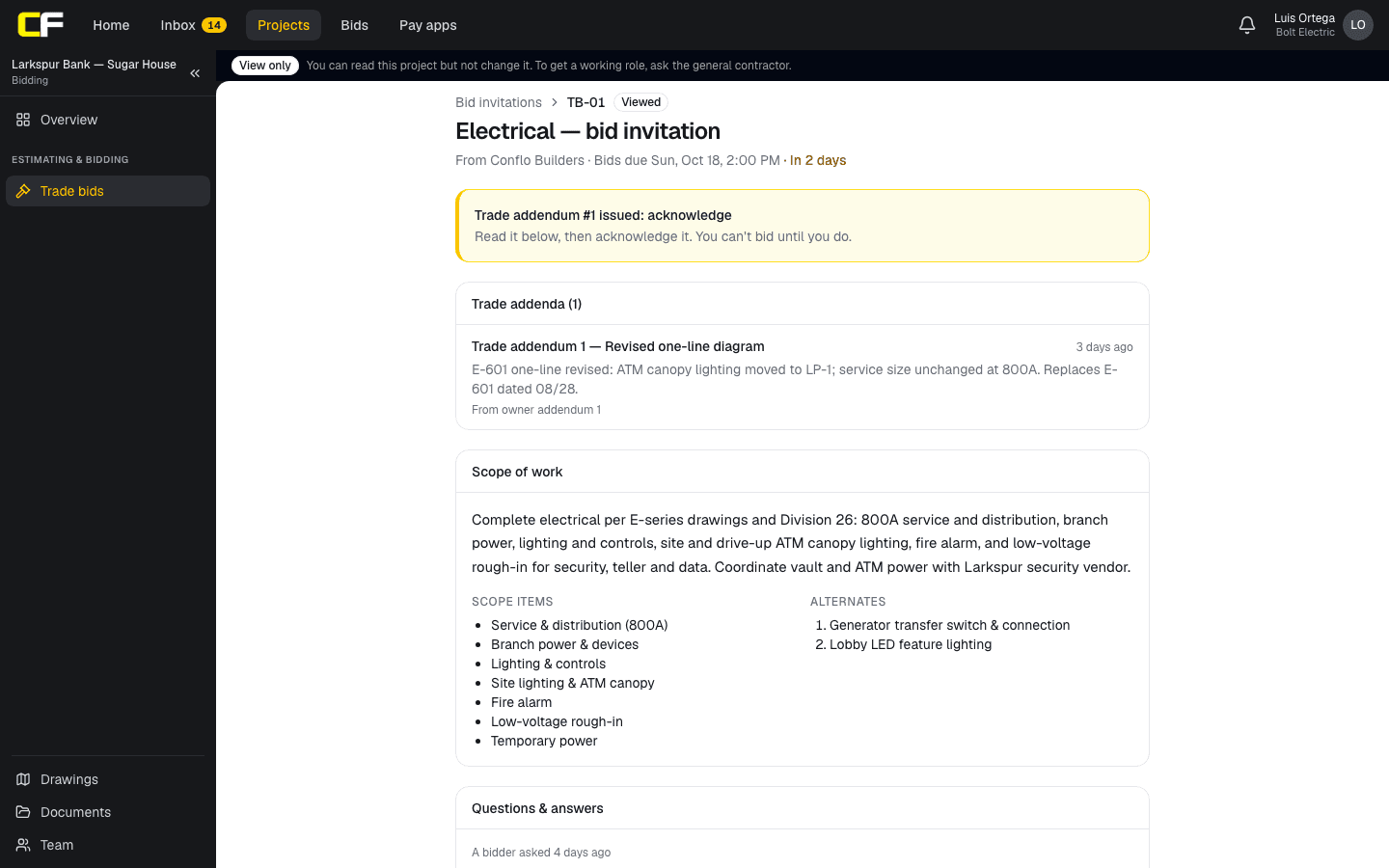
When a GC invites you to a package through Trade bids in Conflo, you see the scope items and alternates, ask questions (answers go to every bidder without your name), acknowledge each trade addendum, and submit a base bid with each scope item marked included or excluded, an optional breakout, alternates, and your exclusions and qualifications. When the GC lists the split items (pathway, firestopping, power to devices) as scope items, your answer to each is on the bid. There is no unit-price field: put per-drop adds and deducts in your qualifications or attach your proposal.
Under contract, you bill in Pay apps: percent complete this period and materials stored on each line, with previous billing carried forward, no line billed past 100%, and retainage calculated on completed and stored to date. The GC approves the pay app or sends back only the lines that are wrong, each with a note.
The bottom line
A low-voltage bid is a count of drops and devices plus a clear line with the electrical sub and the owner's IT vendor. Price testing and labeling as part of the work, and give them their own lines so you are paid when the reports are in.
Before your next bid, add the seven split items in the table above to your proposal template.
Sources
- UFGS 27 10 00, Building Telecommunications Cabling System (May 2025) — Whole Building Design Guide (USACE, NAVFAC, AFCEC). Read October 22, 2026.
- UFGS 28 10 05, Electronic Security Systems (ESS) (May 2024) — Whole Building Design Guide (USACE, NAVFAC, AFCEC). Read October 22, 2026.
- BICSI home page — BICSI. Read October 22, 2026.
Questions
What does a low-voltage contractor do on a commercial job?
Installs structured cabling for voice and data, and often security (access control, intrusion detection, video surveillance) and audiovisual systems: the cable, terminations, patch panels, racks and devices, then tests, labels and documents them.
Who installs conduit for low-voltage cabling?
Usually the electrical sub sets boxes and conduit stubs, and the low-voltage sub provides cable tray, J-hooks and the cable. It varies by job, so name each pathway item as included or excluded in the bid.
How do you estimate a structured cabling job?
Count drops from the telecom plans, multiply by an average run length plus slack for each telecom room, then count terminations (two per drop), patch panels, racks and devices, and price labor per drop and per termination.
What testing does structured cabling need?
Specs commonly require every cable to be tested and the results delivered in the tester's native format and PDF, with cable IDs matching the labels and record drawings. Price the tester and technician time into the bid.
Related
Bidding
How Electrical Subs Bid and Bill Commercial Work
How electrical subs bid commercial work and bill it: clarifications, a schedule of values with rough-in, gear and trim, and stored switchgear.
· 7 min read
Role hub
The Subcontractor's Guide: Bidding to Getting Paid
Every step of a commercial job from the subcontractor's seat: bidding, the subcontract, submittals, RFIs, change orders, pay apps, retainage and closeout.
· 9 min read
Money
How Does a Subcontractor Fill Out a Pay Application?
A subcontractor's pay app bills percent complete and stored materials per schedule-of-values line, less retainage and prior payments, with a lien waiver.
· 9 min read