
How Does a Sub Close Out Punch List Items?
By Wyatt Cooper · Published · 6 min read
Key takeaways
- Get your own items from the GC's punch list as soon as it is issued, and question any that belong to another trade before you send a crew.
- Sort the items by floor and room so one crew trip closes as many as possible.
- Prove each fix with a photo taken from the same spot as the issue photo, and say what you did.
- An item is closed only when the GC verifies it; track what was sent back and fix the cause, because punch work usually stands between you and your retainage.
A subcontractor closes out punch items by pulling its own items from the GC's list as soon as it is issued, disputing any that belong to another trade, and sorting the rest by area so one crew trip fixes as many as possible. Photograph each fix from the same spot as the issue, tell the GC it is ready for review, and follow up until each one is verified and closed, since final payment usually waits on it.
Why punch work is worth doing fast
The punch list is the list of work still to complete or correct at substantial completion. On AIA-based jobs, the contractor prepares that list, the architect checks and adds to it, and the certificate records the time agreed to finish it (AIA's G704 summary). Your subcontract usually gives you less time than the GC has, because the GC needs a margin before the owner's deadline.
Punch items are also money. On federal fixed-price work, final payment comes only after "completion and acceptance of all work" (FAR 52.232-5), and many private subcontracts tie the release of your retainage to the GC's final payment or to your own completion. Each open item is a reason for someone upstream to hold your money. For the GC's side of building the list, see how to build a punch list; for where punch sits in the subcontractor's job, see the subcontractor's guide and the project lifecycle.
Step by step: from the list to closed
- Get your items the day the list is issued. Ask for the issue photo and exact location of each.
- Read every item before you schedule. If an item is another trade's damage or scope, say so in writing with a photo now, not after you have fixed it for free.
- Sort by floor and room, then by what crew or material each needs. Order any parts that are not on the truck.
- Fix them in as few trips as you can, and walk the area with your foreman before you leave.
- Photograph each fix from the same angle as the issue photo, and write one line on what you did.
- Mark each item ready for review so the GC can verify it on its next walk.
- For anything sent back, read the note, fix the cause and resubmit with a new photo.
Correction at your own cost is the normal rule. The federal inspection clause, a common model, has the contractor "without charge, replace or correct work found by the Government not to conform to contract requirements" (FAR 52.246-12). Damage caused by others is different, which is why the dispute in step 2 belongs at the start.
Items that get sent back, and how to avoid it
| Sent back because | What the GC saw | Do this instead |
|---|---|---|
| No proof | "Done" with no photo | A photo of the fix from the issue photo's angle |
| Wrong spot | A fix in the next room | Confirm the room and gridline before the crew starts |
| Half fixed | Patched but not painted | Close the item only when the finish matches |
| New damage | Your lift scuffed the wall you passed | Walk the path out and fix what you touched |
| Not your item | Fixed, then disputed afterward | Dispute before you work, in writing |
A worked example: a fictional drywall and paint sub
The sub is fictional: "Cedar Line Interiors", drywall and paint on a three-story office. The GC issues the punch list on Monday with 14 items for Cedar Line, due in 10 days.
- 1SubReviews the 14 items on Monday; disputes 2 as electrician damage, with photos, the same day
- 2GCAgrees on 1 and reassigns it to the electrician; keeps 1 with Cedar Line
- 3SubSorts the remaining 13 by floor: 6 on level 1, 4 on level 2, 3 on level 3
- 4SubOne finisher and one painter fix all 13 on Wednesday and Thursday and photograph each
- 5GCVerifies 11 on Friday's walk and sends 2 back: paint sheen does not match on level 3
- 6SubRepaints both full walls corner to corner on Monday and resubmits with photos
- 7GCVerifies the last 2 on Tuesday, 8 days after the list was issued; all 13 closed
The count: 14 items, 1 reassigned, 13 fixed, 11 closed on the first walk and 2 on the second. Two crew-days and one return trip, and the items closed two days before the due date. The return trip is the one to learn from: touch-up on a wall with a different sheen rarely passes, so Cedar Line now repaints to the nearest corner.
How it works in Conflo
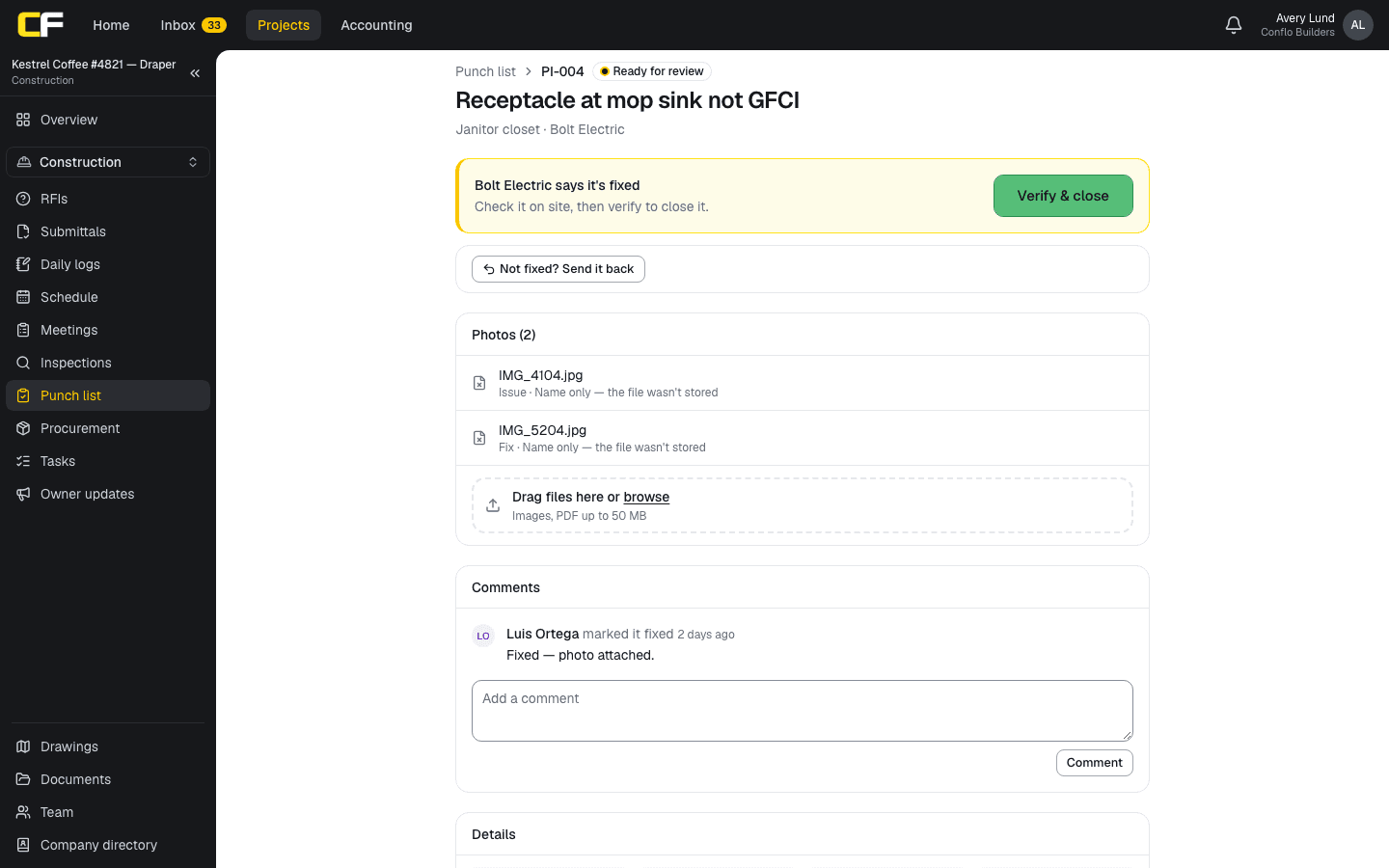
On a GC's project in Conflo, a subcontractor sees only the punch list items assigned to its own company, with the GC's issue photos, the location, the priority and the due date; items past due show as overdue. You can mark an item started, and mark it fixed with a photo of the fix (or a note if you cannot take one), which sends it to the GC for review.
The GC verifies and closes it, or sends it back with a note saying what is still wrong, and the item returns to open; the item keeps a count of how many times it was sent back. Comments on the item stay with it. Conflo is free for subcontractors and suppliers.
The bottom line
Close punch items by getting your list early, disputing what is not yours before you work, fixing by area in as few trips as possible and proving each fix with a photo.
An item is closed when the GC verifies it, not when your crew leaves, so follow each one to closed and keep your retainage moving.
Sources
- Summary: G704–2017, Certificate of Substantial Completion — AIA Contract Documents (The American Institute of Architects). Read October 22, 2026.
- FAR 52.246-12, Inspection of Construction — Acquisition.gov, U.S. General Services Administration. Read October 22, 2026.
- FAR 52.232-5, Payments under Fixed-Price Construction Contracts — Acquisition.gov, U.S. General Services Administration. Read October 22, 2026.
Questions
Who pays to fix punch list items?
The trade whose work does not conform, usually at its own cost. Damage caused by another trade is that trade's, which is why a sub should dispute such items in writing before fixing them.
How long does a subcontractor have to finish punch work?
Whatever the subcontract and the GC's punch list say. The certificate of substantial completion sets the GC's time with the owner, and the GC usually gives subs less so it has a margin.
What counts as proof that a punch item is fixed?
A photo of the finished fix, taken from the same spot as the issue photo, with a short note on what was done. The GC still verifies it in person or from the photo before closing it.
Can a GC hold my retainage over open punch items?
Often, yes: many subcontracts tie retainage release and final payment to completing punch work. Read your payment and closeout articles, and check your state's retainage and prompt payment law.
Related
Closeout
How Do You Build a Punch List?
Build a punch list by walking the job room by room before substantial completion, logging each item with location, trade, photo and due date. With example.
· 9 min read
Template
Free Punch List Template (Excel)
A free punch list template in Excel: location, description, company, trade, priority, photo, due date and status, with a status count. No email needed.
· 4 min read
Definition
What Is a Punch List in Construction?
A punch list is the list of work still to be completed or corrected once a building is substantially complete. What goes on it, who writes it, an example.
· 3 min read
Money
How Does a Subcontractor Get Retainage Released?
Finish your scope, close your punch items, send closeout documents and a written release request with the waiver asked for, and know your state's deadline.
· 6 min read
Role hub
The Subcontractor's Guide: Bidding to Getting Paid
Every step of a commercial job from the subcontractor's seat: bidding, the subcontract, submittals, RFIs, change orders, pay apps, retainage and closeout.
· 9 min read