
How Does a Subcontractor Prepare a Submittal?
By Wyatt Cooper · Published · 9 min read
Key takeaways
- Start from the spec section's Submittals article and Division 01: they say what to send, in what form and how many, and a package that skips one item comes back.
- Mark up product data so the reviewer sees exactly the model, size and options you will supply, and cross out everything you won't.
- List any deviation from the specs in writing, separately, when you submit; under A201–2017 an approval doesn't cover a deviation you didn't point out.
- Send it through the GC, not straight to the architect, and don't fabricate or order until it comes back approved or approved as noted.
To prepare a submittal, read the spec section's Submittals article and the Division 01 procedures, then gather what they ask for: shop drawings, product data, samples or certificates. Mark up cut sheets to show exactly what you will supply, check field dimensions, list any deviation from the specs in writing, and add a cover sheet naming the project, spec section and submittal number. Review and stamp it yourself, then send it to the GC, who reviews it before the architect.
What the reviewer is checking for
A submittal shows how you will meet the contract documents. It isn't part of them: under the AIA's general conditions, A201–2017 §3.12.4, shop drawings, product data and samples "are not Contract Documents", and their purpose is "to demonstrate how the Contractor proposes to conform". The architect checks your package against the design concept. Your job is to make that check fast.
Two rules shape everything else. First, an approval doesn't take responsibility off you: under §3.12.8 and the federal clause FAR 52.236-21, errors in your submittal stay yours even after it is approved. Second, you build to the approved submittal, so what you send is what you will be held to.
What goes in a submittal package
Open your spec section and find the Submittals article in Part 1 (General). It lists every item by type. Then read Division 01, usually section 01 33 00 Submittal Procedures, for the form, the file format, the number of copies and the review time. Build the package to match both.
| Part | What to include | Why it comes back |
|---|---|---|
| Cover sheet or transmittal | Project, submittal number and revision, spec section and paragraph, type, your company, date | No spec section, so the reviewer can't tell what it is for |
| Product data | The manufacturer's cut sheets with the model, size and options marked; others crossed out | A full catalog page with nothing marked |
| Shop drawings | Drawings for this job with field dimensions, connections and coordination with other trades | Dimensions copied from the design drawings, not verified |
| Samples | The number and size the spec asks for, labeled with the project and spec section | The wrong finish, or one sample when the spec asks for a range |
| Certificates and test reports | Signed and dated documents naming the product and the standard it meets | A generic certificate with no project or date |
| Deviations | A separate written list of anything that differs from the specs | Buried in the drawings, so the approval doesn't cover it |
Federal jobs spell out the label. UFGS 01 33 00 §1.6.3 asks for the project title, the contract number, the dates of the drawings, the name and phone number of the sub and supplier, the spec section, the submittal description (SD) number, and the product and its location. It numbers a resubmission with a suffix: "submittal 18 would become 18.1". Use your job's rule if it has one.
Prepare it, step by step
- Pull every submittal your spec sections ask for and check each one against the GC's submittal log. Ask about any row you can't match.
- Get the product data and shop drawings from your suppliers early, with the lead time from approval to delivery.
- Mark up the cut sheets: highlight the exact model, size, voltage, finish and options; strike what doesn't apply. Add the tag or mark from the drawings (FD-3, Panel LP-1).
- Verify field dimensions or say plainly which ones are still to be verified.
- Write down every deviation from the specs on a separate sheet, with the reason and the spec paragraph it differs from. A substitution usually has its own request procedure; check Division 01.
- Review the package yourself and stamp it. Then send it to the GC with the cover sheet, by the submit-by date on the log.
- 1SubcontractorPrepares the package, reviews it and sends it to the GC
- 2GC project managerChecks it against the specs and other trades, stamps it and logs it
- 3ArchitectReviews it, or routes it to the engineer whose work it is
- 4EngineerReviews the technical content and returns comments to the architect
- 5ArchitectReturns it with a review code
- 6GC project managerLogs the code and returns it to the subcontractor
The GC's stamp means something. Under §3.12.5 and §3.12.6 of A201–2017, by submitting the contractor represents that it has reviewed and approved the submittal, verified field measurements and coordinated it with the rest of the work. The City of Los Angeles Bureau of Engineering's shop drawing procedure puts the return on the contractor too: it sends rejected submittals back to its subs and suppliers, and approved ones to them before the work starts.
A worked example: floor drain product data
A plumbing subcontractor on a made-up job, the Mill Creek Clinic, prepares submittal 002 for floor drains. The spec section asks for product data for each drain type on the plumbing fixture schedule.
Submittal 002, Rev 0 — Floor drains and cleanouts, product data
- Project
- Mill Creek Clinic (fictional)
- Spec section
- 22 13 19 Sanitary Waste Piping Specialties, paragraph 1.3
- Type
- Product data
- From
- Bluefield Plumbing (fictional), plumbing subcontractor
- To
- GC project manager, for the architect and MEP engineer
- Contents
- Cut sheets for FD-1, FD-2 and FD-3 and the cleanouts, each marked with its tag from P-001; model, outlet size, strainer and finish highlighted
- Deviations
- One: FD-3 strainer is nickel bronze, not polished bronze as specified in 2.2.B. Reason: the specified finish has a 12-week lead time; this one ships in 3. Same size and flow rating.
- Field dimensions
- Not applicable to product data
- Sub's review
- Reviewed and checked against the specs and the fixture schedule; stamped
- Needed back by
- November 16, to order for the December 7 rough-in
The deviation is on the cover, in writing, with the paragraph it differs from and the reason. If the architect approves the submittal without noticing a strainer finish buried in a cut sheet, A201–2017 §3.12.8 says you are still responsible for it. Pointed out like this, the architect can accept it in writing as a minor change, authorize it by change order, or say no before you buy anything.
When it comes back: codes and resubmittals
The review code tells you what you may do next. Specs word them differently, but they come down to four, plus an information-only receipt. How the architect chooses the code is its own process; here is what each one means for you.
| Code | What you do next |
|---|---|
| Approved (no exceptions taken) | Order, fabricate and install to the submittal |
| Approved as noted (make corrections noted) | Proceed and make every correction; some specs want a corrected copy for the record |
| Revise and resubmit | Don't proceed. Fix every comment and resubmit under the same number with the next revision |
| Rejected (not approved) | Don't proceed. Submit a compliant product or detail |
On a resubmittal, answer each comment and flag anything else you changed. A201–2017 §3.12.9 makes the contractor direct "specific attention, in writing" to revisions the architect didn't ask for; without that notice, the approval doesn't cover them. And keep to the order of things: §3.12.7 says no work that needs a submittal is done until it is approved, and under the federal clause any work done before approval is "at the Contractor's risk". If a comment changes your scope or price, tell the GC in writing and follow your subcontract's notice rules: that is a change order question, not a submittal one.
How it works in Conflo
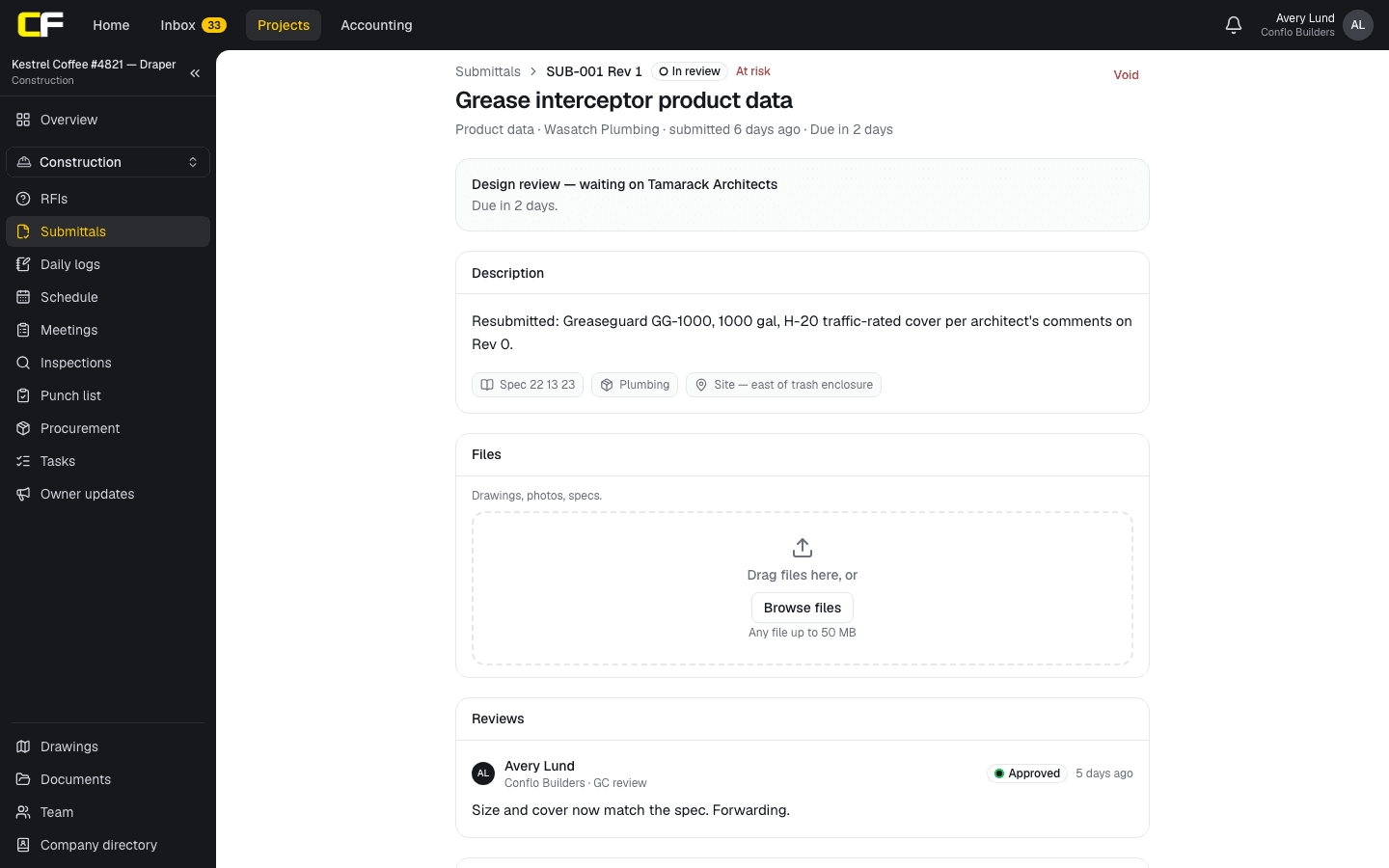
In Conflo's Submittals tool, a subcontractor sees only its own company's submittals. You can start one yourself (you become its submitter, and the GC's project manager runs the log) or prepare one the GC set up for you: title, spec section, type, package and location, with the files attached to the record. When you submit, the GC reviews it first, then the design team.
Each submittal shows whose court the ball is in and which review step it is at. Reviewers answer with approved, approved as noted, revise and resubmit, or rejected, and anything other than approved carries a note. When it is returned as revise and resubmit, the next revision opens as a draft for you under the same number.
The bottom line
A submittal that comes back approved the first time is complete to the spec section's list, marked up to the exact product, honest about every deviation in writing, and checked by you before the GC sees it.
Send it through the GC by the log's submit-by date, and don't buy or build until it comes back approved or approved as noted.
Sources
- Summary: A201–2017, General Conditions of the Contract for Construction — AIA Contract Documents. Read October 17, 2026.
- UFGS 01 33 00 Submittal Procedures (August 2026), §1.6.3 and §1.12.1 — Whole Building Design Guide, USACE / NAVFAC / AFCEC. Read October 16, 2026.
- FAR 52.236-21, Specifications and Drawings for Construction — Acquisition.gov, U.S. General Services Administration. Read October 16, 2026.
- Project Delivery Manual, 16.1 Shop Drawings — City of Los Angeles, Bureau of Engineering. Read October 16, 2026.
Questions
What should a submittal include?
Everything the spec section's Submittals article lists, in the form Division 01 asks for: a cover sheet with the project, submittal number and spec section; marked-up product data, shop drawings or samples; certificates if required; and a separate written list of any deviations from the specs.
Does a subcontractor send submittals directly to the architect?
Usually not. The subcontractor's contract is with the GC, so the submittal goes to the GC, who reviews it, stamps it and sends it on. Under AIA A201–2017 the contractor's submission represents that it has reviewed and coordinated it. Follow your contract's routing.
Can I order material before the submittal is approved?
You can, but at your own risk. A201–2017 says work that requires a submittal isn't performed until the submittal is approved, and the federal clause says work done before approval is at the contractor's risk. If the submittal comes back rejected, the order is yours.
How do you resubmit a submittal?
Answer every review comment, keep the same submittal number with the next revision (Rev 1, or 18.1 on federal jobs), and point out in writing anything else you changed. Changes you don't point out aren't covered by the next approval.
What is the difference between a deviation and a substitution?
A deviation is a part of your submittal that differs from the specs, listed in writing so the reviewer can accept or refuse it. A substitution proposes a different product than the one specified and usually has its own request procedure and deadline in Division 01. Check your specs for which applies.
Related
Preconstruction
How Do You Set Up a Submittal Log From the Specs?
Build a submittal log from the specs: one row per required item, section by section, with approve-by and submit-by dates worked back from the schedule.
· 10 min read
Construction
How Do Architects and Engineers Review a Submittal?
How the design team reviews a submittal: what the review covers and what it doesn't, choosing the review code, writing comments, and returning it on time.
· 8 min read
Definition
What Is a Transmittal in Construction?
A transmittal is the cover sheet that records what was sent, to whom, when and why, such as a submittal sent to the architect. The fields, with an example.
· 3 min read
Preconstruction
What Paperwork Does a GC Require From a Sub?
The documents a GC asks a subcontractor for before work and payment: W-9, insurance certificate and endorsements, license, safety program, waivers.
· 6 min read
Construction
Revise and Resubmit: What Should a Sub Do Next?
A submittal came back revise and resubmit. What a sub should do next: read every comment, answer each one, and get the next revision approved fast.
· 6 min read
Role hub
The Subcontractor's Guide: Bidding to Getting Paid
Every step of a commercial job from the subcontractor's seat: bidding, the subcontract, submittals, RFIs, change orders, pay apps, retainage and closeout.
· 9 min read