
How HVAC Subs Bid and Bill Commercial Work
By Wyatt Cooper · Published · 7 min read
Key takeaways
- Equipment drives an HVAC job: its price, its lead time and its submittal approval date belong in the bid, with how long the quote holds.
- Clarify controls, testing and balancing, crane picks, roof curbs and electrical connections, the edges where HVAC scope is most often disputed.
- Bill equipment on its own material line, so a delivered unit can be billed as stored when the contract allows, including off-site storage only where it is authorized.
- In the example below, a period with stored rooftop units and ductwork progress bills $249,520, with $24,952.00 retained at 10%.
HVAC subcontractors bid commercial work from the mechanical drawings and specifications with equipment quotes, a ductwork and piping takeoff, and labor by system, stating equipment lead times, how long the quote holds, and clarifications for controls, testing and balancing, crane picks and electrical connections. They bill monthly against a schedule of values with equipment material separate from setting labor, so delivered equipment can be billed as stored material where the contract allows it.
What drives an HVAC bid
On most commercial jobs the equipment (rooftop units, air handlers, chillers, boilers, split and VRF systems, exhaust fans) is the biggest single cost and the longest lead. The rest of the scope is sheet-metal ductwork, hydronic and refrigerant piping, insulation, grilles and diffusers, controls, startup, and testing, adjusting and balancing. The Mechanical Contractors Association of America represents contractors in mechanical, plumbing, HVAC, service and industrial piping work (MCAA), and the Plumbing-Heating-Cooling Contractors Association serves the plumbing and HVACR industry (PHCC).
Get equipment quotes in writing with the lead time from approved submittals, and say in your bid how long your equipment pricing holds and that the schedule depends on submittal approval and release by a date. There is no standard lead time: ask the supplier each time and write the answer down.
Clarifications that protect an HVAC bid
| Item | The question | State in the bid |
|---|---|---|
| Controls | In your scope, a controls subcontractor's, or owner-direct? | Included as specified, by your controls sub, or excluded |
| Testing, adjusting and balancing | Often owner-held or a separate contract | Included or excluded, and who corrects deficiencies |
| Crane and rigging | Who provides the crane and the pick plan? | Included, with how many picks |
| Roof curbs and openings | Who furnishes curbs, frames openings and flashes them? | You furnish curbs; framing and roofing by others, or as priced |
| Electrical connections | Who wires units, starters and disconnects? | Power wiring by the electrical trade; control wiring as listed |
| Commissioning | Is there a commissioning agent, and how many site visits? | Support for the stated number of visits |
| Temporary heat and cooling | Will the permanent equipment run during construction? | Excluded, or the conditions and filters you include |
A schedule of values with equipment broken out
| Line | Description | Scheduled value |
|---|---|---|
| 1 | Mobilization and submittals | $22,000 |
| 2 | Rooftop units, material | $214,000 |
| 3 | Equipment set and connect | $41,500 |
| 4 | Ductwork, fabricate and install | $236,800 |
| 5 | HVAC piping | $128,300 |
| 6 | Controls | $96,400 |
| 7 | Grilles, registers and diffusers | $34,900 |
| 8 | Insulation | $52,700 |
| 9 | Startup | $14,500 |
| 10 | Testing, adjusting and balancing | $27,500 |
| 11 | Exhaust fans and split systems | $38,000 |
| 12 | Closeout documents, O&M and training | $12,000 |
| Total | $918,600 |
Ductwork is the largest line; split it by floor or zone on a bigger job so it bills as it is hung. Keep startup, balancing and closeout as their own lines so the last payments are tied to the work the owner needs to accept the system.
Billing stored equipment
Equipment often arrives before the roof is ready, or waits at the supplier for the crane date. The contract decides whether you can bill it. On federal fixed-price work, material delivered to the site may be counted, and material stored elsewhere only if the contract specifically authorizes it and you furnish satisfactory evidence that you have title to it and it will be used on the job (FAR 52.232-5). Private contracts often ask for a bill of sale, an insurance certificate naming the stored goods, photos and, for off-site storage, the storage location and access. Stored material carries retainage; see how to calculate retainage.
Worked example: rooftop units stored off site
The fictional "Brightwater Mechanical" holds the $918,600 subcontract above with 10% retainage, and the subcontract allows off-site stored material with a bill of sale and insurance. In period 5 the rooftop units are complete and held at the supplier's yard for the crane date, and ductwork moves from 25% to 40%.
| Line | Previous | This period | Stored | To date |
|---|---|---|---|---|
| 2. Rooftop units, material ($214,000) | $0 | $0 | $214,000 | $214,000 (100%) |
| 4. Ductwork ($236,800) | $59,200 (25%) | $35,520 (15%) | $0 | $94,720 (40%) |
| Total of these lines | $59,200 | $35,520 | $214,000 | $308,720 |
This period bills $35,520 of work plus $214,000 stored = $249,520. Retainage at 10% is $24,952.00, so these lines add $224,568.00 to the payment due. Checks: 25% of $236,800 is $59,200 and 15% is $35,520, together $94,720, which is 40%; $59,200 + $249,520 = $308,720. When the units are set, the setting labor bills on line 3, not on line 2 again.
Brightwater Mechanical, stored equipment, period 5: rooftop units (line 2)
- Equipment
- Rooftop units RTU-1 to RTU-4, per approved submittal
- Where stored
- The supplier's yard, tagged for this project
- Amount billed as stored
- $214,000.00, the supplier's invoice
- Proof of title
- Bill of sale from the supplier to Brightwater Mechanical
- Insurance
- Certificate covering the units in storage and in transit
- Attached
- Invoice, bill of sale, dated photos of the tagged units
HVAC closeout documents
- The testing, adjusting and balancing report.
- Startup reports for each piece of equipment, often on the manufacturer's forms.
- Controls as-builts, sequences of operation and points lists.
- O&M manuals, equipment warranties and owner training records.
- As-built ductwork and piping drawings, the final lien waiver and the retainage release request.
For the monthly form, see how to fill out a pay application as a subcontractor; the same phased approach for the plumbing trade is in how plumbing subs bid and bill.
How it works in Conflo
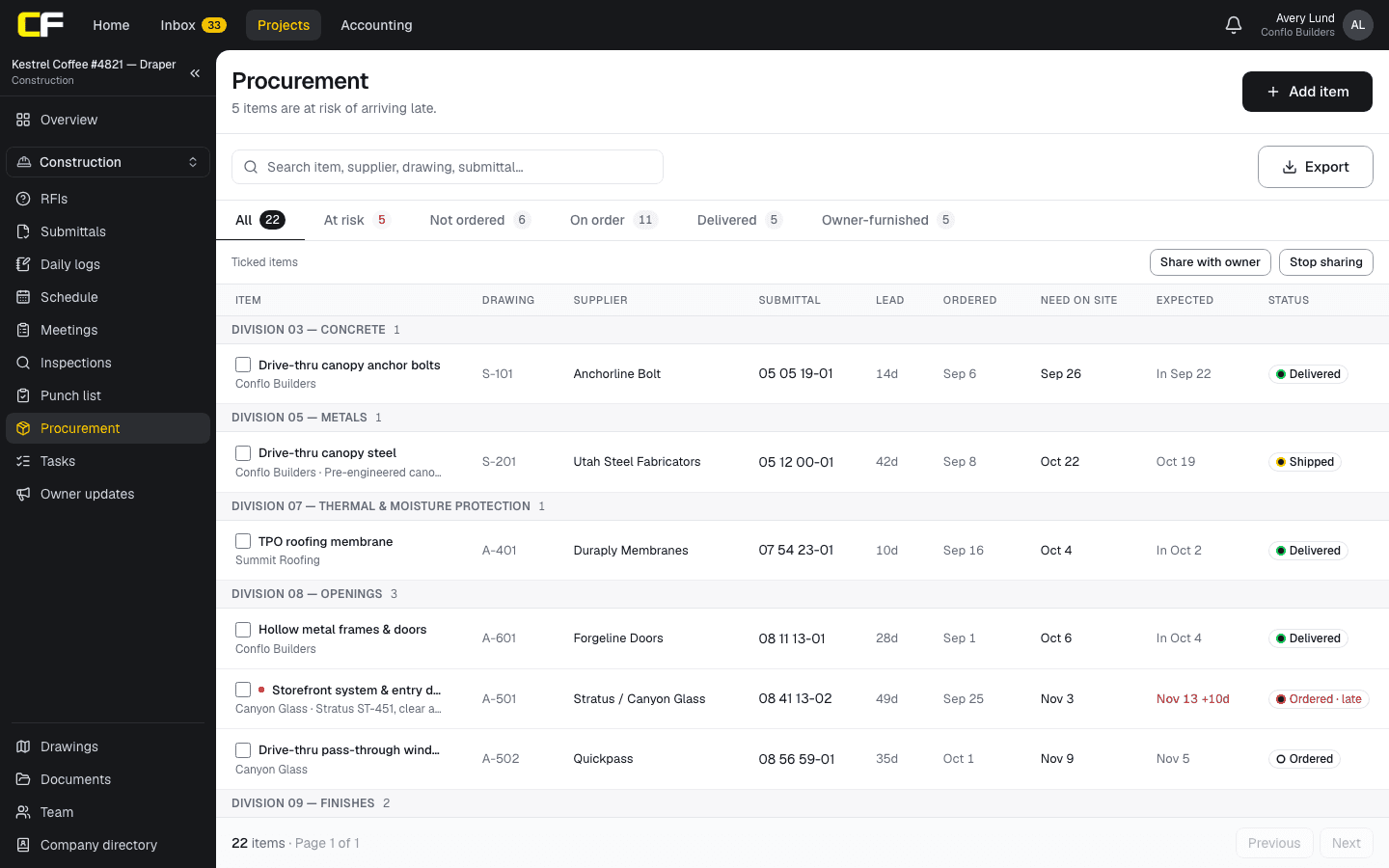
On a GC's job in Conflo, long-lead equipment is tracked in Procurement: each item with its CSI division, supplier, responsible company, submittal reference, lead time and need-on-site date, from which Conflo works out the latest date to order it, and flags items that are late to order or expected after they are needed. A sub sees the items its company is responsible for, can add its own, moves them from ordered to shipped to delivered with their dates, and can change an item's details unless the GC has locked it.
The sub bids through Trade bids and bills in Pay apps, entering percent complete this period and materials stored per line; stored material billed once carries into previous billing on the next pay app. Not built today: a bill of sale or storage location attached to a stored line, and a separate retainage rate for stored materials.
The bottom line
HVAC bids are equipment bids with a lot of labor attached. Put equipment price, lead time and how long the quote holds in writing, clarify controls and balancing, and keep equipment on its own material lines so it can be billed when it is delivered.
Before the next bid, ask your equipment supplier for lead times from submittal approval, not from order, and write them into your proposal.
Sources
- Who We Are — Mechanical Contractors Association of America. Read October 16, 2026.
- Plumbing-Heating-Cooling Contractors Association — PHCC. Read October 16, 2026.
- FAR 52.232-5, Payments under Fixed-Price Construction Contracts — Acquisition.gov, U.S. General Services Administration. Read October 16, 2026.
Questions
How do you bid commercial HVAC work?
Get written equipment quotes with lead times, take off ductwork, piping and insulation, price labor by system, and state clarifications for controls, testing and balancing, crane picks, roof curbs and electrical connections, plus how long your equipment pricing holds.
Can an HVAC sub bill for equipment before it is installed?
Usually as stored material, if the contract allows it. Off-site storage normally needs specific authorization and proof of title and insurance; on federal fixed-price work it is allowed only where the contract authorizes it.
Is testing and balancing part of the HVAC subcontract?
Sometimes. It is often held by the owner or let as a separate contract so the balancer is independent. Say in your bid whether it is included and who corrects deficiencies.
Why split equipment material from setting labor on the schedule of values?
So a delivered unit can be billed as stored material before it is set, and the setting labor billed when it happens, without billing the same dollars twice.
Related
Bidding
How Plumbing Subs Bid and Bill Commercial Work
How plumbing subs bid commercial work and bill it in phases (underground, rough-in, finish), with clarifications, a schedule of values and an example.
· 6 min read
Bidding
How Electrical Subs Bid and Bill Commercial Work
How electrical subs bid commercial work and bill it: clarifications, a schedule of values with rough-in, gear and trim, and stored switchgear.
· 7 min read
Money
How Does a Subcontractor Fill Out a Pay Application?
A subcontractor's pay app bills percent complete and stored materials per schedule-of-values line, less retainage and prior payments, with a lien waiver.
· 9 min read
Preconstruction
How Do You Track Long-Lead Items on a Job?
How a GC tracks long-lead items: work back from the need-on-site date through lead time and submittal review to an order-by date, and review it weekly.
· 6 min read
Role hub
The Subcontractor's Guide: Bidding to Getting Paid
Every step of a commercial job from the subcontractor's seat: bidding, the subcontract, submittals, RFIs, change orders, pay apps, retainage and closeout.
· 9 min read