
How Concrete Subs Bid and Bill Commercial Work
By Wyatt Cooper · Published · 7 min read
Key takeaways
- Price commercial concrete as a lump sum broken into pour-based lines, and add unit prices for the quantities nobody knows yet, such as extra footing depth.
- Read the spec for who pays for testing and how often samples are taken; on a federal spec it is at least once a day and once per 150 cubic yards.
- Build the schedule of values by element and pour (footings, slab on grade, decks, site concrete) so each month's billing matches what the GC can see in place.
- Bill stored rebar and embeds only where the contract allows it, with the delivery tickets and the GC's agreement before the pay app goes in.
A concrete sub bids commercial work as a lump sum split by element and pour (footings, foundation walls, slab on grade, elevated decks, site concrete) plus unit prices for uncertain quantities. It reads the specification for testing, tolerances and finishes, schedules inspections before each pour, and bills monthly against a schedule of values built on those pours, with stored rebar billed only where the contract allows.
What a commercial concrete bid covers
Most commercial concrete is specified by reference to the American Concrete Institute's ACI 301, "Specifications for Concrete Construction", which covers materials and proportioning, reinforcement, "production, placing, finishing, and curing", formwork, joints, embedded items and repair of surface defects. Read the project's Division 03 sections for what it changes: mix strengths, finish tolerances, curing method and the testing regime.
| Item | Often with concrete | Often with another trade | Write it down |
|---|---|---|---|
| Excavation for footings | Hand trimming and cleanup | Bulk and trench excavation (earthwork) | Who digs, who hauls the spoil |
| Reinforcing steel | Furnish and install, or install only | Furnished by a rebar supplier under the GC | Furnish, install, or both |
| Vapor retarder under slab | Supply and place | The waterproofing sub | Taped seams and penetrations |
| Anchor bolts and embeds | Set them | Furnished by steel or the GC | Who furnishes, who sets, who surveys |
| Testing | Contractor's quality control | The owner's testing agency | Who pays for retests after a failure |
| Winter protection | Blankets and curing | Heat and enclosure (the GC) | As a unit price per day or excluded |
Add unit prices for what can't be measured on bid day: footing concrete per cubic yard below the design depth, rock excavation, and extra slab thickness. If the GC's bid form has no line for them, list them in your qualifications. In Conflo, those go in the bid's qualifications or an attached schedule, since a trade bid's fields are the base bid, scope items, alternates, exclusions and qualifications.
Inspections and tests around each pour
Before a pour, plan for the inspections the job requires (rebar placement, embeds, forms) and the testing agency on site. The federal unified guide specification for cast-in-place concrete (UFGS 03 30 00) has strength samples taken for each mixture placed each day "not less than once a day, nor less than once for each" 150 cubic yards, "nor less than once for each" 5,000 square feet of slab or wall surface. Your project spec may differ; read its testing article.
After the pour, forms come off only when the concrete can carry its own weight and the loads on it. OSHA (29 CFR 1926.703) allows removal once that is shown by the conditions in the plans and specifications or by tests to an appropriate ASTM method, and requires the formwork drawings to be available at the jobsite.
Slab pour 2 — 310 cubic yards over 18,000 square feet in one day
- Once a day
- 1 sample set
- Once per 150 cubic yards
- 310 ÷ 150 = 2.07, so 3 sets
- Once per 5,000 square feet of slab
- 18,000 ÷ 5,000 = 3.6, so 4 sets
- Required
- The largest: 4 sample sets for the day
A worked example: the schedule of values and a pay app
A made-up sub, Granite Line Concrete, holds a $612,000 lump-sum subcontract on a two-story office. It splits the value by element so each line can be seen and measured.
| Line | Scheduled value | Complete to date | Billed to date |
|---|---|---|---|
| Footings and foundation walls | $186,000 | 100% | $186,000 |
| Slab on grade | $214,000 | 40% | $85,600 |
| Elevated deck | $148,000 | 0% (rebar stored on site: $22,000) | $22,000 |
| Site concrete (curbs, walks) | $64,000 | 0% | $0 |
| Total | $612,000 | $293,600 |
Pay app 2 — Granite Line Concrete
- Completed and stored to date
- $186,000 + $85,600 + $22,000 = $293,600
- Less retainage at 10%
- $29,360
- Earned less retainage
- $264,240
- Less previous payments
- Pay app 1: footings 60% = $111,600, less 10% = $100,440
- Current payment due
- $264,240 − $100,440 = $163,800
- Check
- This period: $74,400 (footings 40%) + $85,600 + $22,000 = $182,000, less 10% = $163,800
The $22,000 of stored rebar is billable only if your subcontract allows it. The AIA's general conditions (A201–2017 §9.3.2) allow payment for materials "delivered and suitably stored at the site", and off site only if the owner approves in advance; subcontracts usually pass the same terms down. Send the delivery tickets with the pay app. More on the arithmetic in how retainage is calculated and how a sub fills out a pay app.
Change orders on concrete work
Concrete changes are often quantity changes: a footing deepened after the soils engineer looks at the bearing, or an added equipment pad. That's where your bid's unit prices pay off. If the subcontract carries a unit price of $285 per cubic yard for added footing concrete and the engineer adds 12 cubic yards, the change is 12 × $285 = $3,420, with no argument over the rate. Without a unit price, price it the way how to price a change order shows, and give notice within your subcontract's deadline.
How it works in Conflo
When a GC invites you to a trade bid in Conflo, you see your own invitation, ask questions (the answers go to every bidder without your name), acknowledge addenda, and submit a base bid, each scope item marked included or excluded with an optional breakout, alternates, exclusions and qualifications. There is no unit-price field on a bid today: list unit prices in your qualifications or attach your schedule.
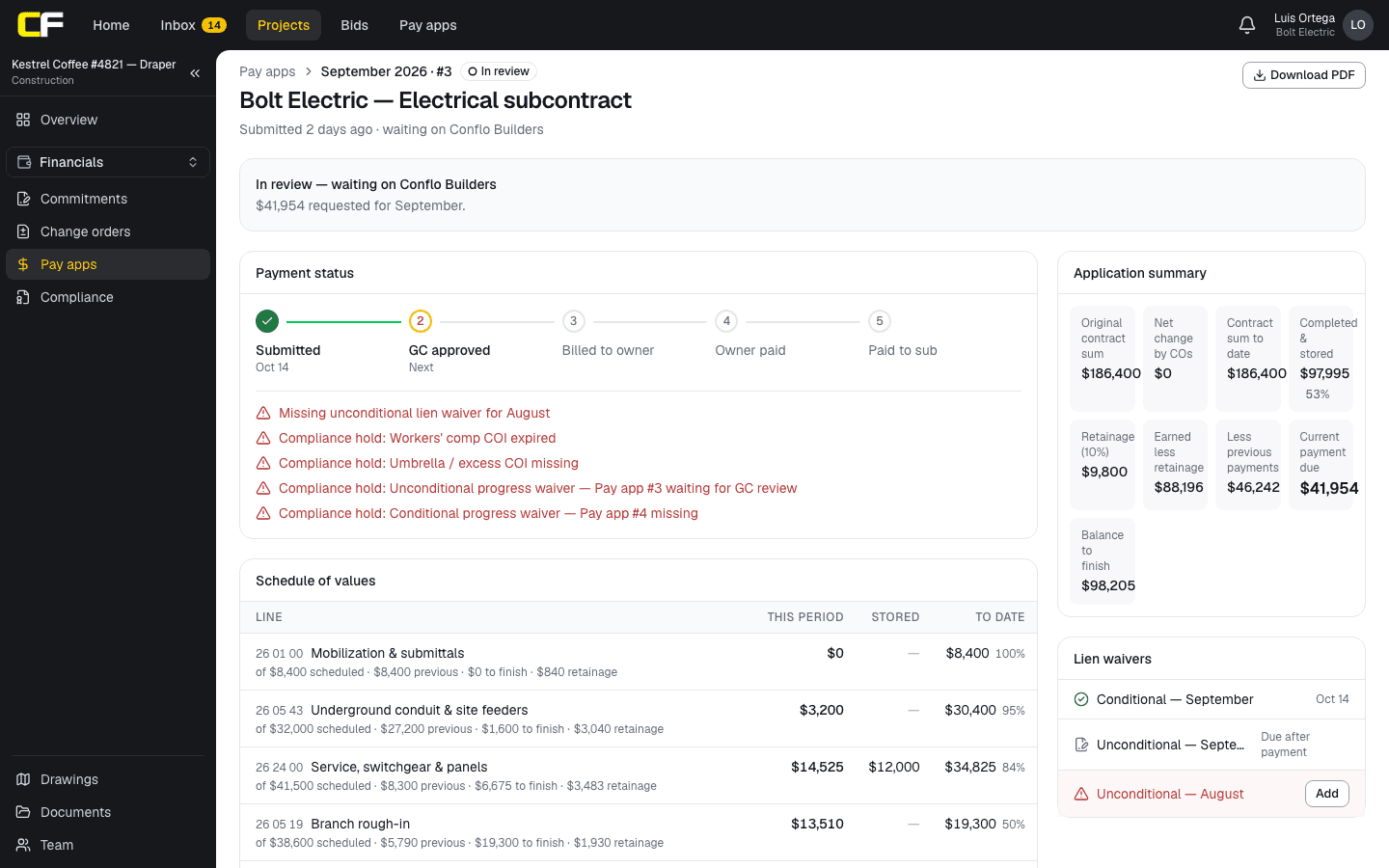
Once you are under contract, you bill monthly in pay apps against your schedule of values: percent complete this period and materials stored for each line, with previous billing carried forward, retainage calculated, and no line billed past 100%. The GC approves it or sends back the lines that are wrong with a note. Billing is by percent, not by quantity times unit price, so enter the percent your measured quantities represent.
The bottom line
Bid concrete as a lump sum split by element and pour, with unit prices for the quantities nobody knows yet and a clear line on rebar, embeds, testing and winter work. Bill against those same lines each month, stored materials only where the contract allows.
Subcontractors invited by a GC use Conflo free. Join the waitlist to bid and bill your next job in it.
Sources
- ACI SPEC-301-20, Specifications for Concrete Construction (product description) — American Concrete Institute. Read October 16, 2026.
- UFGS 03 30 00, Cast-in-Place Concrete (February 2019, change 10) — Whole Building Design Guide (USACE, NAVFAC, AFCEC). Read October 16, 2026.
- 29 CFR 1926.703, Requirements for cast-in-place concrete — Occupational Safety and Health Administration. Read October 16, 2026.
- Summary: A201–2017, General Conditions of the Contract for Construction — AIA Contract Documents. Read October 17, 2026.
Questions
Should a concrete sub bid lump sum or unit price?
Commercial building work is usually lump sum, because the drawings define the quantities. Add unit prices for what can't be measured on bid day, such as footing concrete below design depth or rock excavation, so changes are priced by an agreed rate.
Who pays for concrete testing?
It depends on the specification. Often the owner hires the testing agency, and the contractor pays for retests after a failure. Some specs put quality-control testing on the contractor. Read the testing article and say in your bid which tests you carry.
Can a concrete sub bill for rebar delivered to the site?
Usually, if the contract allows payment for stored materials. AIA A201–2017 allows materials suitably stored on site and, with the owner's advance approval, off site. Check your subcontract and send delivery tickets with the pay app.
How should a concrete schedule of values be split?
By element and pour: footings and foundation walls, slab on grade (by pour if it is large), elevated decks, and site concrete. Lines the GC can see in place are easier to approve than one line for all concrete.
Related
Money
How Does a Subcontractor Fill Out a Pay Application?
A subcontractor's pay app bills percent complete and stored materials per schedule-of-values line, less retainage and prior payments, with a lien waiver.
· 9 min read
Money
How Do You Calculate Retainage on a Pay App?
Retainage is a percentage of work completed and stored to date, held back each pay period. How to calculate it, reduce it, release it, with an example.
· 9 min read
Bidding
How Steel Subs Bid and Bill Commercial Work
How structural steel subs bid commercial work by the ton and bill it: shop drawings as the release to fabricate, mill material and a spend-based SOV.
· 11 min read
Bidding
How Masonry Subs Bid and Bill Commercial Work
How masonry subs bid commercial work in units and bill it: block and brick counts, grout and rebar, the mock-up panel, weather, and the lintel line.
· 10 min read
Bidding
How Flooring Subs Bid and Bill Commercial Work
How commercial flooring subs take off and order carpet, LVT and base, settle slab moisture testing and prep with the GC, and bill material and labor.
· 11 min read
Role hub
The Subcontractor's Guide: Bidding to Getting Paid
Every step of a commercial job from the subcontractor's seat: bidding, the subcontract, submittals, RFIs, change orders, pay apps, retainage and closeout.
· 9 min read