
How Do You Track Long-Lead Items on a Job?
By Wyatt Cooper · Published · 6 min read
Key takeaways
- Track long-lead items backward from the date each one is needed on site, not forward from today: need date minus lead time is the latest order date.
- Keep going back: the order usually waits on an approved submittal, so subtract review time and preparation time to get the date the submittal must go in.
- Ask every supplier whether the quoted lead time runs from the purchase order or from release after approval; the difference can be the length of a review cycle.
- Review the log every week: anything not ordered past its order-by date, or expected after its need date, is a schedule problem to raise now.
To track long-lead items, list every material or piece of equipment whose order-to-delivery time could hold up the schedule, and for each one record the date it is needed on site, the supplier's lead time, and the submittal it waits on. Subtract the lead time from the need date to get the order-by date, then subtract submittal review and preparation time to get the date the submittal is due. Review the log weekly and act on anything late.
What counts as a long-lead item
A long-lead item is one whose procurement takes long enough that ordering it on the normal rhythm would delay the work. One federal specification puts a number on it: the U.S. Army Corps of Engineers' project schedule section, UFGS 01 32 01.00 10 (August 2026), has the contractor schedule "the critical submittals and their approvals, procurement, fabrication, and delivery of long lead materials, equipment, fabricated assemblies, and supplies", and defines long lead procurement activities as "those with an anticipated procurement sequence of over 90 calendar days." Your spec may use another number or none; the method is the same.
On a commercial building the list usually starts with electrical gear (switchgear, switchboards, panelboards, transformers, generators), HVAC equipment (air handlers, rooftop units, chillers), elevators, curtain wall and storefront, structural steel, joists and deck, and anything custom or imported. The trade guides for electrical and HVAC subs say why their equipment drives the schedule. Get each trade's own list at buyout, along with its quoted lead times.
Work back from the need date
- 1ScheduleNeed-on-site date: the start of the activity that installs it, less a few days to receive and stage
- 2SupplierLead time: fabrication and shipping, quoted in days or weeks. Need date − lead time = order-by date
- 3Design teamSubmittal review: the review period in your spec, times the cycles you expect. Order-by − review = submittal due date
- 4SubcontractorSubmittal preparation: shop drawings, product data, calculations. Submittal due − preparation = start date
The one question that changes the answer: does the supplier's lead time start at the purchase order or at release for fabrication after the submittal is approved? Some suppliers of engineered items, such as electrical gear and curtain wall, quote from release. If it runs from release, the order-by date is the approval date, and the review cycles sit in front of the lead time rather than inside it. Ask, and write the answer on the log.
The submittal review time comes from your specifications, usually Division 01. The Corps' submittal section, UFGS 01 33 00 (August 2026), is a useful model: it tells the contractor to coordinate submittals "with performance of work so that work will not be delayed by submittal processing", to allow additional time for "long lead time submittals", and adds: "The review period for each resubmittal is the same as for the initial submittal." So plan for a resubmittal on anything complicated. For building the submittal side, see how to set up a submittal log.
A worked example: two items on one job
| Item | Need on site | Lead time | Order (release) by | Review, two cycles of 14 days | Submittal due | Preparation | Start submittal by |
|---|---|---|---|---|---|---|---|
| Main switchgear | June 1, 2027 | 26 weeks (182 days) | December 1, 2026 | 28 days | November 3, 2026 | 21 days | October 13, 2026 |
| Curtain wall | March 1, 2027 | 12 weeks (84 days) | December 7, 2026 | 28 days | November 9, 2026 | 21 days | October 19, 2026 |
Check the switchgear row by counting: 182 days before June 1, 2027 is December 1, 2026; 28 days before that is November 3; 21 days before that is October 13. The curtain wall, needed three months earlier, has to be released only six days after the gear, because its lead time is shorter. That is why a list sorted by need date misleads: sort by order-by date, and the item at the top is the one to chase.
The gear ties to the critical path if energizing the building waits on it. A slip on the order-by date then moves the finish, so it belongs in the three-week look-ahead and the owner meeting, not only the log.
The weekly review
- Sort by order-by date. Anything not ordered and past its date is late now: call the sub and supplier the same day.
- Check every item on order against its need date. If the expected delivery is after the need date, expedite, re-sequence the work, or tell the owner.
- Check the submittals the next items wait on. An item can't be released while its submittal is still out for review.
- Update expected dates from the suppliers' acknowledgments and shipping notices, not from memory.
- Mark owner-furnished items separately: the owner places those orders, and someone has to chase the owner.
How it works in Conflo
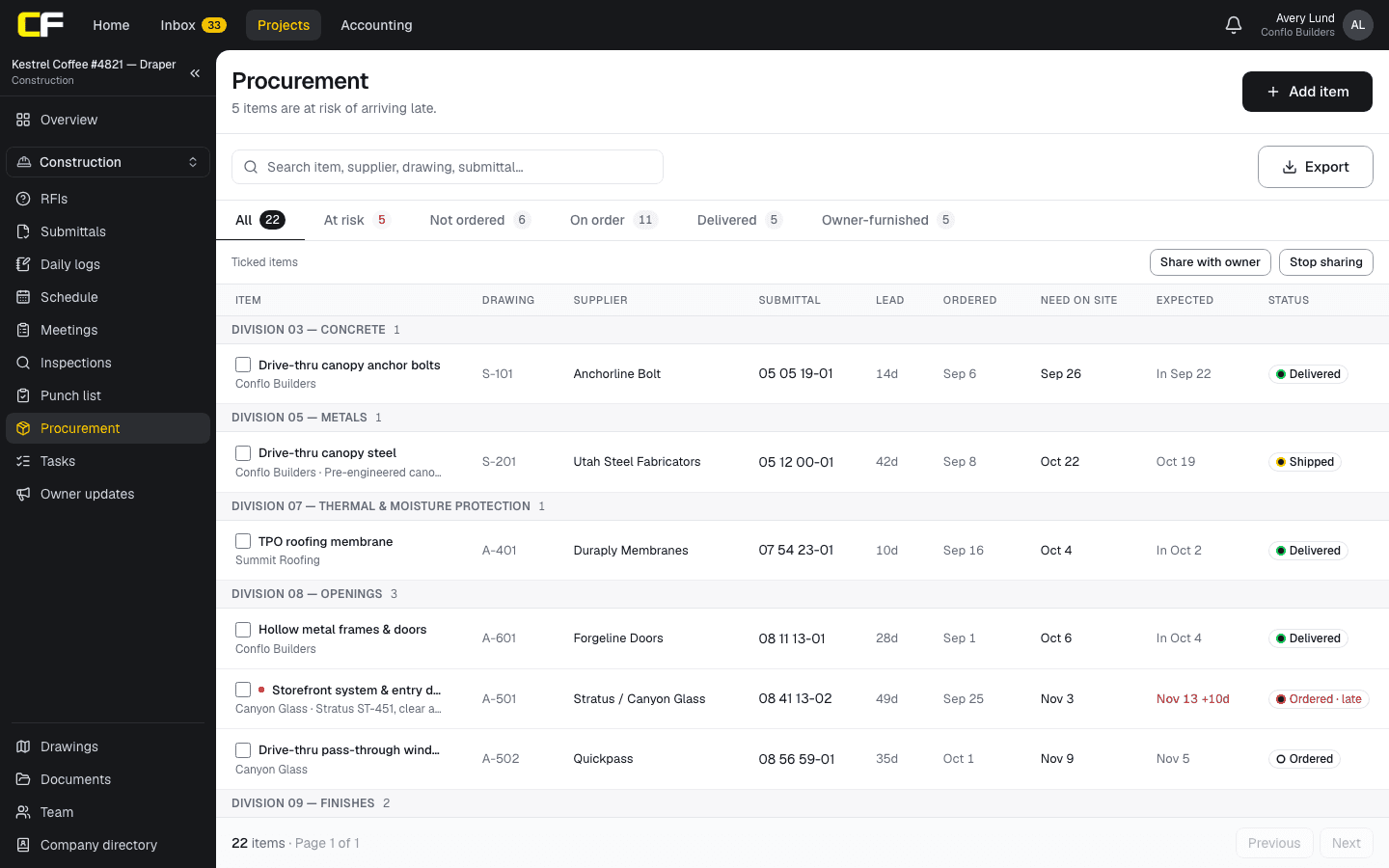
Conflo's Procurement log keeps each item by CSI division with its drawing, supplier, responsible company, lead time in days, need-on-site date and expected date, and a status of not ordered, ordered, shipped or delivered. It works out the order-by date as the need-on-site date minus the lead time, so enter the lead time that runs to the point you control. An item not ordered past its order-by date is flagged to order now, and one expected after its need date shows how many days late it will arrive.
An item can link to its submittal and shows whether it is approved. The responsible sub records dates and status on its own items, the GC can lock what an item is, owner-furnished items are marked, and the GC can share an item with the owner.
The bottom line
Work every long-lead item back from its need date: lead time to the order-by date, review and preparation to the day the submittal work must start. Sort by order-by date and review it weekly.
Most long-lead surprises are a lead time that ran from release, not order, or a submittal nobody started. Both show up on the log weeks before they show up on site.
Sources
- UFGS 01 32 01.00 10, Project Schedule (August 2026) — Whole Building Design Guide, U.S. Army Corps of Engineers. Read October 22, 2026.
- UFGS 01 33 00, Submittal Procedures (August 2026) — Whole Building Design Guide, U.S. Army Corps of Engineers. Read October 22, 2026.
Questions
How do you calculate an order-by date for a long-lead item?
Subtract the supplier's lead time from the date the item is needed on site. If the lead time runs from release after submittal approval, that date is the latest approval date, and the submittal must go in a review period or more before it.
What is considered a long-lead item?
Anything whose procurement could hold up the schedule if ordered on the normal rhythm. The Corps of Engineers' project schedule spec defines long lead procurement activities as those with an anticipated procurement sequence of over 90 calendar days.
Who tracks long-lead items, the GC or the sub?
Both. The sub or supplier knows the lead time and order status; the GC owns the need dates and the schedule. One shared log with the sub updating its own items keeps them in step.
How often should the long-lead log be reviewed?
Weekly, sorted by order-by date, and at every owner meeting for items that touch the critical path.
Related
Preconstruction
How Do You Set Up a Submittal Log From the Specs?
Build a submittal log from the specs: one row per required item, section by section, with approve-by and submit-by dates worked back from the schedule.
· 10 min read
Bidding
How Electrical Subs Bid and Bill Commercial Work
How electrical subs bid commercial work and bill it: clarifications, a schedule of values with rough-in, gear and trim, and stored switchgear.
· 7 min read
Bidding
How HVAC Subs Bid and Bill Commercial Work
How HVAC subs bid commercial mechanical work and bill it: equipment lead times, clarifications, a schedule of values and stored-equipment billing.
· 7 min read
Preconstruction
How Do You Buy Out a Construction Job?
Construction buyout step by step: scope review, leveling, award, the subcontract and its exhibits, compliance documents, and savings against budget.
· 7 min read
Role hub
The General Contractor's Guide: Bid to Closeout
What a general contractor is responsible for at every phase of a commercial job, from bidding and buyout to RFIs, change orders, pay apps and closeout.
· 8 min read