
Procore Alternatives for Small and Mid-Size GCs
By Wyatt Cooper · Published · 6 min read · Last checked
Key takeaways
- Procore prices by product and annual construction volume and publishes no figure; most smaller alternatives publish their prices.
- Pricing models differ more than features: per project (Conflo), per user (Fieldwire, JobTread's internal users), user-count tiers (Contractor Foreman), or quoted (Procore, Autodesk).
- For commercial GC work, check that the tool has bidding, RFIs, submittals, change orders and pay apps with retainage on the plan you would buy.
- Procore remains the strongest choice for integrations, payments and enterprise scale; an alternative wins on price clarity and fit for a smaller GC.
The main Procore alternatives for a small or mid-size GC are Conflo (published per-project prices, every tool on every plan, subs free), Autodesk's construction bundles (quoted, strong in preconstruction and design coordination), Fieldwire (per-user, field-first), JobTread (a base fee plus internal users, residential and commercial) and Contractor Foreman (low-cost tiers by user count). Pick by the work you do and how you want to pay, and check the commercial tools are on the plan you'd buy.
How we compared them
Every figure below is from the product's own pricing page on the date at the top of this page, not from a review site. We looked at what a small or mid-size commercial GC needs: bidding to subs, RFIs and submittals, change orders, and pay applications with retainage, plus how the price grows as you add jobs and people. Conflo is our product, and we say plainly where the others are stronger.
| Product | Published price | Priced by | Best known for |
|---|---|---|---|
| Procore | None; custom quote | Product and annual construction volume; unlimited users | Large commercial GCs, integrations, payments |
| Conflo | Free (1 project), $599/mo (5), $1,499/mo (15) | Active project; unlimited users; only the GC pays | Bid to closeout in one plan for small and mid-size GCs |
| Autodesk Forma bundles | None; quote | User, project or account, per Autodesk | Preconstruction (BuildingConnected Pro, Bid Board Pro) and model coordination |
| Fieldwire | Free (5 users, 3 projects); $39, $64 or $89 per user/mo billed annually | User | Field tasks and plans; RFIs and submittals on Business Plus |
| JobTread | $199/mo plus $20/mo per internal user | Base fee plus internal users; customer and vendor users free | Residential and commercial job management |
| Contractor Foreman | $49 to $332/mo billed annually | User-count tiers (1 to unlimited) | Low-cost all-in-one for small contractors |
Conflo
Conflo is built for commercial GCs and their subs, owners and architects. Its prices are on its pricing page: free for one active project, Team at $599 a month for up to five (extra projects $179 a month each), Business at $1,499 a month for up to fifteen, and Enterprise by conversation. Users are unlimited, only the GC pays, and jobs you are bidding never count as active.
Every plan has every tool: trade bids and bid leveling, estimate and buyout, RFIs and submittals, daily logs and schedule, budget, commitments, change orders and pay apps with retainage and lien waivers, and closeout. The limits: Conflo is new, has no live integrations, doesn't process payments, and is opening to companies from a waitlist.
Autodesk, Fieldwire, JobTread and Contractor Foreman
Autodesk's construction pricing page sells three bundles: Model Management, Preconstruction (including BuildingConnected Pro, Bid Board Pro, TradeTapp, ProEst and Forma Takeoff) and Construction Operations (including Forma Build). It publishes no figure and offers "flexible user, project, and account-based pricing" by quote. It suits GCs with heavy design coordination or estimating needs.
Fieldwire is free for up to 5 users, 3 projects and 100 sheets. Pro is $39, Business $64 and Business Plus $89 per user per month billed annually; RFIs, submittals, change orders and budget are on Business Plus. It is strongest in the field: plans, tasks and checklists.
JobTread is $199 a month with the first internal user included, then $20 a month per internal user, with lower rates beyond ten users and 20% off yearly. Customer, vendor and subcontractor portal users are free and unlimited. It markets to residential and commercial contractors.
Contractor Foreman sells tiers by user count, billed annually: $49 a month for 1 user, $105 for 3, $166 for 8, $221 for 15 and $332 for unlimited users. It is a low-cost all-in-one aimed at smaller contractors.
Choose Procore if…
- You need many integrations: Procore lists "500+ integrations and apps" (Procore vs Autodesk).
- You want to pay subcontractors through the platform (Procore Pay).
- You run large jobs or many offices and want an established vendor with unlimited 24/7 support included.
- Your volume makes a quoted annual fee reasonable (Procore pricing), or your owners require Procore.
Choose an alternative if…
- Conflo: you want a published per-project price, every commercial tool on every plan and subs, owners and architects free, and can wait for the waitlist.
- Autodesk: preconstruction and model coordination matter most, and you're comfortable with a quote.
- Fieldwire: your need is mostly field coordination on plans, and you price per user.
- JobTread or Contractor Foreman: you do mixed residential and light commercial work and want a low published price.
Going deeper on one pair? Read Conflo vs Procore or how much Procore costs.
How it works in Conflo
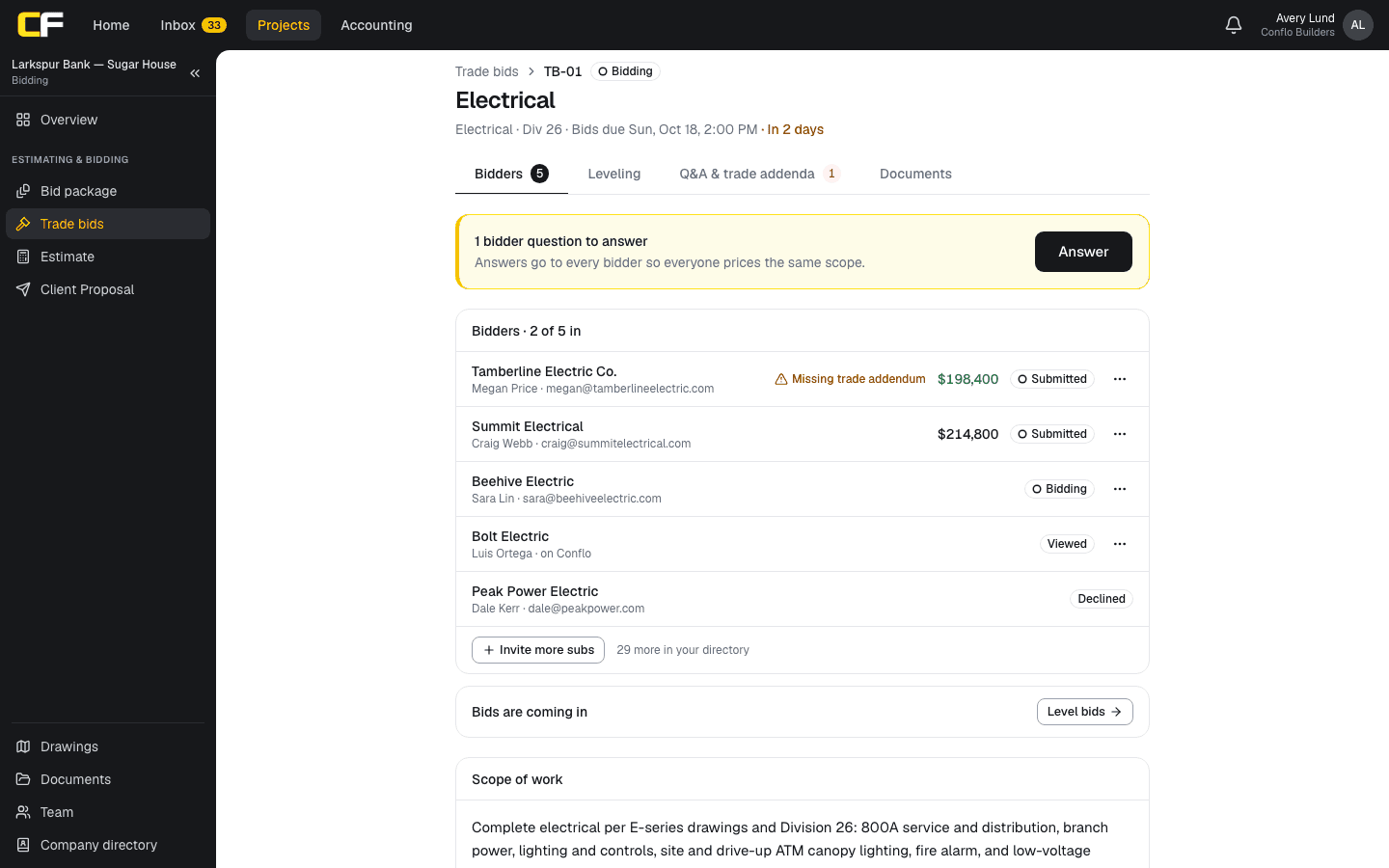
In Conflo, a bidding job's Trade bids list shows each trade's package with how many bidders responded, the low bid, its status and the due date. Subs are invited from your directory and bid free from their own login, and the job carries on into buyout, construction and pay apps without a second system.
The bottom line
Procore is the full-featured, quoted choice. The alternatives differ mostly in how they charge and what kind of work they are built for: decide on that first, then check the commercial tools are on the plan you'd buy.
If a published per-project price with every tool and free subs fits how you work, book a walkthrough, or join the Conflo waitlist.
Sources
- Procore pricing — Procore Technologies. Read October 16, 2026.
- Procore vs Autodesk — Procore Technologies. Read October 16, 2026.
- Construction payment software — Procore Technologies. Read October 17, 2026.
- Pricing — Autodesk. Read October 16, 2026.
- Pricing — Fieldwire. Read October 16, 2026.
- Pricing — JobTread. Read October 16, 2026.
- Pricing — Contractor Foreman. Read October 16, 2026.
Questions
What is the best Procore alternative for a small GC?
It depends on how you want to pay and what work you do. For commercial bid-to-closeout work at a published price, Conflo; for field coordination priced per user, Fieldwire; for mixed residential and light commercial at a low price, JobTread or Contractor Foreman.
Is there a free Procore alternative?
Yes. Conflo is free for one active project with every tool and unlimited users. Fieldwire's Basic plan is free for up to 5 users, 3 projects and 100 sheets, without RFIs or submittals.
Why doesn't Procore publish its price?
Procore prices each product as an annual fee based on your annual construction volume, so it quotes each company. Its pricing page lists what is included (unlimited users, data and 24/7 support) but no dollar figure.
Do subcontractors have to pay in these tools?
In Conflo, no: only the GC pays. JobTread's subcontractor and vendor portal users are free. Procore includes unlimited users in its fee, and Fieldwire charges per user; check each vendor's terms for invited partners.
Related
Comparison
Conflo vs Procore for Small and Mid-Size GCs
Conflo vs Procore for small and mid-size general contractors: how each is priced, what each covers, where Procore is stronger, and who should choose which.
· 7 min read
Pricing explainer
How Much Does Procore Cost?
How Procore pricing works: an annual fee per product set by your construction volume, with unlimited users, and what to ask for in a quote.
· 5 min read
Alternatives
Best Construction Software for Small GCs
How a small GC should choose construction management software: six criteria, then seven products measured against them with their published prices.
· 6 min read
Bidding
How Do You Level Subcontractor Bids?
Level subcontractor bids by pricing every scope gap, exclusion and missing addendum so each bid covers the same work, then compare the leveled totals.
· 9 min read
Role hub
The General Contractor's Guide: Bid to Closeout
What a general contractor is responsible for at every phase of a commercial job, from bidding and buyout to RFIs, change orders, pay apps and closeout.
· 8 min read